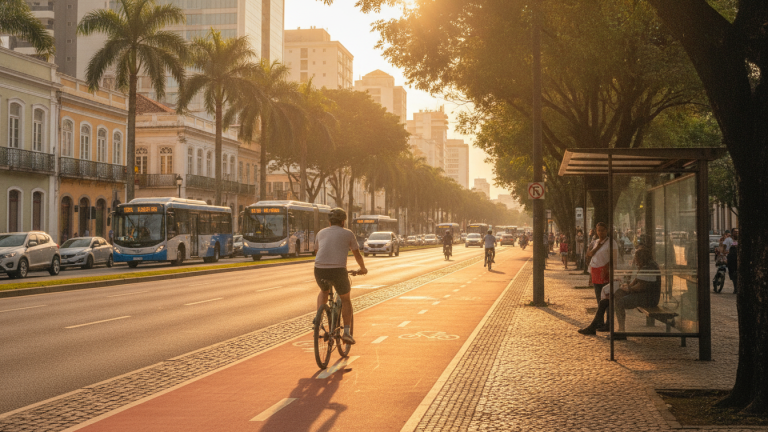
Have you ever stopped to calculate how much time of your life you spend inside a car, bus, or subway? For many Brazilians living in medium and large cities, daily commuting consumes precious hours and, silently, contributes a significant portion of the country’s greenhouse gas emissions. According to the IPCC, the transportation sector accounts for about 16% of global CO₂ emissions related to human activity, and in Brazil this number is even more relevant due to the strong dependence on fossil fuels in the private vehicle fleet.
The good news is that changing how you travel doesn’t require giving up comfort or turning your routine upside down. With gradual and well-planned choices, you can reduce your carbon footprint, spend less on fuel, and still arrive at work with less stress. By the end of this text, you’ll know which changes have the greatest impact, how to apply them to Brazilian reality, and where to start this week.
Why transportation weighs so heavily on your carbon footprint
Brazil has one of the largest fleets of individual vehicles in the world. Data from IBGE shows that the number of automobiles in the country has grown consistently in recent decades, and dependence on private cars is driven, in large part, by still-deficient public transportation infrastructure in many cities.
Gasoline-powered cars release CO₂ with every kilometer driven. An average gasoline vehicle emits approximately 2.3 kg of CO₂ per liter of fuel burned, according to data from the Brazilian Panel on Climate Change. If you travel 40 km per day on the home-work-home route in a car with average fuel consumption of 12 km/l, this represents more than 2.5 tons of CO₂ released into the atmosphere just from your commutes over one year.
Planes, trucks, and motorcycles also enter into this equation. But daily commuting is where you have the most immediate control and where small changes make a measurable difference.
The real map of your sustainable transportation options
Before taking action, it’s worth understanding what’s available and what actually reduces emissions. Not every “green” option has the same impact.
Public transportation: immediate gains
A full urban bus transports dozens of people with a fraction of the emissions per passenger of an individual car. Subways and electric trains, when powered by Brazil’s electrical grid, which is mostly renewable according to ANEEL data, have even lower emissions per passenger/km. Switching your car for the subway or BRT on the first few days of the week is one of the highest-return environmental actions you can take.
Bicycling and walking: zero emissions, double gain
For routes up to 5 km, the bicycle competes equally with the car in time, especially during rush hours in Brazilian cities. Walking, for shorter distances, has zero emissions and also brings cardiovascular health benefits documented by the World Health Organization. Many Brazilian cities have expanded bike lanes in recent years, so it’s worth checking the map for your region.
Electric vehicles: a switch that makes sense in Brazil
Electric vehicles (EVs) have a much better emissions profile in Brazil than in countries dependent on coal. That’s because, according to ANEEL, more than 80% of electricity generated in the country comes from renewable sources, mainly hydroelectric. If you’re thinking about changing cars, understanding which types of renewable energy exist today helps you understand why charging an electric car in Brazil has a smaller carbon footprint than in much of the world.
Carpooling and shared mobility
Ride-sharing apps, neighborhood WhatsApp groups, and corporate carpool programs divide emissions among more people without requiring any investment in a new vehicle. If you already drive to work, sharing the trip with a colleague cuts your personal emissions in half at no additional cost.
How to reduce your carbon footprint in transportation: step by step
You don’t need to change everything at once. The model below is progressive and works for those living in both capital cities and smaller towns.
- Map out your commute routine. During a week, note all the trips you make: destination, approximate distance, transportation mode used, and time spent. This diagnosis reveals patterns that often go unnoticed.
- Identify substitutable routes. With the map in hand, mark which trips could be done on foot, by bicycle, or by public transportation without an unacceptable time cost for you.
- Start with the easiest switches. If you use the car to go to the grocery store 1.5 km from home, that’s the simplest change to make. Reserve the car for trips where it’s truly necessary.
- Try public transportation for one week. Use mobility apps available in your city (such as Moovit, Giro, and similar) to plan your route. The first day is usually the hardest; from the second day on, the trip becomes familiar.
- Evaluate the true cost of car ownership. Add up gas, insurance, vehicle registration, maintenance, and parking. In many Brazilian capitals, this monthly cost exceeds a public transportation plan plus occasional app-based rides.
- Adopt efficient driving if you need to use the car. Avoiding harsh acceleration, maintaining tire pressure, and turning off the engine during long stops can reduce fuel consumption by up to 15%, according to Brazil’s Vehicle Labeling Program from Inmetro.
- Reassess annually. Your routine changes, and your city’s transportation options do too. What wasn’t viable in 2024 may be accessible in 2026 with new bike lanes or metro lines.
Common mistakes that work against sustainable transportation
Many people start with good intentions but end up making decisions that don’t deliver the expected impact.
- Buying an electric car without reducing car use. An EV is better than a gasoline car, but it still takes up urban space, consumes energy, and requires battery production. The best sequence is first to reduce use, then, if necessary, switch the vehicle.
- Ignoring aviation. A single long-distance flight can generate more emissions than weeks of urban commuting. Consider trains or intercity buses for trips up to 600 km; the difference in travel time is often less than it seems.
- Trading your car for a motorcycle thinking it’s more sustainable. Old motorcycles, especially two-stroke models, emit pollutants in greater proportion than modern cars. The switch is only worthwhile for new, low-displacement models.
- Underestimating public transportation because it’s uncomfortable. The discomfort is real, but the comparison should be honest: consider the stress of traffic, the cost of fuel, and the time spent looking for parking.
- Thinking that individual action doesn’t matter. When a significant number of people change their habits, it affects demand for public transportation, pressures city governments to invest in bike lanes, and changes the vehicle market. Individual behavior and collective pressure go hand in hand.
Concrete results: what you gain by making the switch
Talking about “saving the planet” can seem abstract. So let’s get practical.
| Change | Estimated annual savings | CO₂ reduction |
|---|---|---|
| Replace car with subway 3x/week | R$ 2,000 to R$ 4,000 (fuel + parking) | Significant per trip |
| Use bicycle for short routes | R$ 800 to R$ 1,500 (fuel) | Zero emissions |
| Adopt carpool with 1 colleague | Half the fuel cost | Emissions divided by 2 |
| Efficient driving (without vehicle change) | Up to 15% in fuel consumption | Proportional to use |
Values estimated based on average gasoline prices and public transportation fares in Brazilian capital cities in 2026. Numbers vary by city and frequency of use.
The financial savings are real and happen in the first month. The reduction in stress is also real: urban mobility research in various cities shows that regular public transportation and bicycle users report lower stress perception during commuting than drivers during rush hour.
Frequently asked questions about sustainable transportation
Is Brazilian ethanol really more sustainable than gasoline?
Ethanol from sugarcane produced in Brazil has a better carbon balance than gasoline in terms of lifecycle, according to data from Embrapa and MAPA. Sugarcane absorbs CO₂ during growth, which partially reduces combustion emissions. This doesn’t mean zero emissions, but it’s an improvement over pure gasoline, especially for those who don’t yet have access to an electric vehicle.
Is it worth investing in an electric bicycle for daily commuting?
For distances of 5 to 20 km in cities with some bike lane infrastructure, the electric bicycle is one of the options with the best cost-benefit. Energy consumption is very low, maintenance is simple, and the cost per km is a fraction of a car. The main barrier is the safety of the route, so evaluate the conditions of your path before buying.
Is the hydrogen-powered car a real option for Brazil in 2026?
Hydrogen vehicles exist and are in expansion phase in some countries, but the refueling infrastructure in Brazil is still practically nonexistent for private use. It’s a promising technology for the future, especially for buses and trucks, but it’s not a practical option for most Brazilians at this time.
Does living close to work really make a difference?
Yes, and it’s one of the decisions with the greatest long-term impact. Reducing your daily commute distance decreases emissions, wasted time, and transportation costs. When choosing where to live or relocating for a job, considering commute proximity is a sustainable and financially smart criterion.
Start this week with one small and real change
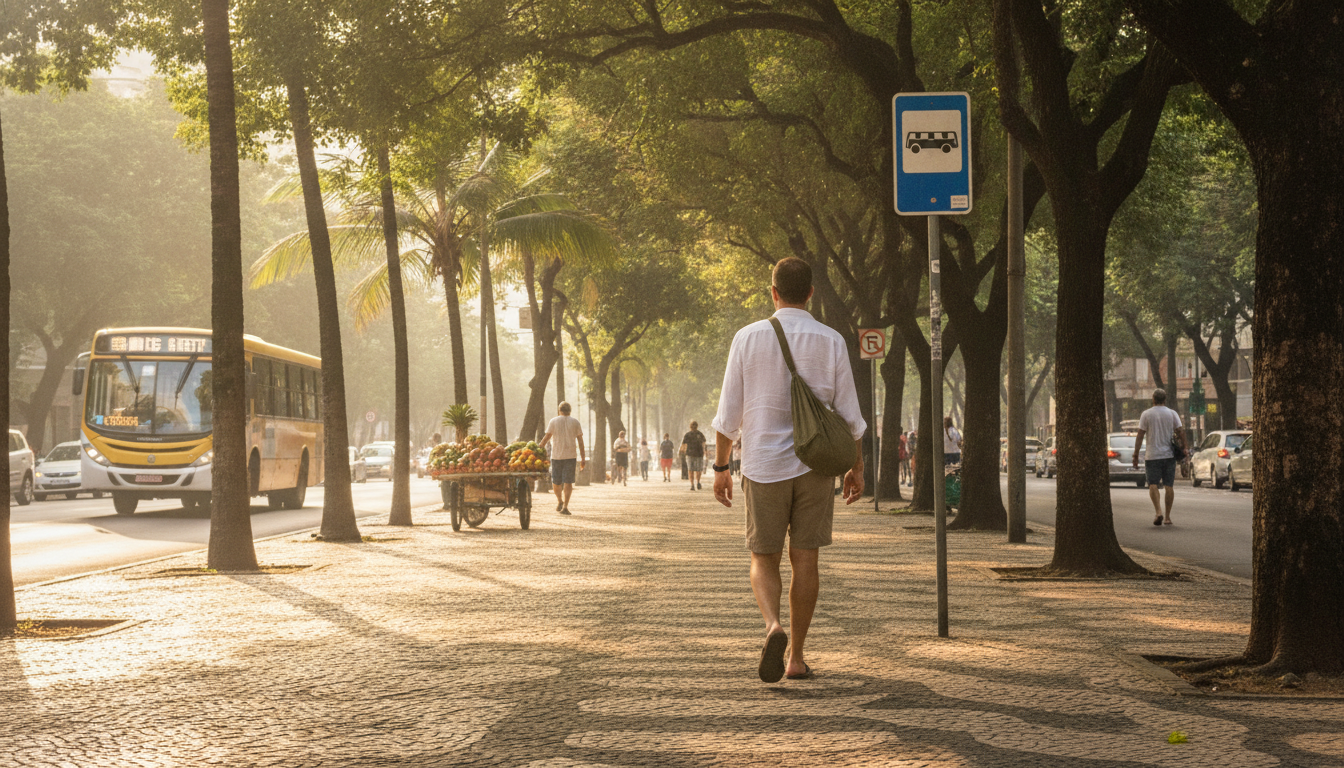
You don’t need to sell your car tomorrow or install solar panels on your roof to have more sustainable transportation. Change starts with one different trip, once a week.
Choose a route you normally drive and try doing it by bicycle, on foot, or by public transportation over the next seven days. Observe the time, the cost, and how you feel when you arrive. This simple experiment usually reveals that the change is easier than it seemed, and often more enjoyable. Just as reusing packaging at home is easier than it seems, adopting sustainable transportation habits is, above all, a matter of taking the first step.
Your carbon footprint in transportation can start to decrease this week. And the planet, of course, will thank you.
