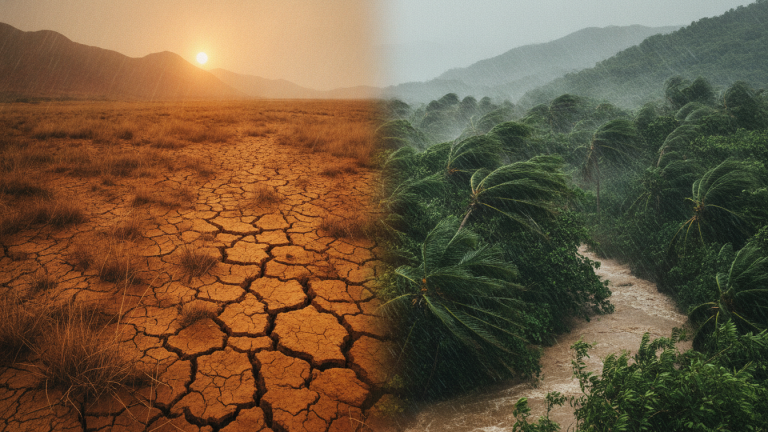
Have you ever heard someone say “but if it’s heating up so much, how can there be frost in May?” or “winter this year was harsh, where is global warming?”. This confusion is more common than it seems, and it has real consequences: when we don’t understand what’s happening with the climate, it becomes harder to act effectively. The two terms, global warming and climate change, appear all the time together, but they describe different things. Understanding this difference will change the way you read the news, make daily decisions, and explain the subject to those around you.
By the end of reading this article, you’ll know how to distinguish the two concepts precisely, understand why this matters for Brazil specifically, and have a list of concrete attitudes that make a difference, without needing to become a climatology expert.
What global warming actually is
Global warming refers to the increase in the average temperature of Earth’s surface over time. This increase is caused mainly by the growing concentration of greenhouse gases in the atmosphere, such as carbon dioxide, methane, and nitrous oxide. According to the IPCC (Intergovernmental Panel on Climate Change), the average global temperature has already increased about 1.1 degrees Celsius compared to pre-industrial levels by the beginning of this decade.
The central point is that “average” doesn’t mean “everywhere at the same time”. The average temperature of the planet rises, but that doesn’t mean every corner of the world will register higher temperatures on every day of the year. It’s like the average salary of a city: the number can go up while a part of the population continues to earn less.
This warming is measurable, documented, and monitored by satellites, ocean buoys, and weather stations around the world. In Brazil, the National Institute for Space Research (Inpe) maintains historical records that show the trend of rising average temperatures in different regions of the country.
What climate change is and why it goes beyond temperature
Climate change is the broader term. It describes all alterations in the planet’s climate patterns that result, directly or indirectly, from this temperature increase. This includes changes in rainfall patterns, the frequency and intensity of extreme events, ocean levels, wind distribution, and even seasonality, that is, when the seasons “arrive” and “leave”.
That’s why a frost out of season in São Paulo and a historic drought in the Northeast can be, at the same time, manifestations of the same climate change. The climate system is interconnected: when the average global temperature rises, patterns of air circulation and humidity change, and the result can be events that seem contradictory to each other.
UNEP (United Nations Environment Programme) uses the term climate change precisely to capture this complexity. It’s not just about “getting hotter”, but a planetary system moving out of an equilibrium that lasted millennia.
How this confusion hinders action
When someone confuses the two concepts, it opens space for misinterpretations. A cold winter becomes an argument against global warming. Heavy rain during a historic dry period seems to contradict everything heard in the news. This type of reasoning, besides being scientifically incorrect, can lead to paralysis: “if scientists don’t know what’s happening, why should I change my behavior?”
The reality is that scientists know, and climate models already predicted exactly this type of extreme variation. What changes with climate change is not just the temperature, it’s the variability. More intense rains in fewer days, more prolonged droughts, more frequent heat waves. For Brazil, a continental country with biomes as distinct as the Amazon, the Cerrado, and the Caatinga, this has direct implications for water security, agriculture, and public health.
Brazil at the center of the problem and solutions
Brazil occupies a unique position in this story. We are one of the world’s largest emitters of greenhouse gases, but much of these emissions come from deforestation and agriculture, not from industry or automobiles, as happens in wealthy countries. Data from Inpe shows that Amazon deforestation continues to be one of Brazil’s main sources of emissions.
At the same time, we are a highly vulnerable country. Extreme events like the floods in Rio Grande do Sul in 2024, severe drought in the Amazon, and heat waves in major cities directly affect the lives of millions of people. Embrapa has already identified that important crops for family farming, such as beans and corn, may have their productivity compromised in several regions of the country with the advance of climate change.
But Brazil also has an electricity matrix that is predominantly renewable, with significant participation from hydroelectric plants and impressive growth in solar and wind energy, according to ANEEL data. This is a real advantage, and recognizing it helps focus efforts where they matter most.
How ordinary citizens can act on this information
Understanding the difference between the two concepts is not an academic exercise. It changes what you prioritize in your daily life. If climate change is about variability and extremes, then your most impactful actions are those that reduce greenhouse gas emissions consistently, not just on days when the heat reminds you that “the planet is warming”.
See what you can do:
- Reduce beef consumption, especially from areas of deforestation. Livestock is the largest source of emissions in Brazilian agribusiness, according to SEEG (Greenhouse Gas Emissions and Removals Estimation System). Small dietary changes already make a difference, and you can start with small steps to reduce meat consumption without giving up the pleasure of eating well.
- Prefer public transportation or bicycling when possible. The transport sector accounts for a significant share of urban emissions in Brazil.
- Avoid food waste: food that goes to the trash also represents wasted emissions, plus money down the drain.
- Support selective collection in your neighborhood: sorting garbage correctly enables recycling, which consumes less energy and emits fewer gases than producing materials from scratch.
- Consume less and better: each product you don’t buy is a product that didn’t need to be manufactured, packaged, and transported.
- Talk about the subject: having conversations with family, friends, and coworkers using the correct concepts expands collective understanding and reduces misinformation.
The difference between the terms at a glance
| Concept | What it describes | Practical examples |
|---|---|---|
| Global warming | Increase in Earth’s average temperature | Average temperature 1.1 degree above the pre-industrial era |
| Climate change | Changes in all climate patterns | Droughts, floods, heat waves, out-of-season frosts |
The two are connected: global warming is one of the main causes of current climate change. But climate change is the set of effects, and global warming is one of the drivers.
Frequently asked questions about global warming and climate change
Why does it still rain a lot if the planet is warming?
Global warming alters patterns of evaporation and moisture circulation in the atmosphere. The result can be both more intense dry periods and more concentrated and violent rains. The question is not whether it will rain less or more, but when, where, and with what intensity, and these answers are changing.
Will Brazil be more affected than other countries?
Brazil is already feeling the effects of climate change concretely, with increasingly frequent extreme events. Because it has an economy heavily dependent on agriculture and water resources, the country is considered highly vulnerable to climate according to IPCC and UNEP reports.
What can an individual do if the problem is global?
Climate change is global, but emissions are local and add up to each other. Every decision about consumption, transportation, and food has a real carbon footprint. Besides, informed citizens pressure companies and governments for more effective policies, and that has voter and market weight.
Is there a difference between “weather” and “climate”?
Yes, and it’s one of the most important distinctions. Weather is the state of the atmosphere in a specific place at a given moment (is it raining now in São Paulo?). Climate is the average pattern of that weather over decades (São Paulo usually has concentrated rains in summer). Climate is what changes; weather is what you see through the window.
Start today: a small action with real effect

You don’t need to solve global warming this week. But you can do one thing now: next time someone uses a cold winter as an argument against climate science, you’ll have the right words to explain the difference. This conversation, multiplied by thousands of people, changes the political and cultural environment that sustains or hinders larger actions.
And if you want to go beyond the conversation, think about your daily commute. Replacing a car trip with public transportation or a bicycle a few times a week is one of the individual actions with the greatest impact on urban emissions, as shown in the way to reduce your carbon footprint with sustainable transportation. One step at a time, and the planet truly thanks you.
