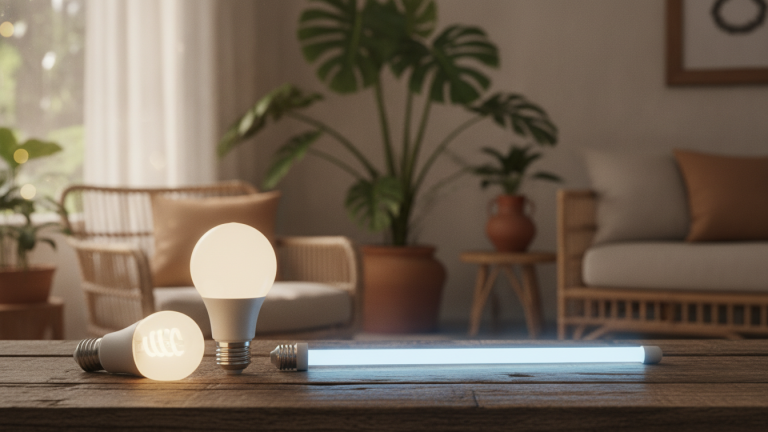
Have you ever looked at your electricity bill and wondered if that old fluorescent bulb is still worth keeping? The doubt is more common than you might think, especially since many people still hold the idea that fluorescent is synonymous with savings. But the lighting market has changed dramatically in the last decade, and today’s comparison is much clearer than it was when LED bulbs first arrived in Brazil.
The truth is that choosing the right bulb can make a real difference in your wallet and reduce your home’s environmental impact. In this scenario, with electricity rates in Brazil at elevated levels according to ANEEL data, understanding what each technology consumes and how long it lasts becomes a practical decision, not just a matter of environmental awareness. By the end of this article, you’ll know exactly which bulb to buy, why, and how to calculate the return on that switch in your bill.
What changed in Brazilian lighting since incandescent bulbs
For a long time, the incandescent bulb dominated Brazilian homes. It heated up, consumed a lot of energy, and lasted a short time. The arrival of compact fluorescents was sold as the great solution: they consumed less energy and lasted longer. And indeed, they were a real advance over incandescent bulbs.
The problem is that fluorescents came carrying a silent and dangerous ingredient: mercury. Each fluorescent bulb contains a small amount of this heavy metal, which is highly toxic to the human nervous system and the environment. When broken or disposed of incorrectly, which happens frequently in Brazil, it contaminates soil and water.
Regulations exist. The Law 12.305/2010, known as the National Solid Waste Policy (PNRS), determines that bulbs containing mercury must be returned to specific collection points. In practice, however, a very small portion of Brazilians dispose of these products correctly. The infrastructure of collection points is still unequal across municipalities, according to IBAMA data.
How LED and fluorescent work differently
To compare the two technologies fairly, it’s worth understanding what each does with the electrical energy it receives.
The fluorescent bulb works by exciting mercury gas inside the tube with electrical discharge. This process generates ultraviolet light, which is then converted to visible light by the inner coating of the bulb. A significant portion of energy is dissipated as heat, which reduces efficiency.
The LED bulb (acronym for light-emitting diode) works in a completely different way. It converts electrical energy directly into light through electronic components. This conversion is much more efficient and generates far less heat. Because of this, the same amount of light can be produced while consuming less energy.
Real comparison between consumption, durability, and cost
Let’s put the numbers on the table honestly. The data below is based on widely available technical specifications from manufacturers and references from the energy efficiency sector.
| Feature | Compact Fluorescent | LED Equivalent |
|---|---|---|
| Power for ~800 lumens | 15 W | 8 to 10 W |
| Estimated lifespan | 6,000 to 10,000 hours | 15,000 to 25,000 hours |
| Contains mercury | Yes | No |
| Heating | Moderate | Low |
| Time to reach full brightness | 30 seconds to 2 minutes | Immediate |
| Average price in 2026 | R$ 8 to R$ 15 | R$ 12 to R$ 25 |
The difference in power may seem small, but think of it this way: if you have 10 bulbs in your home and each one is on for an average of 5 hours a day, switching from 15 W fluorescents to 9 W LEDs represents a savings of 360 Wh per day. In a month, this equals approximately 10.8 kWh less on your meter. Depending on the tariff flag in effect and your distributor, according to ANEEL tables, this can represent savings of R$ 10 to R$ 20 per month in lighting alone.
The longer lifespan of LEDs also means you buy fewer bulbs over the years. While a fluorescent may need to be replaced in two or three years with intensive use, a quality LED can last ten years or more.
Why LED is also better for the environment
The discussion about the sustainability of bulbs goes beyond energy consumption. There’s an entire chain of impacts that begins in manufacturing and ends in disposal.
LED contains no mercury, which eliminates one of the biggest environmental problems with fluorescents. As mentioned, improper disposal of fluorescents is a real problem in Brazil, and mercury contamination has lasting effects on ecosystems.
Additionally, because LED lasts longer, the frequency of manufacturing and disposal of bulbs drops significantly. Fewer bulbs manufactured means less energy and natural resources spent in production. This directly connects to the reduction of greenhouse gas emissions over the product’s life cycle. If you want to better understand how these emissions affect the planet, it’s worth reading about the greenhouse effect: what it is and why it warms the planet.
LED is not perfect either. It contains electronic components and metals that need proper disposal. But the impact is considerably less than fluorescents when compared over the entire life of the product.
How to make the switch intelligently at home
Replacing all your bulbs at once might seem like a high upfront cost. The good news is you don’t have to do it all at once. A simple and effective strategy is to replace bulbs as old ones burn out or start to flicker.
If you want to speed up the process, start with the rooms where lights stay on the longest: the kitchen, living room, and office are usually the biggest consumers. Bedrooms and bathrooms, where lights are used for shorter periods, can wait a bit longer.
Here’s a practical step-by-step guide to make the switch without mistakes:
- Check the current power of your fluorescent bulbs (it’s written on the base or packaging).
- Calculate the LED equivalent: a 15 W fluorescent equals an 8 to 10 W LED in terms of brightness.
- Observe the color temperature: bulbs with 2,700 K to 3,000 K provide warmer, more yellowish light; 4,000 K to 6,500 K are whiter or cooler, recommended for kitchens and work areas.
- Check the bulb base (E27, E14, or double pin) to ensure compatibility with your fixtures.
- Keep working fluorescents to take to a proper collection point instead of throwing them in regular trash.
- Dispose of old fluorescents correctly: many supermarket chains and hardware stores have collection points. Some city governments also offer this service.
Common mistakes when buying LED and how to avoid them
Not all LEDs are the same, and buying the wrong one can be frustrating. Some points deserve attention.
- Don’t rely on watts alone: what defines brightness is lumens, not power. A 9 W bulb of good quality can illuminate more than a 12 W bulb of questionable origin.
- Be careful with unknown brands: very cheap LEDs often don’t deliver the promised lifespan. Prefer brands with INMETRO certification.
- Avoid confusing “dual voltage” with “universal”: verify if the bulb is compatible with your home’s voltage (110 V or 220 V).
- Dimmer requires compatible LED: if you use a dimmer switch, not all LED bulbs work with it. Look for packaging indicating compatibility.
- Color temperature matters for well-being: light that’s too cool in bedrooms can disrupt sleep. This isn’t a myth; it’s something chronobiology researchers have documented, although practical application still varies by person.
Frequently asked questions about LED and fluorescent bulbs
Does LED really last 25,000 hours as the packaging promises?
The lifespan declared by manufacturers is usually measured under controlled laboratory conditions. In real home use, with voltage variations, heat, and humidity, it’s common for quality LEDs to last between 15,000 and 20,000 hours. This is still much superior to fluorescents, which rarely exceed 10,000 hours.
Can I mix LED and fluorescent bulbs in the same room?
Technically yes, but the difference in color temperature can make the environment visually unpleasant. If you do mix them, try to keep the same color temperature (in kelvin) for all bulbs in the room.
Where can I dispose of burned-out fluorescent bulbs?
Chains like Leroy Merlin, Telhanorte, and some supermarket branches accept fluorescent bulbs for proper disposal. You can also check with your city government to see if there are voluntary drop-off points or collection campaigns. Never dispose of them in regular trash.
Does LED emit UV or infrared radiation?
Home-use LED bulbs emit very small amounts of UV and infrared radiation, well below levels considered safe. For normal residential use, there is no documented risk. UV bulbs for specific uses (disinfection, for example) are different products and should not be used as home lighting.
Start today: a simple switch with real returns
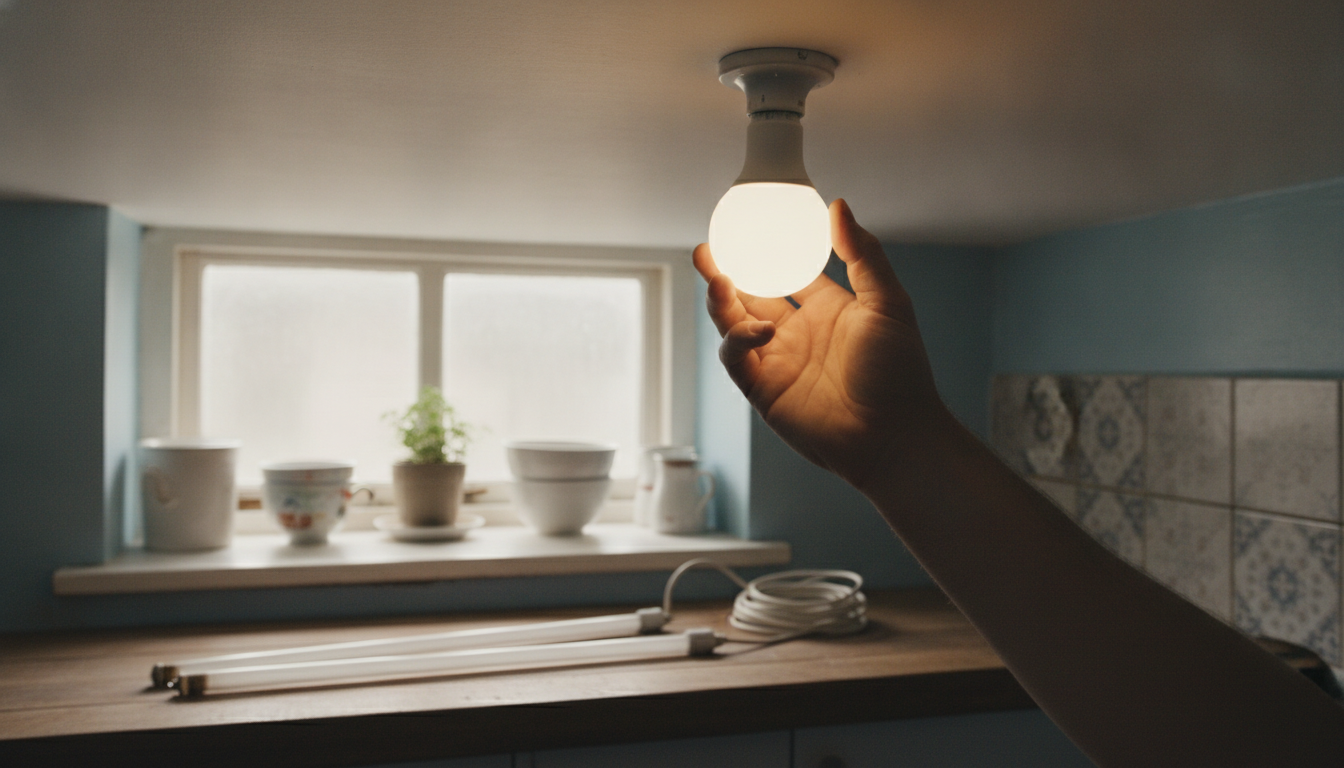
The best bulb for your home and the planet, in 2026, is LED. The energy savings are real, durability is greater, disposal is less problematic, and the upfront cost pays for itself in just a few months of lower electricity bills.
You don’t need to renovate your home or spend a lot all at once. Start with the bulb in the room where lights stay on the longest today. When you go to the market or hardware store, replace a fluorescent with an equivalent LED, observe the difference in your next bill, and feel the difference in your daily life. Small switches like this, combined with other sustainable habits, make a much bigger difference than it seems when looking at a single bulb.
