Greenwashing on Labels: How to Avoid Deceptive Marketing Traps
You grab a product from the supermarket shelf, read “100% natural,” “eco-friendly” or “carbon neutral” on the packaging and feel you’re making the right choice. But what if that sense of duty fulfilled is exactly what the brand wants to provoke, without the product having changed anything substantial? It has a name: greenwashing, the practice of using environmental language and symbols to create a green image that doesn’t match reality.
The phenomenon isn’t new, but it has grown alongside Brazilian consumers’ environmental awareness. The more people seek sustainable products, the greater the incentive for companies to paint themselves green when they’re not. The problem is real and documented: the United Nations Environment Programme (UNEP) has already identified greenwashing as one of the main barriers to genuine sustainable consumption.
By the end of reading this article, you’ll know how to identify the most common greenwashing tactics on Brazilian labels, ask simple questions before buying, and build a practical filter for your everyday shopping.
Why Greenwashing Works So Well
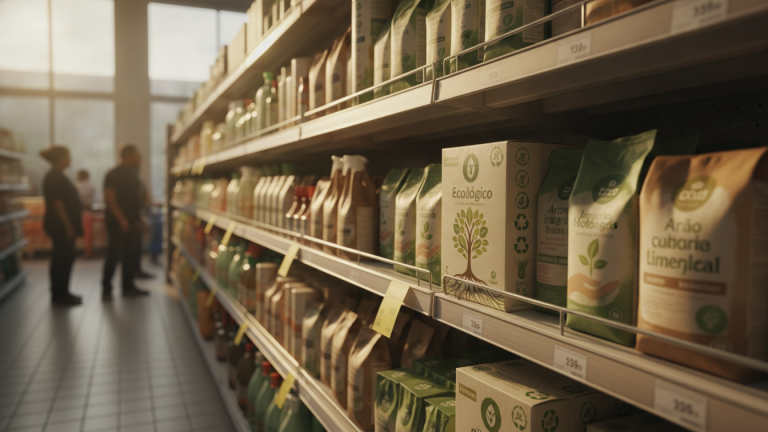
The most honest answer is: because we want to believe. When someone is already willing to pay a bit more for a product that seems less harmful to the planet, the packaging’s job is simply not to disappoint that expectation. A green leaf, kraft paper brown, words like “pure,” “clean” or “sustainable” activate positive associations before you even read any details.
Design is a powerful tool here. Consumer behavior studies show that packaging with earthy tones and natural elements are perceived as healthier and more ecological, regardless of contents. This isn’t opinion: it’s a calculated marketing strategy.
In Brazil, the situation has an extra layer of complexity. Environmental labeling legislation is still fragmented. There is no single, binding standard until 2026 that defines what a company can or cannot call “sustainable” on consumer product packaging. This opens space for vague claims that no agency systematically monitors.
Alert Phrases You’ll Start Noticing
Some expressions appear so frequently on labels they seem official. They’re not. Learn to treat them as red flags, not approvals.
- “Eco-friendly” or “environmentally friendly”: terms with no legal definition in Brazil. Any product can use them.
- “100% natural”: natural doesn’t mean safe, sustainable, or responsibly produced. Arsenic is natural.
- “Carbon neutral” or “neutral carbon”: it might be true, but it requires third-party verification. Without a recognized certifier cited on the label, it’s just text.
- “Recyclable packaging”: technically, almost everything can be recycled under ideal conditions. The real question is whether collection and recycling infrastructure exists for that material in your municipality.
- “Made with natural ingredients”: the key word is “with.” It could be 2% natural ingredient in an entirely synthetic formula.
- “Biodegradable”: without timeframe and without specific conditions, the claim says nothing. Conventional plastic technically degrades; it just takes centuries.
How to Read a Label Without Falling Into the Trap
It’s not about distrusting everything, but asking the right questions. The process is simple and becomes automatic with practice.
- Look for the certifier, not just the symbol. There’s a huge difference between a generic seal designed by the company itself and certification issued by an independent organization. In Brazil, examples of seals with real credibility include FSC (for paper and wood), Rainforest Alliance, USDA Organic (for imported items), and SisOrg from the Ministry of Agriculture for organic products. If the symbol on the label isn’t accompanied by a verifiable certifier name, treat it skeptically.
- Ask: is the claim specific or vague? “We reduced our carbon emissions by 30% since 2020, verified by SGS” is specific. “Committed to the planet” means nothing.
- Check if the claim is relevant to the product. A water brand advertising that its packaging is “CFC-free” is being deceptive: CFCs were banned decades ago and never were part of water packaging. This is called irrelevant claim, and it’s classic greenwashing.
- Look at the back and fine print. Serious companies explain how the sustainable practice works, even briefly. Brands practicing greenwashing tend to keep everything on the surface of the package.
- Research before trusting. A quick search for the company name and “sustainability” often reveals reports, lawsuits, or analyses that contradict what’s on the label.
Greenwashing Beyond Supermarkets
The phenomenon isn’t limited to shampoos and detergents. It appears in sectors you might not expect.
Fashion and apparel are among the most affected fields. Brands launching “conscious” or “eco” collections while maintaining mass production models use sustainability as a marketing niche, not a practice change. The volume of discarded clothing globally continues to grow, according to UNEP data.
Energy and fuels also play the game. Gas stations announcing “green” fuel or companies promoting carbon offsets without transparency about methodology deserve extra attention. In Brazil’s electric sector, ANEEL regulates energy origin, and you can verify your provider’s energy matrix in official documents available by the agency.
Tourism is another sector where the term “ecotourism” has become an empty label in many contexts. A hotel that separates kitchen waste but builds in a protected environmental area is not sustainable, regardless of what the brochure says.
What Brazilian Legislation Says (and What’s Still Missing)
The National Solid Waste Policy, known as PNRS (Law 12.305/2010), establishes responsibilities for manufacturers, importers, and retailers regarding product and packaging lifecycles. It’s relevant legislation, but its practical application is still uneven across Brazilian territory.
The Consumer Protection Code (Law 8.078/1990) prohibits misleading advertising, including false environmental claims. The National Council for Advertising Self-Regulation (Conar) receives complaints and has already issued warnings against campaigns with greenwashing, but self-regulation has limits.
What’s missing, until 2026, is specific regulation for environmental claims on labels, with clear criteria, mandatory certification, and enforcement with teeth. The European Union advanced in this direction with the Green Claims Directive, approved in 2024, requiring companies to prove environmental claims before publishing them. Brazil doesn’t have an equivalent yet.
While regulation doesn’t arrive, your critical eye is the main available filter.
Real Alternatives: Where to Find Products with Less Green Smoke
Changing your buying habits doesn’t need to be radical or expensive. Some practical substitutions already reduce exposure to greenwashing and, in many cases, excessive consumption itself.
- Prefer products with ingredients listed transparently and in understandable language
- Shop at local markets: small-scale producers rarely have budget for greenwashing and often have more traceable practices
- For cleaning items, simple formulas with fewer ingredients tend to be more honest than products with long lists of environmental attributes on the label
- When possible, choose refills: they reduce packaging in fact, not just in discourse
- For packaging, what matters is what happens after use. Before buying something advertised as recyclable, check if your neighborhood’s selective waste collection system accepts that specific material
- Be suspicious of products with many colored seals but no certifier name: quantity of symbols isn’t synonymous with environmental quality
If you want to deepen sustainable choices beyond labels, it’s worth considering alternatives to single-use plastic in daily life, a field where greenwashing also appears strongly, especially in products advertised as “bioplastic” without further details.
Frequently Asked Questions About Greenwashing
How do you know if an environmental seal is real?
Look for the name of the certifying organization on the label and research whether it’s independent of the manufacturing company. Legitimate seals like FSC, Rainforest Alliance, and SisOrg have websites where you can verify if the company is actually registered and certified.
Does reporting greenwashing do any good?
It does. Conar accepts complaints about misleading advertising, and Procon in your state can receive complaints about false packaging information. Additionally, social media comments and public reviews create real pressure on brands that depend on image.
Is more expensive product more sustainable?
Not necessarily. Higher price can reflect responsible production cost, but it can also be just marketing positioning. Price doesn’t replace label analysis and certification.
What do I do when I’m unsure about a product?
The simplest option is to choose the product with fewer vague claims, not the one with more. A brand that says nothing special about sustainability but has clear ingredients and simple packaging might be more honest than one loaded with seals of unknown origin.
Start Today with a Small, Concrete Gesture
Next time you pick up a product with a green label, pause for ten seconds. Read an environmental claim that caught your attention and ask: who guarantees this? If there’s no answer on the label, you already have enough information to decide more consciously.
You don’t need to be an expert or reject everything. It’s just about stepping out of autopilot. Over time, this filter becomes instinct, and your purchases start to reflect what you truly value, not what a well-designed package wants you to feel.
