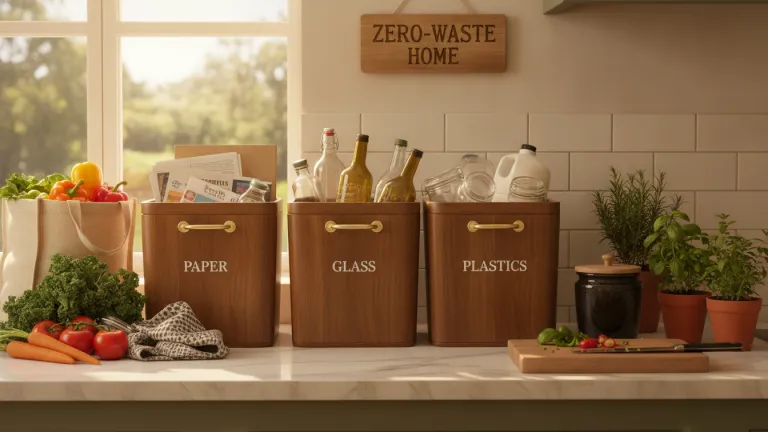
Every time we throw something in the trash, we rarely think about where that material ends up. But the truth is that Brazil faces a growing challenge with solid waste generation: according to the Panorama of Solid Waste in Brazil, published by the Brazilian Association of Public Cleaning and Special Waste Companies (Abrelpe), the country generates tens of millions of tons of waste per year, and a significant portion still ends up in dumps or landfills without proper treatment. This cycle has real consequences: soil and water contamination, greenhouse gas emissions, and direct impact on the health of communities around these areas.
The good news is that much of the waste that leaves our homes can be avoided — even before it reaches collection. Research on household waste composition indicates that organic materials (food scraps) represent the largest fraction of what we discard, followed by plastics, paper, and packaging. This means that changes within the home have real potential to reduce the volume of waste each family generates every month.
This article is not about perfection. It’s about concrete, accessible steps that you can start today. Small habit changes, when adopted by many people, add up to significant results. See below how to transform your household routine in a practical way without giving up comfort.
Understand the Waste You Generate: The First Step to Reducing Household Waste
Before changing any habit, it’s worth observing what you actually discard. This simple step is often revealing.
How to conduct a household waste audit
- For one week, separate waste by category: organic (peels, food scraps), plastics, paper, glass, metals, and non-recyclables (what cannot be reused).
- At the end of the week, observe which category dominates the volume.
- Identify patterns: are there many packages from products you buy frequently? Is a lot of food being wasted?
- With this map in hand, define one or two priority areas to act on.
This exercise helps personalize your strategy. A family that discards a lot of plastic packaging will benefit from different strategies than another whose biggest problem is food waste.
Reduce Food Waste and Cut Organic Trash at the Root
Food waste is a large-scale global problem. The Food and Agriculture Organization of the United Nations (FAO) estimates that approximately one-third of all food produced worldwide for human consumption is lost or wasted along the production chain. At the household level, a significant part of this loss happens due to lack of planning in shopping and meal preparation.
Practical habits to waste less food
- Plan your weekly meals before going to the store. A shopping list based on a real menu avoids impulse purchases and food that gets forgotten in the fridge.
- Adopt the FIFO method (First In, First Out): when storing groceries, place older items in front and newer ones in back.
- Use stems, peels, and leaves from vegetables. Kale stems, beet peels, carrot tops — many of these items have nutritional value and can become stir-fries, broths, or chips.
- Freeze what you won’t use immediately. Day-old bread, ripe fruits, leftover rice and beans freeze well and last weeks.
- Transform leftovers into new meals. Yesterday’s rice becomes croquettes or soup; the ripe banana becomes pancakes or smoothies.
Reducing food waste is perhaps the individual action with the greatest direct impact on the amount of household waste generated.
Home Composting: Turn Food Scraps into Fertilizer
For organic waste that inevitably remains — like peels, coffee grounds, tea bags, and plate scraps — composting is the most efficient solution. Instead of going to the landfill, these materials transform into organic compost, a rich fertilizer that can nourish pots, vegetable gardens, and gardens.
How to set up a simple composter in an apartment or house
- Choose the type of composter: it can be a ready-made worm bin, a stacked bucket composter (homemade with recycled paint buckets), or even bokashi (anaerobic fermentation with inoculated bran, ideal for those with little space).
- Separate appropriate waste: fruit and vegetable peels, coffee grounds, tea bags, shredded non-plastic cardboard, dry leaves. Avoid meat, dairy, and oils in conventional composters.
- Balance wet and dry materials: for each layer of wet organic waste, add a layer of dry material (cardboard, sawdust, dry leaves). This prevents bad odors.
- Turn the composter every two or three days for aeration (except for bokashi).
- In a few weeks to months, depending on the method, you’ll have compost ready to use on plants.
Composting eliminates the heaviest and most voluminous material from household waste and closes a natural cycle: what came from the earth returns to the earth.
Say Goodbye to Unnecessary Packaging: Strategies to Reduce Plastic
Disposable packaging, especially plastic, is one of the biggest villains of household waste. Many of them have a useful life of just a few minutes — like straws, bags, and disposable cups — but take decades to decompose in the environment.
If you want to dive deeper into this topic, check out our complete guide on Less Disposable Plastic in Daily Life: Where to Start.
Simple substitutions that make a difference in household waste
| Disposable item | Reusable alternative |
|---|---|
| Plastic bag | Fabric or cotton tote bag |
| PET bottle | Reusable stainless steel or glass bottle |
| Disposable cup | Mug or glass cup |
| Synthetic dish sponge | Natural fiber sponge or loofah |
| Plastic wrap (PVC) | Beeswax wrap or container with lid |
| Shampoo sachet | Solid shampoo or refill packaging |
The key is not to buy everything at once — that would generate more waste during the transition. The ideal is to replace gradually, as each disposable item runs out.
Separate Correctly and Maximize Recycling of Household Waste
Selective collection only works if materials arrive clean and correctly separated. Contaminated waste — like a milk carton with leftover contents — can make recycling an entire batch impossible.
Best practices for efficient recycling separation
- Rinse food packaging before disposing of it in selective collection. It’s not necessary to wash with soap — just a quick rinse with the water from the last use of the sponge helps.
- Crush PET bottles and cans to save space and facilitate transportation.
- Separate glass from other recyclables, as in many municipalities it has specific collection.
- Pay attention to the recycling symbol: not all plastic is accepted by municipal selective collection. Styrofoam packaging, thin plastic films, and mixed materials are usually not accepted in most cities.
- Find voluntary drop-off points (VDPs) in your city for special materials: batteries, electronics, and light bulbs should go to specific locations — never to regular trash, as they contain toxic substances.
Learn about your municipality’s solid waste policy. Many city halls provide online guides about what can and cannot go to local selective collection.
Reuse, Repair, and Refuse: The Other Pillars of Waste Reduction at Home
Recycling is important, but it occupies the last step of the waste hierarchy. The previous steps — refuse, reduce, reuse, and repair — are even more effective because they prevent waste from being generated.
Daily attitudes that reduce waste at the source
- Refuse what you don’t need: promotional items, extra bags, straws you won’t use. Politely, but firmly.
- Buy in bulk when possible: cereals, grains, spices, and nuts at bulk stores generate much less packaging than pre-packaged products.
- Prefer concentrates and refills: concentrated laundry detergent, dish soap refills, and fabric softener refills generate less plastic per dose than diluted versions in larger packaging.
- Repair before throwing away: a fallen button, a broken zipper, a shoe with a loose sole — often the repair costs little and extends the product’s useful life by years.
- Donate and exchange what you no longer use: clothes, books, electronics, and furniture in good condition can have new life with someone else. Donation groups, thrift stores, and exchange platforms are great options.
- Make at home what’s feasible: simple cleaning products (like a mixture of baking soda and vinegar for general cleaning) or homemade soap reduce packaging and can be more economical. See how to make homemade soap with used cooking oil in our complete tutorial.
Involve the Whole Family in Reducing Household Waste
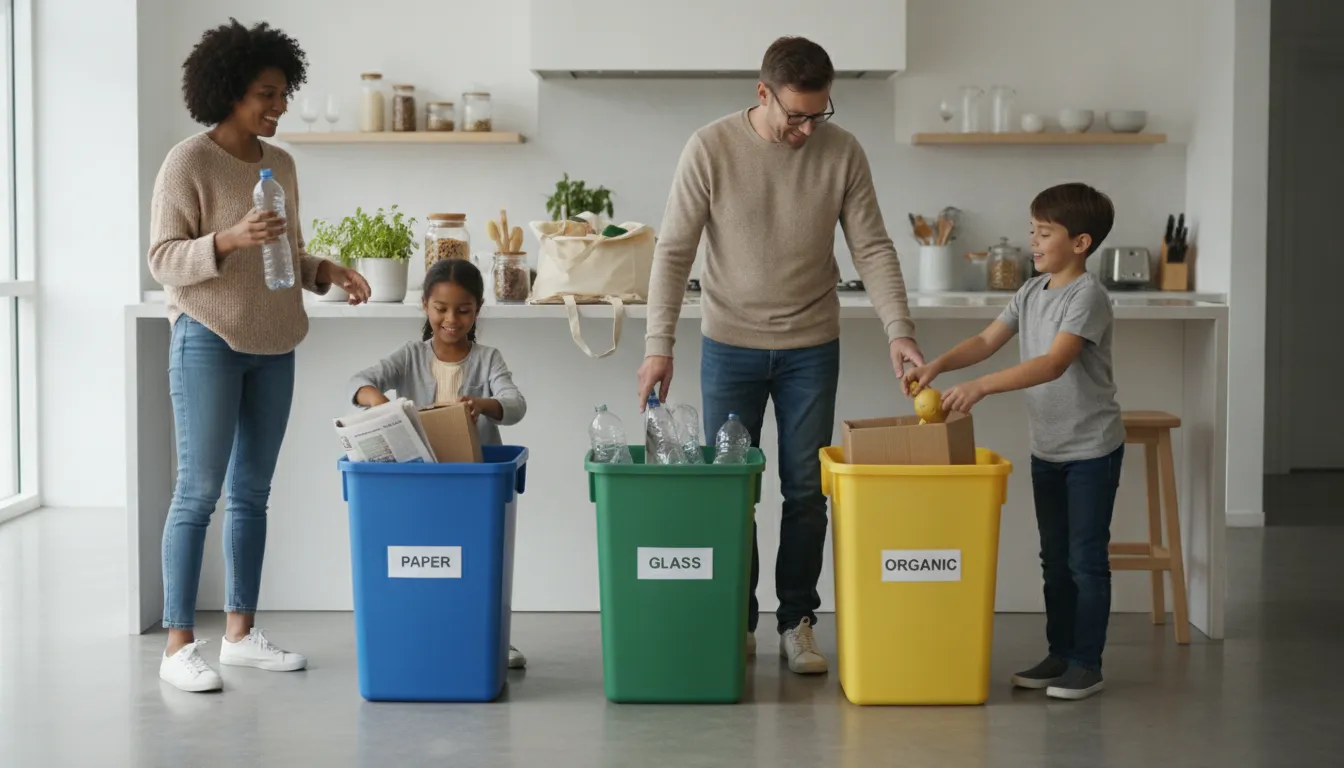
Sustainable habits consolidate more easily when the whole family shares the same understanding. Children who learn from an early age to separate waste, avoid waste, and value what they have grow up with a more conscious relationship with consumption.
How to engage the family in a light and positive way
- Make waste separation visual and simple: bins identified with colors and figures make it easier for children and adults.
- Celebrate small achievements: “this week we generated less waste than last week” is a reason for satisfaction.
- Cook together and teach full use of food — besides reducing waste, it’s a moment of connection and learning.
- Include children in composting: digging in the soil and watching the cycle happen is educational and fascinating for little ones.
- Discuss conscious purchases: before acquiring something new, ask together: do we need this? Is there a version with less packaging? Can it be secondhand?
Reducing household waste doesn’t require a radical and immediate transformation. It requires intention, observation, and the willingness to adopt one habit at a time. Every bag of trash less that leaves the house represents less weight in landfills, fewer natural resources consumed, and fewer emissions throughout the disposal chain.
Start with what seems easiest — maybe it’s stopping using plastic bags, or setting up a small composter, or better planning the week’s shopping. Any starting point is valid. The important thing is to start. And when you notice the results — in the grocery bill, in the volume of trash, in the awareness of taking action — the motivation to go further will appear naturally.
Your trash tells a story about your habits. How about starting to rewrite that story today?
