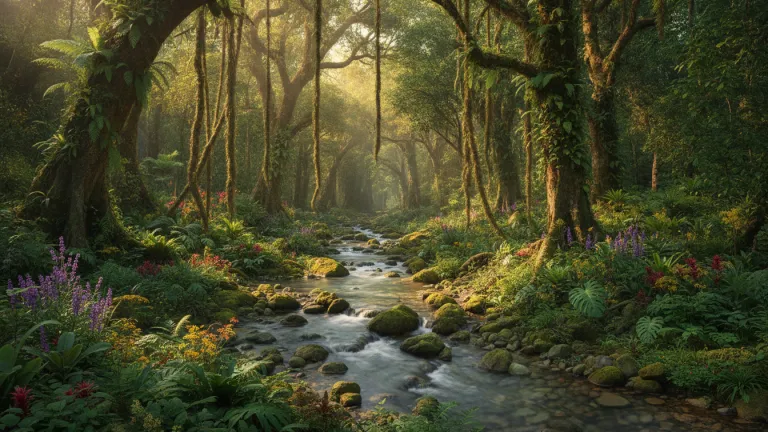
Imagine you just stepped into a dense forest. Above your head, tree canopies form a living roof that filters sunlight. On the ground, fungi decompose fallen leaves. Birds carry seeds far away. Insects pollinate flowers. A fox drinks water from a stream. All of this happens simultaneously, in perfect — and fragile — synchrony. What you’re seeing isn’t just “nature”: you’re observing an ecosystem in full operation.
The concept of an ecosystem is one of the most important in environmental science, but also one of the most misunderstood. Many people think an ecosystem is synonymous with tropical forests or deep oceans — something distant, grand, and unrelated to daily life. Reality is quite different. A flower bed in your backyard, a lake in a city park, even a potted plant on your windowsill can be considered small ecosystems. And understanding how they work completely changes how we see the world — and our place in it.
In this article, we’ll explain in simple and straightforward terms what an ecosystem is, how it works, why it matters to your life, and what you can do to help protect it. You don’t need to be a biologist to understand. You just need curiosity — and perhaps a little willingness to act.
What Is an Ecosystem: A Clear and Simple Definition
In scientific terms, an ecosystem is the set formed by all living beings in a given area — plants, animals, fungi, bacteria — in constant interaction with each other and with the surrounding physical environment, which includes soil, water, air, sunlight, and nutrients.
The word was coined by British ecologist Arthur Tansley in 1935, and has since become one of the pillars of modern biology and ecology. What makes the concept so powerful is the idea of system: nothing exists in isolation. Each element depends on the others to exist.
Think of it this way:
- A bee needs flowers for food
- The flower needs the bee for pollination
- The plant needs soil rich in organic matter
- The soil is enriched by earthworms and fungi that decompose organic remains
- These organisms need moisture — which comes from rain, which in turn is influenced by vegetation
Removing any of these elements affects all the others. That is an ecosystem: a network of mutual dependencies.
The Components of an Ecosystem: Living and Non-Living
Every ecosystem is made up of two major groups of components:
Biotic components (living things)
- Producers: plants, algae, and some microorganisms that perform photosynthesis and convert solar energy into organic matter. They are the foundation of almost every food chain.
- Primary consumers: herbivorous animals that feed on producers — grasshoppers, rabbits, cattle, caterpillars.
- Secondary and tertiary consumers: carnivores and omnivores that feed on other animals — frogs, snakes, eagles, lions.
- Decomposers: fungi, bacteria, and some invertebrates that break down dead organic matter and return nutrients to the soil. They are the planet’s invisible “recyclers.”
Abiotic components (the physical environment)
- Sunlight
- Temperature
- Water
- Air and atmospheric composition
- Soil and its minerals
- Terrain and altitude
The interaction between these two groups is what keeps the ecosystem alive and functional. Soil without minerals cannot support plants. Without plants, there are no herbivores. Without herbivores, carnivores disappear. And without decomposers, nutrients remain trapped in dead organisms and the cycle breaks.
Types of Ecosystems in the World and in Brazil
Ecosystems can be classified in various ways, but the most common division is between terrestrial and aquatic.
Terrestrial ecosystems
| Type | Main Characteristic | Example in Brazil |
|---|---|---|
| Tropical forest | High biodiversity, abundant rainfall | Amazon |
| Cerrado | Rich savanna, acidic soil, seasonal drought | Brazilian Central-West |
| Caatinga | Semi-arid, drought-resistant plants | Northeastern Brazil |
| Atlantic Forest | One of the most biodiverse in the world, highly fragmented | Eastern coast of Brazil |
| Pampa | Temperate grasslands, low vegetation | Southern Brazil |
| Pantanal | Floodplain, high wildlife diversity | Mato Grosso and Mato Grosso do Sul |
Brazil is home to six recognized terrestrial biomes, making it one of the countries with the greatest diversity of ecosystems on the planet — a natural heritage of inestimable value.
Aquatic ecosystems
- Marine: oceans, seas, coral reefs, mangroves
- Freshwater: rivers, lakes, ponds, marshes
- Transitional: estuaries and mangroves, where freshwater and saltwater meet
Mangroves, for example, are fundamental transitional ecosystems: they serve as nurseries for fish, protect the coast from erosion, and store large amounts of carbon in the soil.
How an Ecosystem Sustains Itself: Cycles and Balance
A healthy ecosystem works like a perpetual motion machine — but one that depends on external energy (the sun) to keep running. It sustains itself through biogeochemical cycles, which are the circuits through which matter circulates between living beings and the environment.
The most important ones are:
- Carbon cycle: carbon is absorbed by plants during photosynthesis, passes to animals that eat them, and returns to the atmosphere through respiration and decomposition. Forests are enormous carbon reservoirs.
- Water cycle: water evaporates, forms clouds, falls as rain, is absorbed by soil and plants, and returns to the atmosphere through plant transpiration. The Amazon, for example, generates the so-called “flying rivers” — currents of water vapor that influence rainfall across the continent.
- Nitrogen cycle: nitrogen from the air is fixed by bacteria in the soil, used by plants to grow, consumed by animals, and returned to the soil through decomposition.
When these cycles function well, the ecosystem self-regulates. When they are disturbed — by deforestation, pollution, or introduction of invasive species — the balance breaks.
Why Ecosystems Are Essential for Human Life
Here’s the part many people ignore: we depend on ecosystems to survive. It’s not a metaphor. It’s a biological and economic fact.
Ecosystems provide us with what science calls ecosystem services — concrete benefits that nature provides for free:
- Climate regulation: forests absorb CO₂ and regulate local and global temperature
- Water purification: soils and vegetation filter water before it reaches rivers and aquifers
- Pollination: about 75% of the world’s food crops depend on pollinators like bees and butterflies, according to the FAO
- Pest control: natural predators keep insect populations in balance
- Food production: from fishing to plant extraction, natural ecosystems feed hundreds of millions of people
- Disaster protection: mangroves and floodplains buffer floods; forests prevent erosion and landslides
- Mental and physical health: studies show that contact with natural environments reduces stress and improves well-being
The loss of biodiversity and ecosystem degradation directly threaten these services. The Intergovernmental Science-Policy Platform on Biodiversity and Ecosystem Services (IPBES) has already warned that ecosystem degradation affects the well-being of at least 3.2 billion people worldwide.
What Threatens Ecosystems Today
The main threats to ecosystems worldwide are well known — and largely caused by human action:
- Deforestation and habitat conversion: destruction of forests for agriculture, livestock, and urbanization is the leading cause of biodiversity loss
- Pollution: of rivers, soils, and air by pesticides, plastics, and industrial effluents
- Climate change: changes in temperature and rainfall patterns destabilize entire ecosystems — to better understand the relationship between warming and climate, see our article on global warming and climate change
- Invasive species: animals and plants introduced outside their natural habitat can devastate local communities
- Overexploitation: predatory fishing, illegal hunting, and uncontrolled mineral extraction
None of these threats is inevitable. All can be reduced with appropriate public policies, technology, and behavioral changes.
What You Can Do to Protect Ecosystems
The good news is that individual actions, when combined, make a real difference. Here are concrete steps anyone can take:
- Reduce meat consumption, especially beef, whose production is one of the main causes of deforestation in the Amazon and Cerrado
- Choose products with sustainable origin certification — this encourages practices that preserve ecosystems
- Plant native trees in your backyard, condominium, or school. Native trees attract birds, insects, and other animals, creating urban mini-ecosystems. See how to do this correctly in our guide on planting trees the right way
- Avoid chemical pesticides and herbicides in home gardens and vegetable patches — they kill essential pollinators and decomposers
- Dispose of waste properly: trash thrown into rivers and vacant lots contaminates soils and water bodies
- Support conservation areas by visiting them, donating to NGOs, or demanding their creation and maintenance from government officials
- Use less single-use plastic — fragmented plastic contaminates soils, rivers, and oceans, entering food chains
- Educate and share: talking about ecosystems with friends and family multiplies the impact
Each of these actions may seem small on its own. But ecosystems have taught us exactly this: it is the sum of many small parts that creates something large and resilient.
Conclusion: We Are Part of the Ecosystem
Perhaps the biggest mistake we make when thinking about ecosystems is placing ourselves outside — as if we were observers of something that exists separately from us. But we are not. We are an integral part of the ecosystems we inhabit. We breathe the oxygen produced by plants. We drink water filtered by soil. We eat food pollinated by insects. Our health depends on the health of the planet.
Understanding what an ecosystem is isn’t just an intellectual exercise. It’s the first step toward making better decisions — at the supermarket, in the garden, at the ballot box, and in everyday life. The more we understand the connections that sustain us, the more naturally we want to protect them.
The planet doesn’t need everyone to become an environmental scientist. It needs everyone to realize they are connected to something greater — and that every small choice matters. Start today, where you are, with what you have. The ecosystem will thank you.
