Imagine Earth wearing an invisible blanket to stay warm. That blanket is the atmosphere, and the mechanism that regulates heat within it has a name you’ve certainly heard before: the greenhouse effect. Without it, the average temperature at our planet’s surface would be around -18°C, making life as we know it practically impossible. The problem isn’t the existence of this phenomenon — it’s essential — but rather what happens when this blanket becomes too thick.
In recent decades, the concentration of gases that intensify the greenhouse effect in the atmosphere has grown at an unprecedented rate in recent geological history. According to the Intergovernmental Panel on Climate Change (IPCC), the concentration of carbon dioxide (CO₂) in the atmosphere has already exceeded 420 parts per million (ppm), the highest level recorded in at least 800,000 years, as indicated by Antarctic ice core records. This isn’t just a number: it’s a direct reflection of human choices accumulated over generations.
Understanding what the greenhouse effect is and how it works isn’t just a science lesson. It’s the starting point for making more conscious daily decisions, understanding climate news more clearly, and most importantly, knowing why our individual and collective actions truly matter.
What Is the Greenhouse Effect: The Physics Behind the Phenomenon
The greenhouse effect is a natural process of heat retention in Earth’s atmosphere. It works similarly to an agricultural glass greenhouse: solar energy enters easily but has difficulty escaping completely.
Here’s the step-by-step process:
- Solar radiation reaches Earth mainly in the form of visible and ultraviolet light, passing through the atmosphere with little resistance.
- The Earth’s surface — oceans, forests, soil, cities — absorbs this energy and re-emits it as infrared radiation (heat).
- Greenhouse gases (GHGs) present in the atmosphere absorb part of this infrared radiation and radiate it in all directions, including back toward the surface.
- The surface warms more than it would if the atmosphere were completely transparent to heat.
Without this mechanism, Earth would rapidly lose heat to space every night. The natural greenhouse effect is, therefore, one of the main reasons life exists on the planet.
The Main Greenhouse Gases and Where They Come From
Not all atmospheric gases contribute equally to the greenhouse effect. Nitrogen (N₂) and oxygen (O₂), which together make up about 99% of the atmosphere, retain virtually no heat. It’s the so-called trace gases that make all the difference.
The most important gases in the enhanced greenhouse effect
| Gas | Symbol | Main Human Sources | Warming Potential (100 years vs. CO₂) |
|---|---|---|---|
| Carbon dioxide | CO₂ | Burning fossil fuels, deforestation | 1 (reference) |
| Methane | CH₄ | Livestock, landfills, gas extraction | ~28 to 34 times CO₂ |
| Nitrous oxide | N₂O | Fertilizers, agriculture | ~265 to 298 times CO₂ |
| Water vapor | H₂O | Natural amplifier (climate feedback) | Variable |
| Fluorinated gases (HFCs, SF₆) | — | Refrigeration, air conditioning, industry | Thousands of times CO₂ |
Source: IPCC, Sixth Assessment Report (AR6), 2021–2022.
CO₂ is the most discussed gas because it’s emitted in enormous volumes and remains in the atmosphere for centuries. Methane, despite existing in lower concentrations, has much greater warming power in the short term — which makes livestock and waste management central topics in the climate debate.
In Brazil, the agricultural sector and deforestation have historically accounted for a significant share of national GHG emissions, according to data from the Greenhouse Gas Emissions and Removals Estimating System (SEEG), coordinated by the Climate Observatory.
Natural Greenhouse Effect vs. Enhanced Greenhouse Effect
Making this distinction is fundamental because it lies at the heart of the climate debate.
- Natural greenhouse effect: has existed for billions of years, is regulated by biogeochemical cycles, and maintains the average global temperature around +15°C — a condition favorable to life.
- Enhanced (or anthropogenic) greenhouse effect: is the amplification of this phenomenon caused by human GHG emissions, especially since the Industrial Revolution in the mid-18th century.
The IPCC, in its Sixth Assessment Report (AR6), states with very high scientific confidence that human influence has warmed the climate at a rate unprecedented in at least the last two thousand years. The average global temperature is already approximately 1.1°C above pre-industrial levels, and the effects are already observable: more frequent and intense heat waves, melting glaciers, rising sea levels, and more recurring extreme weather events.
Why Deforestation Severely Worsens the Greenhouse Effect
Forests are carbon sinks: they absorb CO₂ from the atmosphere and store it in their biomass and soil. When a tree is cut or burned, this stored carbon is released back into the atmosphere, transforming what was a climate ally into an emissions source.
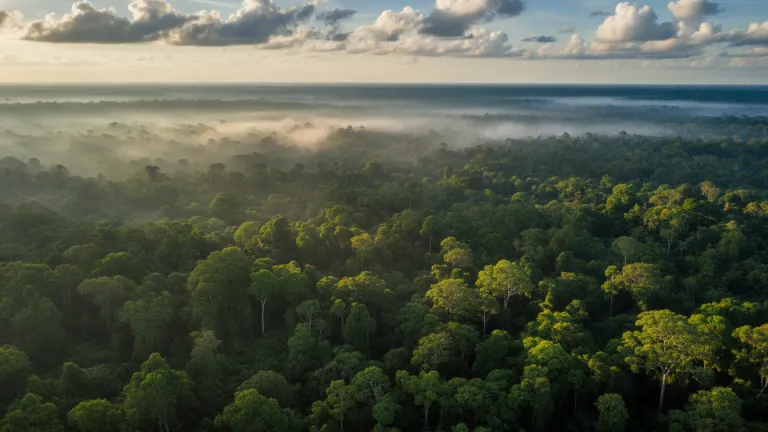
The Amazon, the world’s largest tropical forest, plays a critical role in this balance. Studies published in high-impact scientific journals, such as Nature, indicate that parts of the Amazon forest already emit more carbon than they absorb, a result of the combination of deforestation, degradation, and changes in rainfall patterns. This transformation from sink to source is one of the most concerning scenarios for the global climate.
To better understand this impact, read What Amazon Deforestation Does to the Planet.
The Consequences of the Enhanced Greenhouse Effect in Daily Life
Global warming is not a future abstraction. Its effects are already manifesting in concrete and growing ways:
- Increased frequency of extreme events: floods, droughts, cyclones, and heat waves have become more intense and frequent in various regions of the planet.
- Changes in rainfall patterns: directly affecting agriculture, water supply, and hydroelectric power generation — a sector still dominant in Brazil’s electrical grid, according to ANEEL data.
- Rising sea levels: caused by thermal expansion of oceans and melting glaciers and polar ice caps, threatening coastal communities.
- Impact on biodiversity: species that cannot adapt to the speed of changes face extinction risk. The IUCN (International Union for Conservation of Nature) lists climate change among the main threats to global biodiversity.
- Food security: climate changes affect agricultural productivity, water availability for irrigation, and pest and disease cycles in crops — a direct concern for a country with Brazil’s agricultural relevance, a topic that Embrapa closely monitors in its research on agricultural adaptation to climate change.
What Each Person Can Do to Reduce Their Contribution
Here’s the good news: individual actions combined create real collective impact. It’s not about blaming consumers and absolving large industries — responsibility is shared. But there are practical steps you can start today:
Actions in consumption and at home
- Reduce red meat consumption, especially beef. Cattle ranching is one of the largest sources of methane in Brazil and worldwide.
- Reduce food waste: food thrown away represents emissions that occurred throughout the entire production chain without any benefit. See tips at How to Reduce Food Waste in Daily Life.
- Prefer products with lower carbon footprints: local and seasonal foods generally emit less CO₂ in transportation and storage.
- Consume fashion more consciously: the textile industry is one of the most polluting in the world, with high water consumption and GHG emissions in its production chain.
- Use public transportation, bicycles, or walk whenever possible; individual transportation powered by fossil fuels is one of the largest sources of CO₂ in cities.
- Reduce electricity consumption at home: turn off devices on standby, use LED bulbs, and if possible, consider renewable sources like solar photovoltaic energy.
- Reuse and recycle: producing new materials from virgin raw materials consumes much more energy than reprocessing.
Actions with broader reach
- Participate in and support environmental organizations locally and nationally.
- Demand ambitious climate policies from political representatives that are consistent with Brazil’s commitments under the Paris Agreement.
- Educate and share: talking about the topic with family and friends multiplies the impact of environmental awareness.
Why Climate Science Deserves Trust
In an environment of information abundance, it’s natural for doubt to arise: “But is the greenhouse effect really that serious?” The answer lies in scientific consensus — one of the most robust in the history of modern science.
Studies analyzing published scientific literature on the topic consistently find that the vast majority of climate scientists agree that recent global warming is real and primarily caused by human action. The IPCC doesn’t conduct its own research but synthesizes and evaluates thousands of peer-reviewed scientific studies published worldwide. Its conclusions are, therefore, conservative by nature — representing what is most solid and verified.
Distrusting climate science based on sources without serious scientific review is a risk the planet can no longer afford to take.
Conclusion: Understanding Is the First Step to Action
The greenhouse effect is not a villain created by science fiction. It’s a real phenomenon, well understood by science, and being altered at an accelerated pace by human action. Understanding how it works means no longer seeing climate as something abstract and starting to recognize it as part of every decision we make — at the supermarket, at work, at the ballot box.
The transition to a low-carbon lifestyle doesn’t require immediate perfection. It requires direction. Every small, more conscious choice, multiplied by millions of people, has the power to tip the scales. And Brazil, with its enormous biodiversity, its potential in renewable energy, and its tradition in sustainable agricultural research, has a special role — and responsibility — in this story.
Start with what’s within your reach now. Stay informed, reduce where you can, and share what you’ve learned. The planet thanks you.
