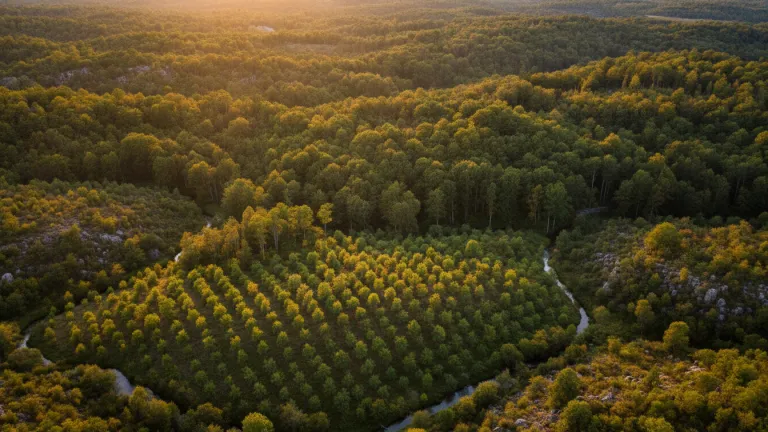
Reforestation: What It Is and Why It Saves Lives
Imagine waking up one day and realizing the air has become harder to breathe, the rains have stopped arriving on time, and the rivers have shrunk. This scenario isn’t science fiction — it’s the reality that entire communities already face in regions where deforestation has advanced unchecked. But there is a powerful and proven response to reverse part of this process: reforestation.
Reforestation is, in essence, the act of replanting trees in areas that have been deforested or degraded. It sounds simple, and in a way it is — but the effects it has on climate, biodiversity, water resources, and even human health are profound and documented by science. It’s no exaggeration to say that planting trees, on a large scale and with intelligence, can literally save lives.
In this article, we’ll explore what reforestation really is, how it works, why it’s so urgent, and — most importantly — what you can do to be part of this solution. Because yes, anyone can take action.
What Reforestation Is (and What It Isn’t)
Reforestation is the recovery of forest cover in areas that once had native vegetation and lost it due to human action, whether through deforestation for agriculture and livestock, timber extraction, wildfires, or unplanned urban expansion.
It’s important to distinguish reforestation from two related concepts:
- Afforestation: planting trees in areas that were never forested, such as open fields or deserts.
- Forest monoculture: planting a single tree species (such as eucalyptus or pine) for commercial purposes. Although it captures carbon, it does not restore biodiversity the way reforestation with native species does.
Ecological reforestation, based on native species adapted to the local biome, goes far beyond “planting trees.” It recreates complex ecosystems, with diversity of fauna and flora, soil recovery, and hydrological cycles. This is the version that science recognizes as truly capable of saving lives.
Why Forests Are Essential for Human Life
Forests are not just “the lungs of the planet” — that metaphor, although popular, is incomplete. Forests are, in practice, vital infrastructure for human survival. Here’s why:
Climate regulation and protection against extremes
Dense forests regulate local and regional climate. In Brazil, the Amazon Rainforest is responsible for a phenomenon called flying rivers: the evapotranspiration of trees generates clouds laden with water vapor that move across the entire continent, supplying rainfall to regions as distant as the Río de la Plata in the south. When the forest is cut down, these rains decrease — and with them, agricultural production and water supply.
Protection of watersheds and water resources
Native vegetation around rivers, streams, and springs is called riparian forest, and its function is essential: it holds the soil, filters rainwater before it reaches waterways, and keeps riverbeds stable. Without riparian forest, erosion, siltation, and contamination of water sources occur — which directly affects water supply to cities.
Carbon absorption and combating global warming
Tropical forests are one of the largest natural carbon stocks on the planet. When cut down and burned, they release all that carbon accumulated over decades into the atmosphere, intensifying global warming. Reforestation reverses part of this process by capturing CO₂ from the atmosphere and storing it in plant biomass and soil.
Protection of biodiversity and ecosystem balance
Loss of forest habitat is one of the main causes of species extinction. Intact forests maintain pollinators like bees and butterflies, which are fundamental for agriculture. They also maintain natural predators that control pests. The destruction of this balance has direct consequences on food production and the health of the ecosystems that sustain us.
The Current State of Forests in Brazil and Worldwide
Brazil is home to about 60% of the Amazon Rainforest, the largest tropical biome on the planet. Despite advances in public policies in recent years, the accumulated deforestation over the past decades still represents an enormous environmental debt to be repaired.
The Cerrado, Brazil’s second-largest biome, has already lost more than half of its original vegetation cover — a silent crisis that directly affects water availability in much of the country, as this biome is the cradle of major river basins.
Globally, the Intergovernmental Panel on Climate Change (IPCC) points to land use, including deforestation, as one of the main sources of greenhouse gas emissions. At the same time, the same IPCC recognizes forest restoration as one of the nature-based solutions with the greatest potential for climate mitigation in the coming decades.
The good news: reforestation has gained global traction. Initiatives like Carbon Neutrality drive investments in forest restoration as a corporate and governmental strategy. Brazil, with its legislation — the Forest Code of 2012 — already provides legal obligations for landowners to restore degraded areas.
How Reforestation Is Done in Practice
The reforestation process is not simply “going out and planting seedlings.” When done properly, it follows important technical steps:
- Area diagnosis: Identification of the original biome, land use history, current terrain conditions, and present fauna.
- Species selection: Selection of native species from the local biome, preferably with a diversity of pioneer species (fast growth) and non-pioneer species (slow growth, dense wood), to create a functional ecological canopy.
- Seedling production: Done in nurseries, often with seeds collected from the region itself to preserve local genetics.
- Soil preparation: Control of invasive species that compete with native seedlings and, in some cases, correction of degraded soil.
- Planting: Preferably carried out at the beginning of the rainy season to ensure seedling establishment.
- Monitoring and maintenance: Tracking growth, replanting seedlings that didn’t take, and controlling invasive species for at least two to three years after planting.
- Assisted natural regeneration: In many cases, the most efficient and cheapest technique is simply protecting the area and allowing nature to regenerate on its own, with minimal human intervention.
What You Can Do: Practical Reforestation Actions
You don’t need to own a farm to contribute to reforestation. There are concrete and accessible ways to participate — from the countryside to the apartment:
- Adopt a seedling or tree through NGOs and projects like Instituto Refloresta, SOS Mata Atlântica, Fundação Grupo Boticário, and others that allow donations for planting native seedlings in specific areas.
- Participate in planting events organized by city halls, environmental collectives, and civil society organizations — many cities promote these events especially during the rainy season.
- Consume products with sustainable origin certification, prioritizing brands that invest in real and audited forest compensation.
- Advocate for public policies by signing petitions, voting for candidates with environmental agendas, and monitoring the implementation of the Forest Code.
- Plant at home or in your neighborhood: even pots with native species attract pollinators and contribute to urban micro-ecosystems. Some cities have programs that donate native seedlings for free.
- Avoid products linked to illegal deforestation: meat, soy, and uncertified timber are still associated with forest destruction in some regions.
- Educate those around you: talking about the topic at home, at school, or at work multiplies the impact. Also check out how to teach sustainability to children at home.
Reforestation and Biodiversity: The Connection That Saves Species
An often underestimated aspect of reforestation is its direct role in protecting animals. Threatened species depend on ecological corridors — strips of vegetation that connect isolated forest fragments — to move, reproduce, and find food.
Reforestation of strategic areas can reconnect these fragments and give a new chance to species on the brink of extinction. In Brazil, animals such as the jaguar, golden lion tamarin, and maned wolf depend directly on the integrity and expansion of their forest habitats. To learn more about the situation of threatened species in the country, see our article on endangered animals in Brazil in 2026.
Biodiversity, in turn, makes reforestation itself more effective: diverse forests are more resilient to pests, fires, and climate change than uniform plantations.
Conclusion: The Forest Starts with You
Reforestation is not ecological romanticism. It is a proven technology, based on ecology, that humanity has at its disposal right now to face interconnected crises: climate, water, food, and biodiversity. And unlike many environmental solutions that depend exclusively on governments and large corporations, this is one that allows genuine participation from anyone.
Every seedling planted, every donation made, every conscious consumption choice, and every conversation you start about the topic contributes to a movement that is literally rebuilding ecosystems. Forests don’t come back overnight — but they do come back. And when they return, they bring water, air, life, and future.
The planet doesn’t need perfect heroes. It needs many people making imperfect yet consistent choices in the right direction. Start today. One tree at a time.
