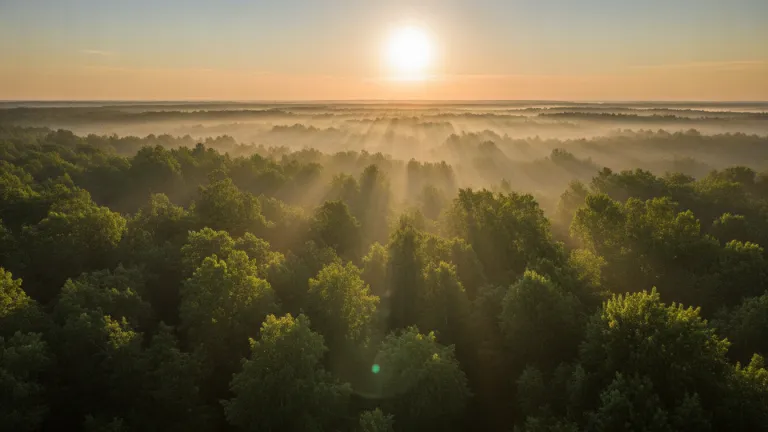
Imagine waking up in a car parked in the summer sun. Even with the windows closed, the heat inside is much more intense than the air outside. Now expand that image to a planetary scale: the entire Earth is wrapped by an invisible layer of gases that works similarly to the glass of that car. This is, in essence, the greenhouse effect — a natural phenomenon without which life as we know it simply would not exist.
The problem is not the greenhouse effect itself. Without it, the average temperature of the Earth’s surface would be approximately -18°C, according to IPCC (Intergovernmental Panel on Climate Change) estimates, making the planet uninhabitable for the vast majority of living beings. What concerns scientists, governments, and civil society is the artificial intensification of this phenomenon caused by human activities since the Industrial Revolution, which has been raising the concentration of greenhouse gases (GHGs) in the atmosphere to levels unprecedented in the last 800,000 years.
Understanding how the greenhouse effect works in practice — and what each of us can do about it — is the first step toward moving past paralysis and acting intelligently. In the following lines, you will find science explained clearly, the most recent available data, and concrete actions that fit into your routine.
What Is the Greenhouse Effect: The Science Behind the Phenomenon
The Sun emits energy mainly in the form of short-wave radiation (visible light and ultraviolet). This radiation passes through the atmosphere with relative ease and heats the Earth’s surface. The surface, in turn, re-emits this energy in the form of infrared radiation — longer and slower waves.
This is where greenhouse gases come in. Unlike nitrogen (N₂) and oxygen (O₂), which make up about 99% of the atmosphere and are practically transparent to infrared radiation, some gases absorb this radiation and re-emit it in all directions — including back toward the surface. The result is additional warming of the lower atmosphere and the Earth’s surface.
This mechanism was first described by Irish physicist John Tyndall in 1859, and its scientific understanding has only deepened throughout the 20th century. Today, it is one of the most studied and verified phenomena in climate science.
What Are the Main Greenhouse Gases
Not all greenhouse gases have the same warming power. Each has distinct characteristics in terms of concentration, atmospheric lifetime, and heat-trapping capacity.
| Gas | Symbol | Main Source | Global Warming Potential (100 years vs. CO₂) |
|---|---|---|---|
| Carbon dioxide | CO₂ | Burning fossil fuels, deforestation | 1 (reference) |
| Methane | CH₄ | Livestock, landfills, natural gas extraction | ~28 to 34 |
| Nitrous oxide | N₂O | Nitrogen fertilizers, biomass burning | ~265 to 298 |
| Water vapor | H₂O | Natural evaporation (amplifier) | Variable |
| HFCs (hydrofluorocarbons) | — | Refrigeration, air conditioning | Thousands |
CO₂ is the most abundant of human-caused GHGs and therefore serves as the reference. Methane, although present in lower concentrations, is dozens of times more potent in the short term — making livestock and landfills sources of growing concern, including in Brazil.
How the Imbalance Happens: From Nature to Human Activity
The natural greenhouse effect kept Earth’s climate relatively stable for millennia. The imbalance begins when the concentration of these gases increases beyond what natural cycles can absorb.
Before the Industrial Revolution, the concentration of CO₂ in the atmosphere was around 280 parts per million (ppm). In 2024, the Mauna Loa Observatory in Hawaii — the global reference for these measurements — recorded average annual concentrations above 420 ppm, the highest level in at least 800,000 years, according to NOAA (National Oceanic and Atmospheric Administration) data.
In Brazil, the scenario has important particularities:
- Deforestation, especially in the Amazon and Cerrado, is one of the main national sources of GHG emissions, as it releases carbon stored in trees and soil.
- Agriculture and livestock account for a significant share of Brazilian emissions, especially via methane from cattle and nitrous oxide from fertilizers.
- The electricity sector, on the other hand, has one of the cleanest energy matrices in the world, with large participation from hydroelectric, wind, and solar power — a relevant advantage compared to countries more dependent on coal and gas.
What Happens When the Greenhouse Effect Intensifies
The consequences of climate imbalance are not abstract. They already manifest in events that make headlines and affect people’s daily lives.
The IPCC Synthesis Report of 2023 (the most recent complete assessment panel available) indicates that the global average temperature has already increased by approximately 1.1°C to 1.2°C compared to the pre-industrial era. This warming, seemingly small, has cascading effects:
- More frequent and intense extreme weather events: droughts, floods, cyclones, and heat waves.
- Melting of glaciers and polar ice caps, contributing to sea level rise.
- Changes in rainfall patterns, affecting agriculture, water reservoirs, and ecosystems.
- Coral bleaching, as repeatedly observed in Australia’s Great Barrier Reef and also in Brazilian reefs.
- Population displacement in coastal regions and areas subject to prolonged droughts.
The IPCC warns that limiting warming to 1.5°C compared to the pre-industrial period requires rapid, deep, and sustained reductions in global GHG emissions across all sectors of the economy.
Brazil’s Role in Global Emissions
Brazil holds a unique position in global climate discussions. On one hand, it has one of the largest reserves of biodiversity and carbon in the world — the Amazon alone stores immense amounts of carbon. On the other hand, deforestation has historically placed the country among the largest global emitters when land-use changes are accounted for.
According to the Greenhouse Gas Emissions and Removals Estimation System (SEEG), linked to the Climate Observatory, Brazil’s gross emissions fluctuate significantly according to deforestation rates — which shows that curbing deforestation is the most powerful climate action available to Brazil in the short term.
The good news is that Brazil has made commitments under the Paris Agreement and has presented targets in its Nationally Determined Contribution (NDC). The effective implementation of these targets is being monitored by researchers, NGOs, and civil society in increasingly detailed ways.
What You Can Do: Practical Actions Against the Greenhouse Effect
Understanding the problem is essential, but transformation happens in practice. The good news is that reducing your contribution to the greenhouse effect doesn’t require you to change everything overnight. Small consistent actions, added together, make a real difference.
Changes in energy consumption:
- Prefer renewable energy sources — if your utility offers a clean energy option, consider switching. Understanding whether solar energy is worth it in Brazil can be a good starting point.
- Reduce electricity consumption at home: turn off devices on standby, use LED bulbs, take advantage of natural light.
- Prefer public transportation, cycling, or walking when possible. For long trips, trains and buses have a significantly lower carbon footprint than planes.
Changes in diet:
- Reduce red meat consumption — cattle ranching is one of the main sources of methane.
- Prefer local and seasonal foods, reducing transportation involved.
- Reduce food waste: food thrown away in landfills generates methane.
Changes in general consumption:
- Buy less and choose durable products.
- Donate or repair before discarding.
- Avoid single-use plastics — a choice that also helps the oceans, major climate regulators.
Engagement and collective pressure:
- Talk about the topic with friends and family — cultural change is as important as technological change.
- Support candidates and policies that take the climate agenda seriously.
- Pressure companies for transparency in emissions and concrete decarbonization goals.
To deepen your conscious consumption journey, it’s also worth exploring simple attitudes that protect the environment and applying these choices in your daily life.
Conclusion: Science, Responsibility, and Hope

The greenhouse effect is not a villain — it’s a natural process that enabled the existence of life on Earth. The challenge we face in 2026 is to recalibrate what we have unbalanced: bringing GHG concentrations back to levels that allow climate stability for future generations.
The science is clear about the diagnosis. Solutions exist — in technology, in public policy, and in individual choices. What is often missing is the connection between understanding the phenomenon and taking concrete action in daily life.
You just took an important step by understanding how the greenhouse effect really works. The next step is to choose one of the actions from the list above and start today. It doesn’t need to be perfect — it needs to be consistent. Every ton of CO₂ not emitted matters, and every person who acts consciously inspires others around them.
The planet doesn’t need perfect heroes. It needs many ordinary people making slightly better choices, every day.
