What Is the Greenhouse Effect and Why It Changes Everything About Climate
Imagine an invisible blanket wrapped around the Earth. It lets sunlight in, warms the planet’s surface, and traps part of that heat before it escapes into space. This is, in essence, the greenhouse effect — a natural process, fundamental and, to a certain extent, completely necessary for life as we know it. Without it, Earth’s average temperature would be approximately -18°C, making the planet uninhabitable for most living organisms.
The problem isn’t the greenhouse effect itself. The problem is what we’re doing to it. Since the Industrial Revolution, the concentration of greenhouse gases (GHGs) in the atmosphere has been growing at an accelerated pace due to human activities — burning fossil fuels, deforestation, intensive agriculture, and industry. This excess is intensifying the “blanket,” trapping more heat than the climate system can balance.
Understanding the greenhouse effect isn’t an academic exercise: it’s the first step toward comprehending why summers are hotter, rainfall more extreme, and sea levels continue to rise. And more importantly, it’s the starting point for action. In this article, we’ll explain the greenhouse effect mechanism clearly, show how it affects global and regional climate, and present concrete actions you can take today.
The Greenhouse Effect Mechanism: How It Works in Practice
The energy that reaches Earth comes from the sun primarily in the form of visible light. Part of this energy is reflected by clouds and Earth’s surface back into space. The remainder is absorbed by the soil, oceans, and vegetation, which then radiate this energy as heat (infrared radiation).
This is where greenhouse gases come in. Molecules like carbon dioxide (CO₂), methane (CH₄), nitrous oxide (N₂O), and water vapor have a special property: they absorb the infrared radiation emitted by Earth’s surface and re-emit it in all directions — including back toward Earth. This process is what keeps the planet warm.
Water vapor is the most abundant GHG in the atmosphere, but its level is naturally regulated by the water cycle. CO₂, although less concentrated, plays a crucial role because its amount in the atmosphere is strongly influenced by human activities and because it remains in the atmosphere for hundreds of years. Methane is even more potent: according to the IPCC (Intergovernmental Panel on Climate Change), CH₄ has a global warming potential about 80 times greater than CO₂ over a 20-year horizon.
The Main Greenhouse Gases and Their Sources
Knowing where GHGs come from helps understand where solutions need to act. Here are the main ones:
| Gas | Symbol | Main Human Source | Time in Atmosphere |
|---|---|---|---|
| Carbon dioxide | CO₂ | Burning coal, oil and gas; deforestation | Hundreds of years |
| Methane | CH₄ | Livestock, landfills, oil and gas extraction | ~12 years |
| Nitrous oxide | N₂O | Agricultural fertilizers, biomass burning | ~120 years |
| HFCs (hydrofluorocarbons) | HFCs | Refrigeration, air conditioning | Variable |
In many tropical countries, including major agricultural nations, the scenario has an important peculiarity: unlike most developed countries where fossil fuel burning is the main emission source, deforestation and agriculture historically account for the largest share of emissions, according to various greenhouse gas emission monitoring systems.
How the Intensified Greenhouse Effect Affects Global Climate
When GHG concentration increases, more heat is retained. The direct result is global warming — and this warming triggers a series of cascading effects on the climate system.
According to the IPCC’s 6th Assessment Report, published between 2021 and 2023, the global average temperature has already increased by approximately 1.1°C compared to pre-industrial levels. This number may seem small, but it represents an enormous amount of additional energy in the climate system, with visible consequences:
- Melting of glaciers and polar ice caps, contributing to sea level rise
- Increase in frequency and intensity of extreme weather events, such as heat waves, prolonged droughts, and torrential rains
- Ocean acidification, caused by absorption of excess CO₂, threatening corals and marine organisms
- Shifting climate zones, affecting ecosystems, agriculture, and biodiversity
- Water stress in regions that depend on seasonal snowmelt for water supply
Warming also creates concerning feedback loops. The melting of permafrost (frozen soil in Arctic regions), for example, releases methane stored for millennia, which further intensifies warming — a cycle that’s difficult to reverse.
Regional Impacts: From Rainforests to Arid Zones
Countries around the world, despite being megadiverse and of enormous global environmental importance, are already feeling the effects of warming quite concretely.
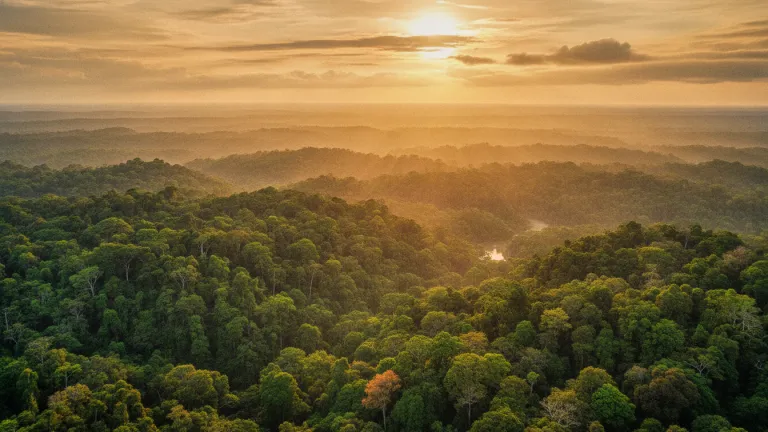
In tropical rainforests, the combination of deforestation and climate change is beginning to pressure what scientists call the “tipping point” — beyond which parts of these biomes may convert to savanna, losing their ability to recycle rainfall to continental interiors. Researchers from various scientific institutions have been documenting concerning signs in this direction.
In savannas and semi-arid regions, longer droughts and higher temperatures compromise agricultural production and water supply for millions of people. The so-called “flying rivers” — which transport moisture from rainforests to other regions — are also affected when forest cover is lost.
In cities, the greenhouse effect combines with urban heat islands to create even more intense heat waves, putting at risk especially the elderly, children, and outdoor workers.
On coastlines, rising sea levels and more frequent storms threaten coastal communities, port infrastructure, and ecosystems like mangroves — which, ironically, are important carbon sinks.
What You Can Do: Practical Actions to Reduce Your Contribution
Understanding the problem is essential, but action is what transforms understanding into real change. Fortunately, there are many ways to reduce your contribution to the intensified greenhouse effect — and many of them also save money.
In transportation:
- Prefer public transit, cycling, or walking whenever possible
- If you have a car, avoid sudden acceleration and keep tires properly inflated — this reduces fuel consumption
- Consider carpooling for frequent trips
In food:
- Reduce beef consumption, especially from pasture-raised cattle — livestock is one of the largest sources of methane
- Value local and seasonal foods, which require less transportation and refrigerated storage
- Reduce food waste: a large portion of what is produced ends up in landfills, generating methane
At home:
- Choose appliances with good energy efficiency ratings
- Turn off lights and unplug devices on standby — the “energy vampire” consumes power without you noticing
- Consider solar water heating, an accessible and very efficient technology in sunny climates
In general consumption:
- Buy less and choose durable products
- Prefer companies with verified sustainable practices
- Reuse, repair, and donate before discarding
You can also take a step further and calculate your carbon footprint and find ways to reduce it — a valuable tool to understand exactly where your personal emissions are concentrated and where you can act with the greatest impact.
The Role of Forests and Nature in Climate Balance
We can’t talk about the greenhouse effect without talking about forests. Trees are natural carbon sinks: they absorb CO₂ during photosynthesis and store it in their biomass and in the soil. Tropical rainforests alone store enormous amounts of carbon accumulated over thousands of years — and release part of that carbon when they are deforested or burned.
But forests don’t function alone. The ecosystems that sustain them depend on pollinators, decomposers, seed-dispersing birds, and an infinity of interactions. That’s why protecting biodiversity is also a climate strategy. In fact, if you want to better understand how each species makes a difference in this balance, it’s worth reading about why bees are essential for planetary balance.
Nature-based solutions — such as reforestation, mangrove restoration, and protection of native grasslands — are recognized by the IPCC as fundamental strategies for climate mitigation and adaptation, often with better cost-benefit ratios than technological solutions.
Conclusion: Understanding Is the First Step, Acting Is the Next
The greenhouse effect isn’t a villain: it’s a natural phenomenon without which life on Earth wouldn’t exist. What needs to change is the rate at which we’re injecting greenhouse gases into the atmosphere, unbalancing a system that took billions of years to stabilize.
The good news is that we have the tools, the knowledge, and — increasingly — the collective will to do things differently. Governments, businesses, and individuals have complementary roles in this transition. Public policies and regulations are irreplaceable, but everyday choices also build — or undermine — emission patterns.
Every meal with less meat, every bike commute, every durable product bought instead of a disposable one is a vote for the kind of planet we want to leave behind. These gestures, combined with pressure for ambitious climate policies and support for environmental restoration initiatives, form the response the moment demands.
The climate is changing. But the direction of that change still depends, in part, on what each of us decides to do today.
