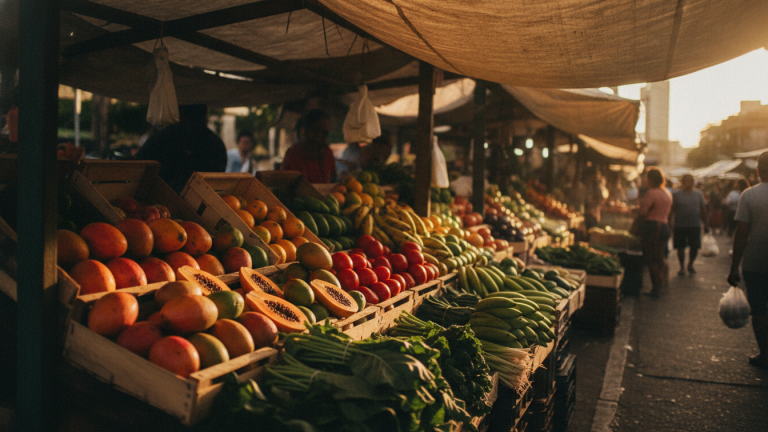
Ever been surprised by strawberry prices in July at the farmer’s market? Or found tomatoes absurdly expensive one week and cheap the next without understanding why? The answer almost always lies in the calendar. When a food is at the right harvest time, supply increases, prices fall, and the product reaches you fresher. When it’s not, it travels hundreds or thousands of kilometers from other regions or countries, raising costs and increasing polluting gas emissions from transport.
What few people know is that this simple choice in the farmers market line has a real impact on the planet. Production and transport of out-of-season foods consume more energy, more water, and more packaging. According to the United Nations Food and Agriculture Organization (FAO), food systems are responsible for about a third of global greenhouse gas emissions. Choosing what’s in season doesn’t solve everything, but it’s a concrete piece of this puzzle.
By the end of this text, you’ll know which foods to buy at each time of year in Brazil, how to build a more economical and sustainable shopping list, and why this change in habit makes a real difference without needing to spend more or become an agriculture expert.
Why seasonality matters beyond price
When a food is in its natural production season, it was cultivated in the climatic conditions that most favor that plant: right temperature, rainfall, and sunlight. The result is a product with more flavor, more nutrients, and less need for chemical intervention to ripen or preserve.
Foods grown out of season often receive more pesticides to compensate for adverse conditions and more post-harvest treatments to reach the market in good condition. Embrapa, Brazil’s public agricultural research company, documents that proper management within the harvest window reduces the need for external inputs and favors the nutritional quality of the product.
There’s also the logistics side. A tomato produced in the interior of São Paulo during harvest travels few kilometers to your city’s farmers market. The same tomato bought out of season may have come from another region, with additional hours in a refrigerated truck, consuming fossil fuel at each kilometer. Multiplied by millions of families making the same purchase, the impact accumulates.
Brazil’s harvest calendar: what to buy at each time
Brazil has a huge advantage: thanks to the tropical climate and territorial extension, there’s almost always something in season somewhere in the country. The challenge is knowing what. Below, a practical guide by time of year, considering the main producing states.
January to March (summer)
- Mango, watermelon, pineapple, melon, and passion fruit are in full harvest
- Tomato, cucumber, zucchini, and okra are easy to find and cheap
- Fresh corn appears in abundance at farmers markets
April to June (autumn) July to September (winter)
- Orange, tangerine, and lemon enter in force, especially in São Paulo and Minas Gerais
- Kale, broccoli, cauliflower, and cabbage become cheaper and more flavorful with the cold
- Carrot, beet, and sweet potato are in good shape
October to December (spring)
- Strawberry begins harvest in states of the South and in São Paulo
- Peach, nectarine, and plum appear on the stands
- Bell pepper, eggplant, and gherkin prices drop again
This division is a general reference. The calendar varies by region: the North and Northeast have their own dynamics, with fruits like caja, umbu, and cupuaçu in specific periods. Talk to the farmer in your city. They usually know exactly what’s in season and where it came from.
How to build a routine of seasonal shopping
Changing your shopping habit doesn’t require complex planning. It just requires a little attention at the right time.
- Visit the farmers market before deciding on the week’s menu. The inverse logic, planning the menu and then shopping, often leads to seeking ingredients that aren’t in season. At the market, you see what’s abundant and cheap, and from there you decide what to cook.
- Observe price as a signal. When a vegetable or fruit is visibly cheaper than normal, it’s almost always because it’s in harvest. Use this criterion as a practical guide.
- Write down what you bought and in what month. After two or three months doing this, you start building your own personalized calendar for your region.
- Talk to the farmer. Asking “what’s coming in well this week?” is the fastest way to find out what’s in season without needing to consult any table.
- Adapt recipes to what you found. Substituting spinach for kale or swapping mango for watermelon doesn’t ruin any dish. Over time, you develop culinary flexibility almost automatically.
The connection with food waste in Brazil
Brazil wastes an enormous amount of food throughout the entire chain, from production to table. The IBGE and other research bodies document significant losses before the product even reaches the consumer. Out-of-season foods are particularly vulnerable to this problem: they arrive with less shelf life, ripen unevenly, and are more sensitive to transport.
When you buy what’s in harvest, the product has more useful life in your refrigerator. This means less disposal at home, less organic waste going to landfills, and according to data from Abrelpe (Brazilian Association of Public Cleaning and Special Waste Companies), organic waste represents the largest fraction of Brazilian household trash. Reducing this volume starts with shopping choices.
A complementary alternative is composting inevitable scraps. If you live in an apartment, home vermicomposting is a practical and odorless option. See how to set up yours in Home Vermicomposting: How to Build from Scratch Without Mistakes.
Seasonal eating and water use
Producing foods out of season often requires more intense artificial irrigation, as natural rainfall conditions don’t favor that crop in that period. This puts pressure on water resources already facing serious challenges in various regions of Brazil.
Water scarcity in Brazil is a real problem, especially in the Northeast and metropolitan regions that depend on increasingly pressured supply systems. Choosing harvest season foods, which grow with the season’s natural rainfall, is an indirect way to contribute to more rational water use in the field.
Embrapa documents that crops planted outside the ideal calendar usually require more frequent supplemental irrigation, which increases water consumption and energy to pump and distribute that water. The chain is longer than it seems.
Common mistakes for those wanting to eat more sustainably
Thinking organic products are always more sustainable than conventional ones. An organic food from the other side of the country, out of season, can have a larger carbon footprint than a conventional product grown near you in harvest. Origin and seasonality also count.
Ignoring local farmers markets and relying only on supermarkets. Large retail chains work with regionalized inventories and long supply chains. The neighborhood farmers market, especially those bringing producers from nearby cities, tends to offer fresher products more aligned with local harvest.
Giving up when you can’t find your favorite ingredient. Seasonal eating logic asks for flexibility. If eggplant disappeared from the stands and got expensive, it’s because it’s not the best time. Take advantage of what’s cheap and abundant.
Buying more than you’ll consume because the price was good. Harvest means low prices, but buying in excess and wasting zeros out the environmental gain. Buy what fits your weekly consumption.
Frequently asked questions about seasonal eating
How do you know if a food is in season without researching much?
Price is the most direct indicator. When a product is visibly cheaper than usual and in large quantities on farmers market stands, it’s almost always in harvest in your region. The farmer is also a reliable source: ask without hesitation.
Are frozen foods from harvest a good option?
Yes. Freezing fruits and vegetables during harvest is a smart strategy. You take advantage of the lower price and better nutritional quality, and have the product available off-season without needing to buy it at the wrong time. Corn, peas, mango, and berries work well this way.
Are organic farmers markets from local producers more sustainable than supermarkets?
Generally, yes, especially when producers are from nearby cities and work with the natural harvest calendar. Short transport and management without synthetic pesticides reduce environmental impact. But the ideal is combining both criteria: local and seasonal.
What about those who live in a big city and don’t have easy access to farmers markets?
Many Brazilian capitals have neighborhood farmers markets organized by the city government on fixed days of the week. Additionally, collective buying groups and producer baskets delivered to homes have grown significantly in recent years. A quick search in your neighborhood usually reveals options you didn’t yet know about.
Start at your next farmers market visit
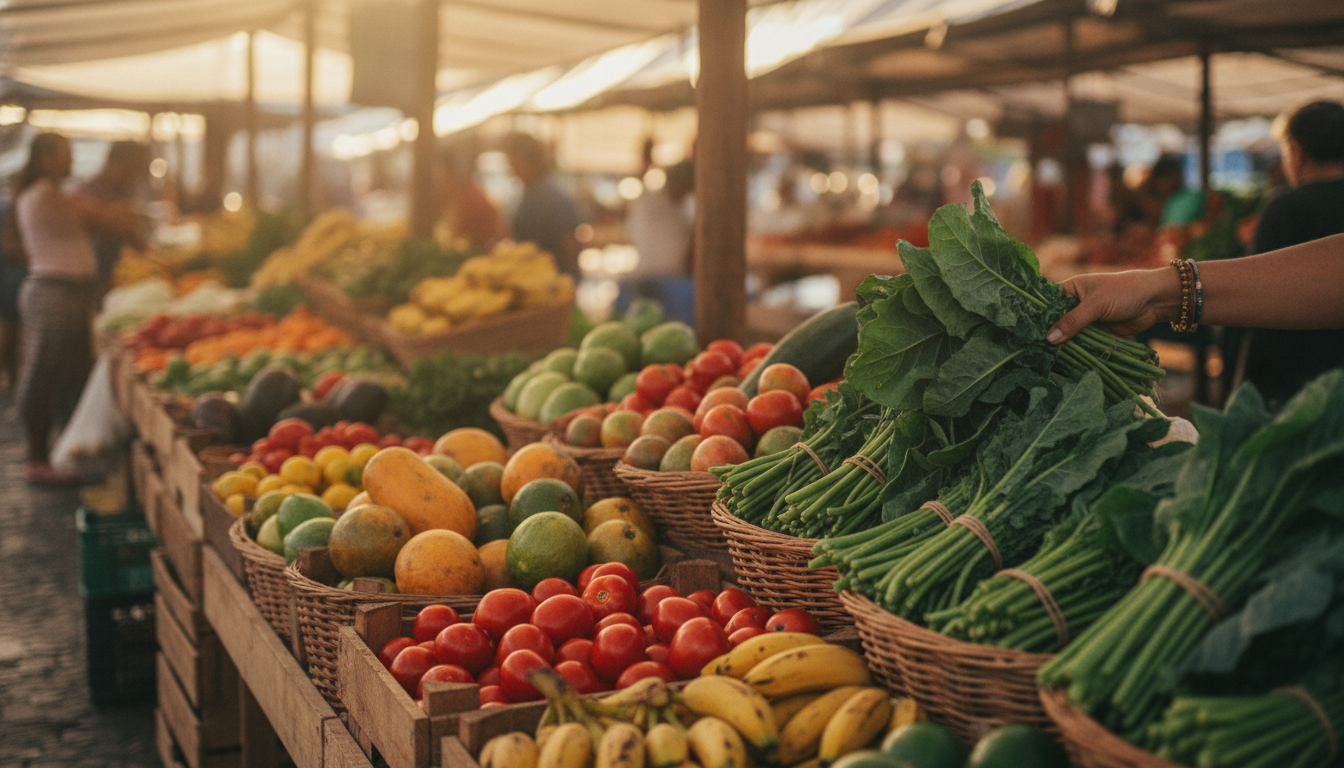
The simplest change you can make today is arrive at the farmers market without a closed list. Look at what’s cheap, ask the farmer what came in well this week, and let that guide the menu. It doesn’t need to be a radical transformation. One or two purchases made this way per month already show the difference in your wallet and on your plate.
Eating by the calendar isn’t a restriction. It’s a way to eat better, pay less, and in the bargain, ease a little the pressure that the food system places on the planet. It starts at the farmers market, but the effect goes well beyond it.
