Why the Waste Leaving Your Home Matters So Much
Have you ever stopped to think about how much trash your home produces each week? One bag, two, maybe three filled to the brim before collection day. It seems small compared to industrial scale, but the numbers reveal a different reality: Brazil generates over 80 million tons of solid waste per year, according to data from the Brazilian Association of Public Cleaning and Special Waste Companies (Abrelpe). A large portion of this volume comes from households, and much of it still ends up in landfills or, worse, open dumps.
The good news is that the equation can change — and it starts at home. Reducing household waste doesn’t require a radical transformation of your routine or high expenses. Most of the time, it’s simple habits, applied consistently, that make the difference. And the benefits go beyond the environment: less waste generated means less money spent on disposable products, a more organized kitchen, and a clearer conscience.
This article brings together concrete, accessible habits already tested by thousands of people who decided to change their relationship with consumption and disposal. None of them require perfection — just a first step.
Understand What Makes Up Your Household Waste
Before taking action, it’s worth knowing the enemy. Brazilian household waste is mostly composed of organic residues — peels, food scraps, coffee grounds — which represent more than half of the total volume generated in homes, according to studies by the Ministry of Environment. The rest includes plastics, paper, glass, metals, and non-recyclable waste.
The Biggest Household Waste Culprits
- Disposable plastic packaging: bags, containers, straws, and single-use plastic films
- Wasted food: fruits, vegetables, bread, and leftovers that go straight to the trash without being used
- Paper and cardboard: delivery boxes, processed food packaging, and office paper
- Hygiene and cleaning waste: shampoo, soap, detergent, and cleaning product containers
- Improperly discarded electronics and batteries: a growing problem with increased technology consumption
Knowing where waste comes from is the first step to cutting it at the source — which is exactly the most efficient principle of waste management.
Habit 1: Buy Less and Buy with Intention
The biggest waste generator is excessive consumption. Every product that enters your home brings packaging with it, and much of that packaging goes straight to the trash within minutes. Changing this starts before you leave for the store.
How to Shop More Consciously
- Make a list before going to the store — and stick to it. Impulse purchases lead to food and packaging waste.
- Choose products with fewer layers of packaging. Cheese sold by the slice, wrapped in wax paper, generates less waste than three stacked boxes of processed cheese.
- Buy in larger quantities when it makes sense. One large yogurt container generates less plastic than four individual cups.
- Bring reusable bags to the store — cloth, straw, or polypropylene — and always carry one in your pocket or bag for unexpected purchases.
- Prefer farmers’ markets and stores with bulk options. You take only what you need, in your own container or bag, without industrial packaging.
This shift in attitude at the time of purchase is perhaps the most powerful of all. It addresses the root of the problem.
Habit 2: Reduce Food Waste
Food waste is one of the most underestimated environmental problems. When we throw food away, we also waste all the water, energy, and labor used to produce it — and we generate methane in the landfill as it rots. The Food and Agriculture Organization of the United Nations (FAO) estimates that about one-third of all food produced in the world is lost or wasted along the supply chain.
Practical Strategies to Waste Less
- Organize your refrigerator by “first in, first out”: older items go in front, newer ones go in back.
- Use stems, peels, and leaves from fruits and vegetables in juices, broths, stir-fries, and toppings.
- Freeze what you won’t consume soon: stale bread, ripe fruits, meat about to expire — everything can be frozen before spoiling.
- Plan your weekly menu to buy exactly what you’ll use.
- Use leftovers creatively: yesterday’s rice becomes fritters, cooked vegetables become soup, stale bread becomes toast or breadcrumbs.
Reducing waste is one of the fastest and most economical ways to decrease the volume of organic waste leaving your home.
Habit 3: Start Composting at Home
For the organic residues that inevitably remain — peels, coffee grounds, tea bags — composting is the smartest answer. Instead of going to the landfill and generating greenhouse gases, this material transforms into rich fertilizer for pots, gardens, and vegetable patches.
Step-by-Step Guide to Setting Up a Simple Home Composter
- Choose your model: stacked plastic bins (worm bin method), buckets with lids, or ready-made composters sold at garden stores.
- Separate organic waste from regular trash right in the kitchen — use a small container with a lid on the counter.
- Add alternating layers: wet residues (peels, food scraps) and dry residues (dry leaves, torn cardboard, sawdust).
- Keep moisture balanced: the material should feel like a slightly damp sponge, not soaked.
- Mix the contents once a week to oxygenate.
- In a few weeks to months, depending on conditions, you’ll have ready-to-use fertilizer.
Even in apartments, worm bins are viable and practically odorless when properly managed. There are also groups on social media and local platforms that organize collaborative collection of organics for community composters.
Habit 4: Replace Disposables with Durables
Many of the items that appear most frequently in household waste have reusable alternatives available on the market — and in the medium term, they also save money.
| Disposable item | Durable alternative |
|---|---|
| Plastic bags | Cloth bags or eco-bags |
| Disposable cups | Reusable cup or personal bottle |
| Paper towels | Dish towels and cloths |
| Disposable pads | Cloth pads or menstrual cup |
| Plastic straws | Stainless steel, bamboo, or glass straw |
| Ziplock bags | Glass containers with lids |
| Synthetic dish sponge | Natural loofah |
The transition doesn’t have to happen all at once. Replace one item at a time, as the disposables you already have run out. This way you don’t throw away what still has use and don’t spend everything at once.
Habit 5: Separate Waste for Recycling — The Right Way
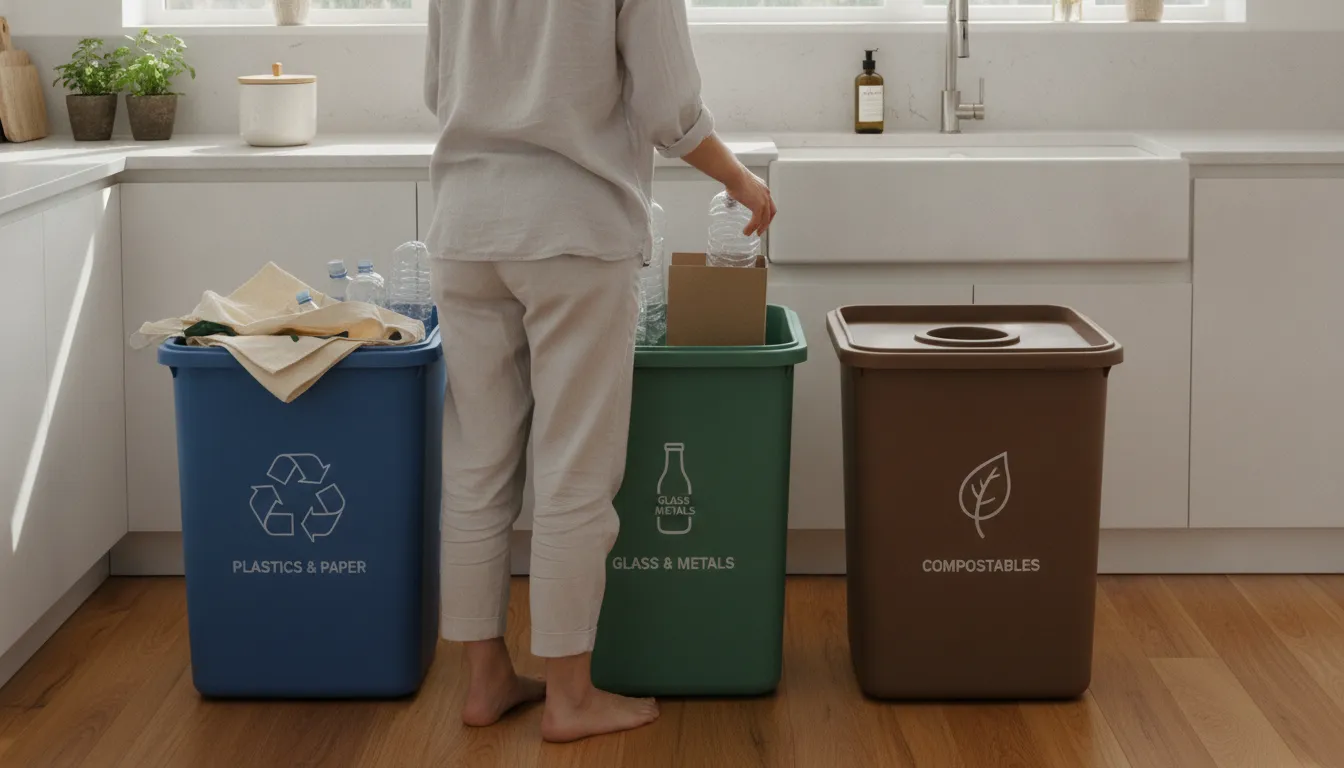
Recycling is important, but recycling incorrectly can contaminate an entire load of recyclable materials and cause it to end up in the landfill anyway. Proper separation starts with cleaning and knowledge.
What Can and Can’t Be Recycled
- Can recycle: dry and non-greasy paper, clean plastics (bottles, containers, packaging), glass, metals (aluminum and steel cans)
- Cannot recycle in regular trash: carbon paper, mirrors, diapers, toilet paper, styrofoam (depending on the city), light bulbs, batteries, and electronics
Batteries and electronics deserve special attention: they contain heavy metals and need to go to specific collection points. Learn more about how to dispose of them correctly in our guide Proper Disposal of Batteries and Electronics.
Additionally, look for recycling cooperatives in your city. Delivering directly to them ensures the material reaches the right destination and also supports workers in the sector.
Habit 6: Think Before Throwing Away
Much of what goes in the trash still has useful life. Before discarding, go through the filter of three questions:
- Can this be repaired? Torn clothes, electronics with simple defects, furniture with loose screws — many things can be recovered with little effort or cost.
- Can this be donated? Clothes that no longer fit, books already read, forgotten toys, and duplicate kitchen utensils have value to someone.
- Can this be sold or traded? Online thrift platforms and trade groups on social media make this process easier.
This habit connects directly with a broader cultural shift: moving from the logic of quick disposal to the logic of durability. To dive deeper into this issue in the fashion field — one of the sectors that generates the most waste — it’s worth reading about Sustainable Fashion: What It Is and Why You Should Care.
Small Actions, Real Results
Reducing household waste isn’t about being perfect. It’s about making slightly better choices each day — in the grocery store line, when organizing the refrigerator, when you reach for paper towels or think about throwing away an object that still works.
When many people adopt these habits at the same time, the impact multiplies. Municipalities with greater waste awareness have lower landfill volumes, more recycled material, and better urban quality of life. You are part of this equation.
Start with one habit this week. Just one. Bring the reusable bag to the store, freeze that fruit that’s getting overripe, separate paper from plastic before throwing it away. After a few weeks, add another. Behavior change works like this: gradual, consistent, and over time, natural.
If you want to go further and explore a lifestyle with minimal waste generation, our complete guide on Zero Waste in Practice: What It Is and How to Start is a great next step. The planet thanks you — and so does your wallet.
