You open the trash bag on Friday and are surprised by how much has accumulated in just seven days. Packaging, food scraps, plastics, cardboard, that empty shampoo bottle that sat in the bathtub for days. According to data from Abrelpe (Brazilian Association of Public Cleaning and Solid Waste Companies), Brazil generates more than 80 million tons of urban solid waste per year, and a significant portion of that total originates in residences. Some goes to landfills, some goes to inappropriate places, and a small portion is actually recycled.
The good news is that changing this scenario starts at home, in your kitchen, in your bathroom, in your shopping list. It doesn’t require perfection, it doesn’t require extra money, and it doesn’t require giving up comfort. What you’ll find here are concrete practices, applicable to Brazilian daily life, to reduce the trash you produce, spend less, and still keep your home more organized.
By the end of this text, you’ll know where to start, what to do with each type of waste, and how to transform small daily decisions into habits that make a real difference.
Why so much trash ends up being generated at home
The problem doesn’t start when you throw something away. It starts when you buy. Most household waste is packaging: plastic film, styrofoam, juice cartons, supermarket bags. The current consumption model was designed to generate rapid disposal, and the industry doesn’t usually communicate this transparently. If you want to better understand how companies use environmental appeals to sell more without actually changing anything, it’s worth reading about greenwashing and how to identify companies that deceive.
In Brazil, Law 12.305/2010, known as the National Solid Waste Policy (PNRS), establishes shared responsibility for the product lifecycle. This means that manufacturers, distributors, retailers, and consumers have a legal role in waste disposal. In practice, however, the burden still falls heavily on those at the end of the chain: you.
Understanding this structure helps you see that reducing trash at home is an act with impact beyond your door. Each purchasing choice, each packaging refused, each waste properly disposed of sends a signal to the market and relieves municipal collection systems, which in many cities already operate at capacity.
The starting point: diagnose your trash
Before changing anything, observe what you discard. Spend a week without modifying any habits and, at the end, look at the contents of your trash bag. Ask yourself: what appears in the largest volume? What repeats itself constantly?
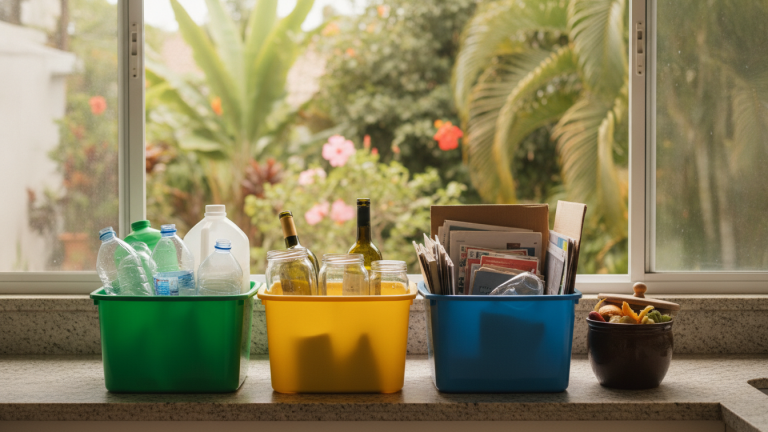
In most Brazilian homes, three categories dominate: organic waste (food scraps, peels, coffee grounds), plastic packaging, and paper/cardboard. Knowing what you generate is the first step to knowing where to act with the most impact.
This exercise seems too simple, but it’s effective. It takes the problem out of the abstract and puts it before your eyes. From there, solutions make much more sense.
How to reduce at the source: shop differently to throw away less
Reduction begins before you get home. Some changes at the time of purchase eliminate waste before it even exists.
- Bring reusable bags to the supermarket and farmers market. Many Brazilian municipalities have already charged for or restricted plastic bags, but the habit of refusing unnecessary packaging depends on you.
- Prefer products sold in bulk when possible. Cereals, nuts, grains, and seasonings at markets or emporia often have lower prices and zero packaging.
- Buy in larger sizes when it’s a product you really use. One large bottle of detergent generates less packaging per liter than two small bottles.
- Avoid single-use products: disposable cups, styrofoam plates, plastic utensils. If you receive visitors frequently, an inexpensive set of dishes pays for itself quickly.
- Plan your weekly meals before shopping. This reduces food waste, which is the largest generator of organic waste in Brazilian homes.
The logic is simple: the best trash is the trash that was never generated.
Separate to reuse: selective collection and voluntary drop-off points
Separating trash is more efficient than it seems, but it requires understanding how your city’s system works. Municipal selective collection exists in many Brazilian municipalities, but coverage and frequency vary greatly. Check with your city hall or public cleaning company whether there’s selective collection in your neighborhood and on which days it passes.
For what selective collection doesn’t cover, there are Voluntary Drop-off Points (PEVs), present in supermarkets, pharmacies, and parks in various cities. You can take batteries, used batteries, electronics, used cooking oil, light bulbs, and cleaning product packaging.
A practical detail many people forget: dirty packaging is not recyclable. Rinse yogurt containers, PET bottles, and cans before separating. You don’t need soap or scrubbing, just some water. This prevents material contamination and ensures that the effort to separate wasn’t in vain.
Composting at home: what to do with food scraps
Organic waste represents the largest share of Brazilian household trash, according to Abrelpe data. Thrown into landfills, it decomposes without oxygen and produces methane, a gas with high global warming potential, as documented by the IPCC (Intergovernmental Panel on Climate Change). Composting at home transforms this problem into a solution.
Composting in an apartment
Those who live in apartments can use a home compost bin with worms, called a worm bin. It fits under the sink, has no smell when properly managed, and produces humus, an excellent fertilizer for plants. Ready-made kits cost between R$ 100 and R$ 200 at gardening stores and online, but you can also assemble your own with reused plastic buckets.
Composting in a house with a yard
With outdoor space, you can set up a simple compost bin with wood or use a perforated plastic box. Fruit peels, coffee grounds, paper filters, vegetable scraps, and dry leaves go in. Meat, dairy, and oil stay out because they attract pests. In a few months you have fertilizer for the garden or for the plants on the balcony.
If you’re interested in going a step further and producing some of your own food, it’s worth knowing how urban farming is growing in Brazilian cities and how this connects to waste reduction.
Common mistakes that sabotage good habits
Even those who want to change make some mistakes that reduce the effect of good practices. Knowing these points prevents frustration.
- Wishful recycling: throwing into the recyclable bin everything that looks recyclable, like potato chip metal packaging, mirrors, or ceramics. These materials are not accepted by most Brazilian recycling plants.
- Mixing organic with recyclable: one food scrap contaminates an entire bag of recyclables. Always keep two separate containers.
- Saving things “to recycle someday” without knowing where to take them. If you don’t have a defined destination, the accumulation becomes trash anyway. Research your city’s PEVs before storing.
- Neglecting the bathroom: the bathroom is often overlooked in separation. Shampoo, conditioner, and toothpaste packaging can be recyclable. Dental floss and cotton swabs, no.
- Giving up because the city doesn’t collect properly: the failure of the public system doesn’t negate what you can do, but it’s legitimate to demand improvements from the city hall. Both things go hand in hand.
Real results: what you gain by reducing trash
Reducing waste is not just an environmental issue. There are practical and financial gains that appear quickly.
| What changes | Benefit perceived |
|---|---|
| Buying in bulk and without packaging | Reduced cost per kilogram of product |
| Composting organic scraps | Free fertilizer for plants and garden |
| Using reusable packaging | Less spending on disposables throughout the month |
| Planning weekly menu | Less food thrown away, smaller grocery bill |
| Properly separating recyclables | Income generation for waste pickers and cooperatives |
The house becomes more organized, the trash bag fills more slowly, and you begin to see consumption with different eyes. It’s not perfection, it’s progress.
Frequently asked questions about household waste reduction
Can I recycle glass packaging through selective collection?
It depends on your city. Many Brazilian municipalities accept glass in selective collection, but others ask you to take it to a specific PEV. Check with your local city hall. Glass is infinitely recyclable, so it’s worth the effort to dispose of it correctly.
What should I do with broken electronics and used batteries?
These items contain heavy metals and should not go into regular trash. The PNRS requires manufacturers and retailers to provide collection points for these materials. Look for a store of the product brand or a supermarket with a PEV for electronics and batteries in your city.
Does it make a difference to separate trash if collection mixes everything afterward?
Unfortunately, this happens in some municipalities where selective collection trucks still don’t operate efficiently. Even so, separating allows you to take recyclables to a PEV or a waste pickers cooperative, which depend on this material for income generation. Furthermore, demanding improvement in public services is easier when you’re already doing your part.
Doesn’t a home compost bin smell bad?
When managed correctly, it has no noticeable smell. The secret lies in the balance between wet material (food scraps) and dry material (leaves, shredded cardboard, sawdust). If smell appears, add more dry material and mix. The problem resolves in a day or two.
Start small and go far
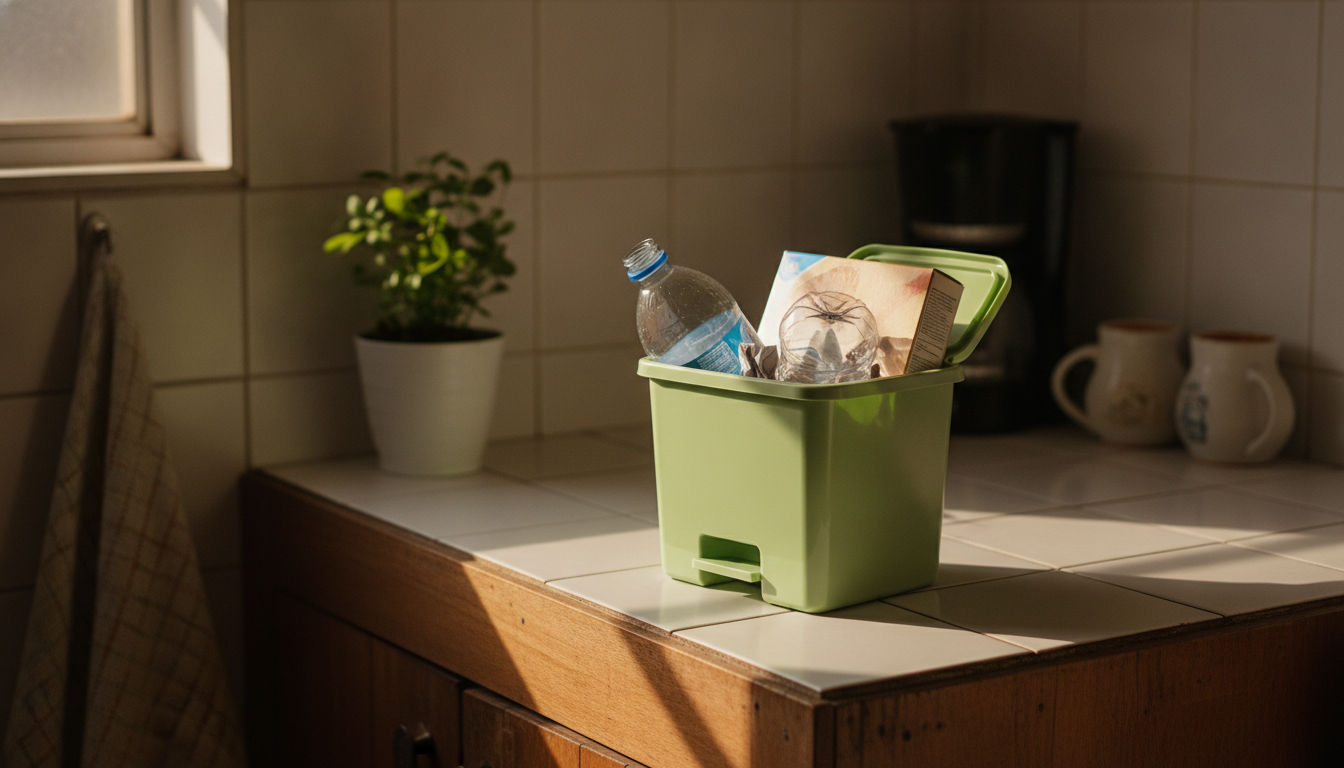
Choose one thing from this list to apply today. It could be rinsing packaging before separating, bringing a reusable bag on your next trip to the market, or researching where the nearest PEV is to your home. One change at a time creates habit, and habit transforms routine.
The trash you don’t generate is the best starting point.
