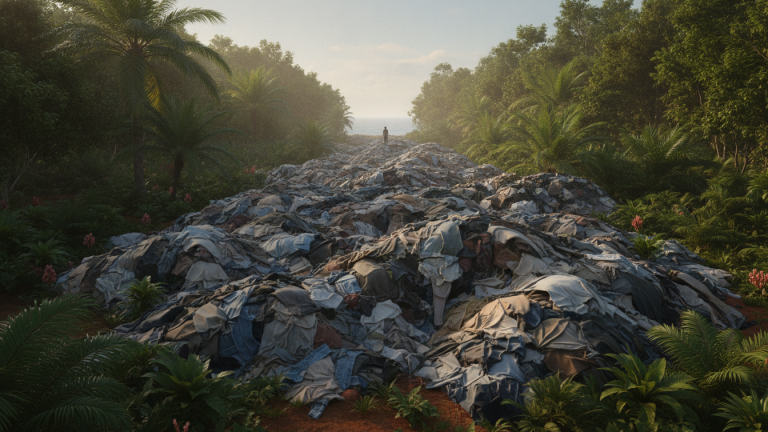
Have you ever stopped to think about what happens to the T-shirt you bought for R$ 29.90 after it ends up in the trash? In Brazil, only a very small portion of discarded clothes receives proper disposal. The rest ends up in landfills or, worse, in open dumps, releasing gases and contaminating soil for decades. The fashion industry is one of the largest consumers of water and polluters in the world, but this side of the story rarely appears on store shelves.
According to the United Nations Environment Program (UNEP), the textile sector is responsible for about 10% of global carbon emissions and consumes more energy than aviation and maritime transport combined. In Brazil, clothing consumption has grown rapidly in recent decades, driven by the fast fashion model, which encourages constant replacement of pieces at increasingly lower prices.
This article shows what happens behind the scenes of fashion, what the real environmental impacts are, and most importantly, what you can do today to consume more consciously without giving up dressing well.
What is fast fashion and why it took off so strongly in Brazil
Fast fashion is a business model that produces clothing in increasingly shorter cycles, sometimes launching new collections every two weeks. The goal is to make the consumer feel their clothes are “outdated” before they even wear out.
In Brazil, this model gained strength with the popularization of e-commerce and the arrival of Asian platforms that sell pieces at prices well below the traditional market. Who hasn’t added a blouse to their cart for less than R$ 15, with free shipping?
The problem is that this low price has a hidden cost. It’s paid by the environment, by garment factory workers, and in the medium term, by the consumer themselves, who buys more, discards more, and spends more overall.
What clothing production does to water and soil
The textile industry is one of the world’s largest consumers of fresh water. According to UNEP, producing a single pair of jeans consumes about 7,500 liters of water, equivalent to what a person drinks in seven years. This involves cotton cultivation, dyeing, and fabric finishing.
In Brazil, part of cotton production is concentrated in the Cerrado, a biome that has already lost a considerable portion of its original coverage, according to INPE data. The intensive use of pesticides in this chain is a serious problem for the region’s rivers and groundwater.
The dyes used in dyeing are another critical point. When not properly treated, they reach rivers and harm aquatic life and the quality of water that supplies cities. The textile hub in Americana, São Paulo, has been subject to investigations due to water contamination in past decades.
The clothes you discard: where do they go in Brazil
Brazil still doesn’t have a specific national policy for textile disposal. Law 12.305/2010, known as the National Solid Waste Policy (PNRS), establishes shared responsibilities among manufacturers, distributors, and consumers, but the textile chain has not yet been comprehensively regulated under this legal framework.
In practice, most of the clothes discarded by Brazilians go straight to regular trash. Data from Abrelpe shows that Brazil still faces serious challenges in managing urban solid waste, with a significant portion ending up in inappropriate places. Clothes, because they’re mixed with household garbage, rarely go through any sorting.
Some cities have collection points for used clothes in good condition, usually linked to charitable organizations or cooperatives. But worn-out clothes, torn or heavily damaged, almost never find an appropriate destination, because Brazil still has very limited industrial textile recycling capacity.
Greenwashing in fashion: when green is only for show
Many brands realized that talking about sustainability sells. Collections emerged with names like “eco,” “conscious,” or “green,” made with a small percentage of recycled or organic material, while the rest of operations stays the same.
This has a name: greenwashing, or green washing. It’s when a company uses environmental language or imagery to appear sustainable without actually changing its practices. If you want to know how to identify this type of strategy before buying, the article Greenwashing: how to identify companies that deceive explains the warning signs in a practical way.
In fashion, the main tricks include highlighting a piece made from recycled PET plastic while the entire collection uses virgin polyester, or claiming that production is “sustainable” without any independent certification to prove it. Be suspicious of vague promises and prefer brands that show concrete data about their supply chain.
How to consume fashion more consciously without overcomplicating things
Changing your relationship with clothing doesn’t require being a radical minimalist or spending more than you can. Small decisions, made with more attention, already make a real difference.
Before buying
- Ask yourself if you really need the piece or if it’s an impulse of the moment
- Check if the clothing is versatile and matches what you already own
- Prefer natural fabrics like cotton, linen, and viscose over pure polyester, which releases plastic microfibers during washing
- Research whether the brand has any recognized certification, such as GOTS (Global Organic Textile Standard) for organic cotton
When discarding
- Donate clothes in good condition to charities or thrift stores in your city
- Take worn clothes to textile collection points, when available
- Repair before discarding: a changed button or a fixed hem gives new life to the piece
In daily life
- Wash clothes in cold water, which preserves the fabric and saves energy
- Use the machine with a full load to reduce the number of washes
- Air dry whenever possible, taking advantage of Brazil’s generous sun
Thrift stores, rental, and exchange: options that fit the Brazilian budget
The secondhand clothing market has grown significantly in Brazil in recent years. Apps for buying and selling used pieces have become popular, and physical thrift stores have regained ground in large and medium-sized cities.
Buying at a thrift store isn’t just economical. It’s a concrete way to keep clothing in circulation longer, delaying the moment it becomes waste. A pair of jeans bought for R$ 30 at a thrift store instead of R$ 150 at fast fashion represents the same water and emissions savings as not producing a new piece.
Some Brazilian platforms work with clothing rental for special occasions, like graduations and weddings. Paying to wear something once, instead of buying and storing it, is one of the most efficient ways to reduce impact per piece.
Clothing exchange groups also exist in many neighborhoods and condos, often organized via messaging app groups. You leave with pieces new to you without spending anything and without generating waste.
Frequently asked questions about sustainable fashion
Is clothing made from recycled PET bottles really sustainable?
It’s a better alternative than using virgin polyester, but it’s not without problems. Recycled polyester still releases plastic microfibers during washing, which go into rivers and oceans. Use specific microfiber washing bags, which are already available in Brazil, to reduce this impact.
How do I know if a fashion brand is really sustainable?
Look for independent and verifiable certifications, such as GOTS for organic cotton or Bluesign for fabrics with more responsible production processes. Transparent brands publish impact reports with real data. Be suspicious of those who only use green images and nice words without presenting any concrete evidence.
Should I stop buying new clothes completely?
It’s not necessary or realistic for most people. What makes a difference is buying less, choosing better, and taking better care of the pieces you already have. Reducing the volume of impulse purchases already represents a significant advance compared to current consumption patterns.
What do I do with very worn clothes that nobody will want?
Some textile cooperatives accept any type of fabric to transform into industrial cleaning material or insulation. Research whether there’s a collection point like this in your city. Some fashion stores also have used clothing return programs, although they’re still occasional initiatives in Brazil.
A change of clothes that starts today
You don’t need to throw away your entire wardrobe or become an expert in textile certifications to act more consciously. Start with just one thing: the next time you feel like buying a new piece, wait 48 hours before completing the purchase.
This simple pause already breaks the impulse cycle. And if, after two days, you still want the piece and it makes sense for what you already have, great purchase. If the desire has passed, you’ve saved money and the planet has gained one less piece of waste.
Fashion can be a beautiful and creative form of expression. It just needs to stop costing so much to those who have no voice in the window display.
