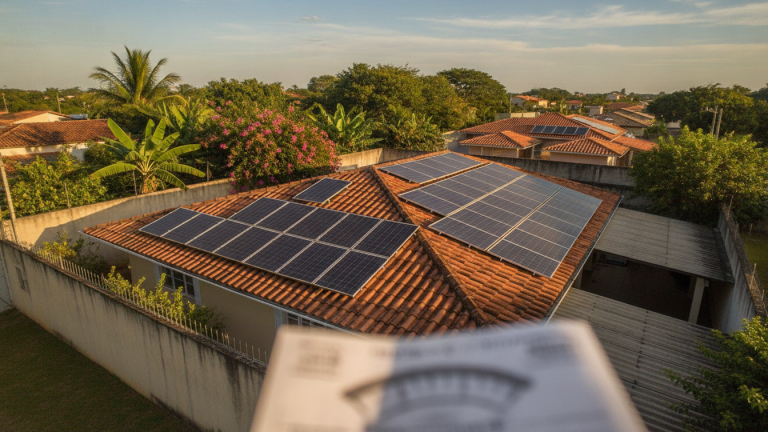
Imagine opening your electricity bill at the end of the month and seeing an almost zero amount. It’s not solar panel company propaganda, nor an illusion. It’s what many Brazilian families already experience after installing a photovoltaic energy system at home. According to data from ANEEL, Brazil exceeded the mark of 4 million solar systems installed in 2024, and this number keeps growing because practical results show up quickly in your wallet.
The question most people ask before any decision is simple: is the investment worth it? The answer depends on a few factors you’ll understand in this text, such as the size of your bill, the type of property, and the region where you live. By the end, you’ll know how to calculate a real savings estimate, understand how long it takes to recover the money invested, and take the first steps to hire a system safely.
You don’t need to be an engineer or understand electricity to make this decision well-informed. Let’s start from the beginning.
How solar energy works in practice
Photovoltaic solar panels capture sunlight and convert it into electrical energy. This energy powers your home’s appliances during the day. When you generate more than you consume, the surplus goes to the power distributor’s electrical grid and becomes energy credits, which you can use at night or on cloudy days. This mechanism is called energy compensation and is regulated by ANEEL through Normative Resolution No. 482, most recently updated by the Legal Framework for Distributed Microgeneration and Mini-generation, Law 14,300 of 2022.
In practice, this means you don’t need a battery to take advantage of solar energy in Brazil. The electrical grid works as a “bank”: you deposit the daytime surplus and withdraw at night. These credits have an expiration date, currently 60 months according to ANEEL, so what you generate doesn’t disappear.
Brazil is one of the countries with the highest solar incidence in the world. According to data from the National Institute for Space Research (Inpe), practically the entire national territory receives solar irradiation superior to the European average, even in the South and Southeast regions, which have more cloudy days in winter. For photovoltaic energy, this is a huge advantage compared to other places where the technology is also widely used.
How much you really save on your electricity bill
The savings vary, but there is an objective way to estimate them. The starting point is the value of your current bill and the rate charged by your distributor. Rates in Brazil differ greatly by state and distributor, as published periodically by ANEEL. In general, those who pay more per kilowatt-hour (kWh) have a faster return.
A typical residential system, aimed at a monthly bill between R$ 300 and R$ 500, usually has between 3 and 5 kilowatts-peak (kWp) of installed power. With this size, it’s common to zero out or almost zero out the consumption portion of the bill, paying only the availability fee, which is a fixed minimum amount charged by the distributor even for those who don’t consume anything from the grid. This minimum cost exists because you remain connected to the electrical infrastructure.
To get a more concrete idea, see a comparison between different consumption profiles:
| Current monthly bill | Estimated system power | Estimated monthly savings | Approximate system cost |
|---|---|---|---|
| R$ 150 to R$ 250 | 1.5 to 2 kWp | 60% to 80% | R$ 8,000 to R$ 14,000 |
| R$ 300 to R$ 500 | 3 to 5 kWp | 80% to 95% | R$ 15,000 to R$ 25,000 |
| R$ 600 to R$ 1,000 | 6 to 10 kWp | 85% to 95% | R$ 28,000 to R$ 45,000 |
The system cost values are market estimates for 2025 and 2026, considering complete installation with inverter and labor. Prices have fallen significantly in the last decade, driven by greater global production scale.
Return on investment time: what to expect
The payback (time to recover the investment) of a residential solar system in Brazil was between 4 and 7 years in most cases in 2025, according to data from the Brazilian Solar Photovoltaic Energy Association (ABSOLAR). Since panels have a guaranteed useful life of 25 years by manufacturers, this means more than 18 years of practically free energy after the return.
Two factors accelerate the return: high tariff and lots of sun. For this reason, Northeast states, with high irradiation and high tariffs, usually have shorter payback. São Paulo and Minas Gerais also show good results. The South of the country has a slightly longer return because of lower irradiation in winter, but it’s still financially attractive.
A practical tip: always ask the installer for the estimated generation report, with the irradiation data for your city. Reputable companies use databases like the Brazilian Atlas of Solar Energy, developed by Inpe in partnership with other institutions, to calculate how much your system will generate month by month.
Who can install: house, apartment, and rental property
Most people associate solar energy with houses with their own roof, but the possibilities have expanded. Law 14,300/2022 regulated remote self-consumption and solar condominiums, which opened the door for those living in apartments.
- Owned house with roof: it’s the simplest scenario. The panels go on the roof and installation is straightforward.
- Apartment in condominium: the condominium can install panels on the roof and divide the credits among residents. This requires assembly approval and a technical project, but it’s already a reality in many cities.
- Rental property: the tenant can negotiate installation with the owner. Alternatively, there are solar energy by subscription companies, in which you sign up for a plan and receive credits from a remote solar plant without installing anything at home. Savings are usually less than with your own system, but the initial cost is zero.
- Financing: public banks like Banco do Brasil and Caixa Econômica Federal offer specific credit lines for solar energy, such as Pronampe and BNDES lines passed through partner banks. It’s worth researching current rates before closing any contract.
How to hire a solar system without falling into traps
The market has grown a lot and, with that, companies without adequate technical preparation have emerged. Following a structured path makes all the difference.
- Survey your consumption from the last 12 months from your electricity bills. This avoids an oversized system (too expensive) or undersized (which doesn’t solve the problem).
- Request quotes from at least three certified installer companies certified by INMETRO or accredited by your local distributor.
- Check if the installer delivers the connection project to the distributor. Without this project, you cannot legally connect the system.
- Check the warranty for panels and inverter separately. Inverters generally have 5 to 10 year warranties; panels have up to 25 years of performance warranty.
- Demand the ART (Technical Responsibility Notation) from the engineer responsible for the project. It’s a mandatory document that protects you in case of problems.
- Be suspicious of promises of return below 3 years or companies that don’t provide detailed generation simulation.
When evaluating brands’ sustainability claims about equipment, it’s worth being careful to check if the allegations have real backing, just as we do when identifying greenwashing on product labels at the supermarket.
The environmental impact that goes beyond the electricity bill
Each kilowatt-hour generated by solar photovoltaic replaces energy that, in Brazil, comes from a matrix predominantly hydroelectric, but in periods of drought is complemented by gas and coal thermoelectric plants. When you generate your own clean energy, you reduce pressure on these more polluting sources.
Distributed solar energy generation also reduces losses in transmission lines, because energy is consumed close to where it’s generated. According to ANEEL, technical losses in the Brazilian electrical grid represent a significant portion of all energy generated in the country. Producing energy where it will be used is, in itself, a form of efficiency.
From a broader perspective, the transition to distributed renewable sources contributes to the health of local ecosystems by decreasing the need for large energy infrastructure projects. Understanding how ecosystems work in practice helps you see why each energy choice has consequences that go far beyond the electricity bill.
Frequently asked questions about residential solar energy
My bill is low. Is it still worth it?
For very low bills, below R$ 100 per month, the return on investment becomes longer and the account may not pay off financially in the short term. In this case, it’s worth considering solar energy subscription options, which don’t require initial investment. If the bill is higher than R$ 150, the analysis already starts to be favorable in most regions.
Does the system work on rainy or cloudy days?
Yes, but with reduced generation. The panels work with diffuse light, not just direct sunlight. On very cloudy days, generation can drop to a fraction of maximum potential. This is why the system is sized taking into account the annual average irradiation of your city, not just full sun days.
Do I need city hall authorization to install panels?
It depends on the municipality. Some require a building permit, especially for listed properties or areas with urban restrictions. The energy distributor always needs to be notified and approve the connection. The responsible installer should handle all this documentation.
Do panels need a lot of care and maintenance?
Maintenance is minimal. The main need is periodic cleaning to remove dust and leaves, especially in dry regions. In cities with regular rainfall, the rain already does much of this work. An annual technical inspection is recommended to check connections and inverter performance.
Where to start now
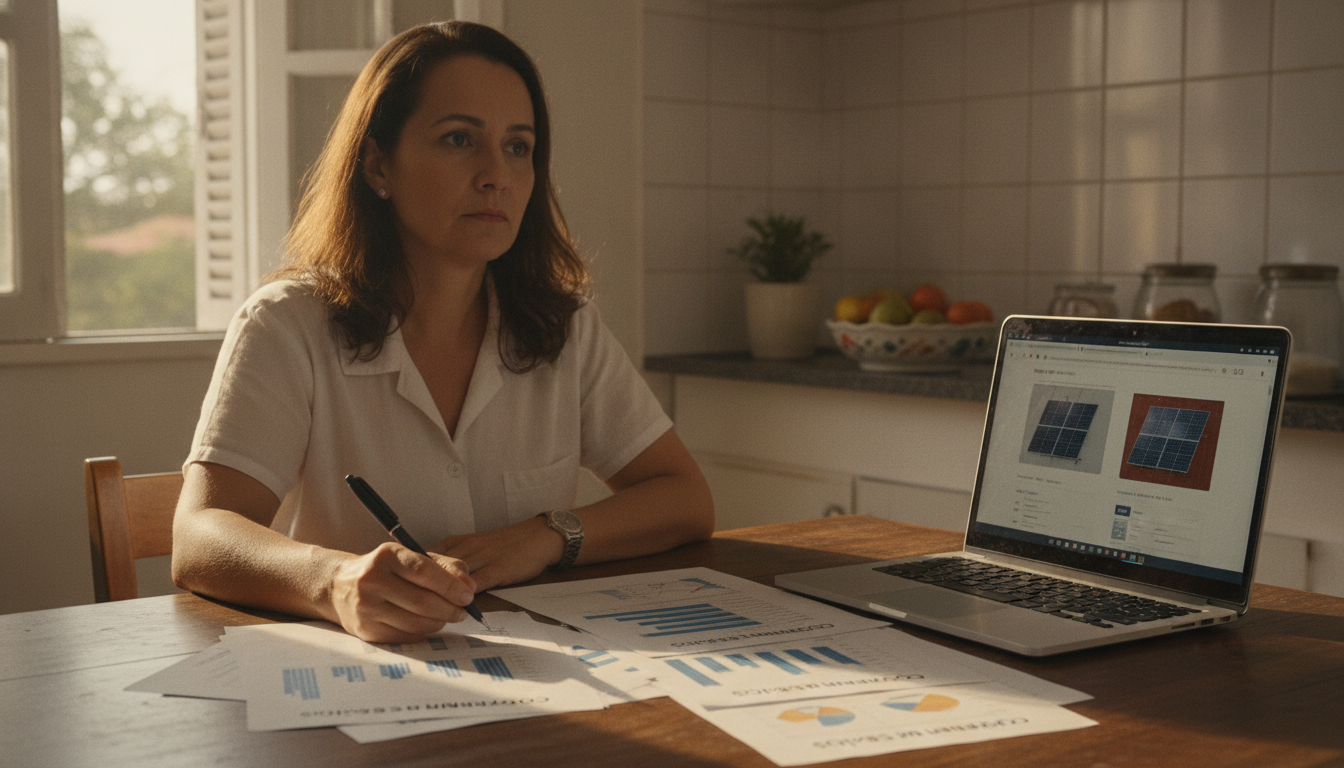
The first step costs nothing: get your last three electricity bills and note the average consumption in kWh. With that number in hand, you can already request a free simulation from any installer company and compare quotes with real data from your consumption.
If you live in an apartment or are still researching, look for solar energy cooperatives or subscription services available in your city. The market has evolved enough that almost every consumer profile has a viable option. The savings will show up on your bill every month, and the planet thanks you at the same time.
