Why your neighborhood’s trash is also your problem, and what you can do right now
Have you ever walked past your home and encountered a plastic bottle thrown in the gutter, an abandoned mattress on the corner, or plastic bags clogging the storm drain? This scene is common in practically every Brazilian city. According to data from Abrelpe (Brazilian Association of Public Cleaning and Solid Waste Companies), Brazil generates tens of millions of tons of urban solid waste per year, and a significant portion of this material still ends up in inappropriate places, including public roads, streams, and vacant lots.
Participating in a community cleanup drive in your neighborhood is one of the most direct ways to transform this reality. It requires no prior experience, costs almost no money, and can be done on a Saturday morning. By the end of this article, you’ll know how to find or organize a cleanup near you, what to bring, how to avoid the most common mistakes, and how this action connects with environmental laws and policies that already exist in Brazil.
What is a community cleanup drive and why it works
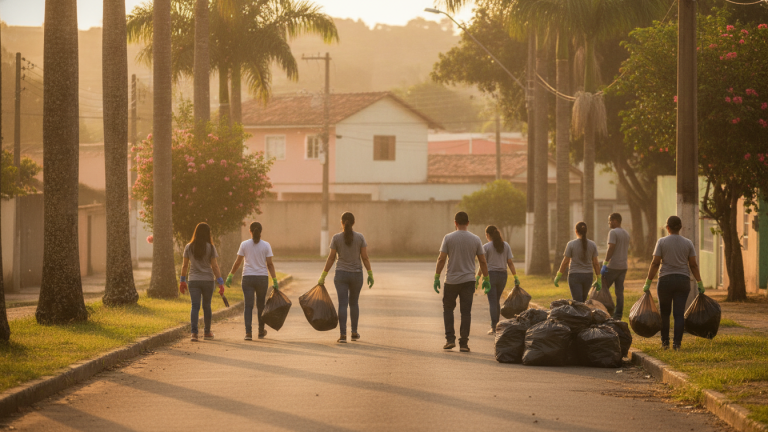
A community cleanup drive is a voluntary gathering of residents to collect irregularly discarded waste in public spaces. It can happen in a plaza, along a river bank, in a park, or simply along the streets of your neighborhood. The strength lies in the collective: what would take days for a single person gets done in hours when there are ten, twenty, or fifty people working together.
Beyond the immediate result, the cleanup drive has a rarely discussed social effect: it changes the behavior of people living in that space. When a place is clean and visually well-maintained, the tendency to litter there decreases. Researchers call this phenomenon the “broken windows effect,” which has been observed in urban studies around the world. In practice, a well-executed cleanup drive creates a positive cycle.
In the Brazilian legal context, Law 12.305/2010 (National Solid Waste Policy, or PNRS) establishes that adequate waste management is a shared responsibility among government, companies, and citizens. In other words, participating in a cleanup drive is not just a nice gesture; it’s exercising a right and fulfilling a role that the legislation itself recognizes.
How to find an existing cleanup drive in your neighborhood
Before organizing a cleanup drive from scratch, it’s worth checking if one already exists near you. Many initiatives are already active and simply need more people.
Where to look:
- WhatsApp and Telegram groups for your condominium, street, or neighborhood
- Pages of residents’ associations on Instagram or Facebook
- City hall: environmental and urban cleaning departments usually coordinate or advertise events like this
- Local NGOs and environmental collectives; in larger cities, groups like “Muda SP,” beach cleanup initiatives in São Paulo and Rio coastal areas, or networks linked to WWF Brazil usually publish open calendars
- Community mobilization apps, such as Colab
If you live in a small town and can’t find anything, don’t lose heart. It just means you can be the person who starts.
How to organize a cleanup drive from scratch: step by step
Organizing a cleanup drive doesn’t require being an environmental expert or having resources. It only requires willingness and minimal planning.
Materials needed:
- Durable rubber gloves (one per person)
- Large and durable garbage bags (black for waste, colored if sorting is involved)
- Trash grabbers or pincers (reduces contact with sharp material)
- Sunscreen and cap (Brazil is hot, and cleanups happen in the morning)
- Drinking water for all participants
- ID badges or improvised vests to identify organizers
Estimated time: 2 to 4 hours, depending on the chosen area.
Average cost per participant: close to zero if everyone brings their own materials. Disposable gloves cost a few reals per unit at hardware stores. Garbage bags can be donated by local shops or requested from the city.
Step by step:
- Choose the area clearly: delimit a perimeter that is viable for the number of available volunteers. One block well done is worth more than five blocks done halfway.
- Set the date and time: Saturday mornings work well. Start at 8 AM to take advantage of the cool hours and finish before midday heat.
- Publicize in advance: WhatsApp, physical posters at neighborhood shops, and social media posts. Give at least two weeks’ notice.
- Contact city hall: request support for collecting the gathered material. Many cleaning departments respond to this type of request. Without this arrangement, you might collect tons of trash and not know what to do with it.
- Organize waste separation on-site: separate at least recyclables (plastic, metal, glass, paper) from waste. If there’s a partnership with a waste pickers’ cooperative in your city, this increases the impact.
- Document everything: before and after photos document the work, help with promotion, and can be sent to city hall as evidence for permanent improvements.
- End with a collective moment: a simple snack, a conversation circle, or simply a verbal thank you are enough to create the sense of community that makes people return for the next edition.
Common mistakes that sabotage a cleanup drive (and how to avoid them)
Not arranging the trash destination in advance is the most frequent mistake. Imagine gathering one hundred bags of trash and discovering that the city truck doesn’t pass that day. Confirm collection before the event, in writing if possible.
Another mistake is underestimating the heat. In Brazil, even on cloudy days, temperatures can be intense. Dehydrated or sun-irritated volunteers won’t come back. Bring generous amounts of water and instruct participants to use sunscreen and hats.
Not separating waste is also a problem. Mixing recyclables with general waste invalidates sorting work and wastes material that could be reused. If it’s complicated to separate on the spot, at least signal for plastic bottles, cans, and glass to be placed in separate bags.
Finally, not documenting makes the effort disappear from collective memory. Comparative photos (before and after), record of collected volume, and participant names help build a history that attracts new volunteers and gets local media attention.
How to connect the cleanup drive with greater impact actions
An isolated cleanup drive solves the symptom, not the cause. To go further, think about how to connect this action to more structural changes in your neighborhood.
One concrete possibility is to map illegal dumping points and take this map to the sub-prefecture or city council. With data in hand, it’s easier to request trash bin installation, increased collection frequency, or implementation of selective collection points. The PNRS requires municipalities to have waste management plans, and organized citizens have the right to demand compliance with these goals.
Another possible connection is with tree planting. Neighborhoods with more trees accumulate less litter on sidewalks and have lower ambient temperatures, improving everyone’s quality of life. If your group is already mobilized, a tree planting drive can be the natural next step. You can learn how to plant a tree correctly and have it survive to ensure seedlings last beyond the first months.
Frequently asked questions about community cleanup drives
Do I need city hall permission to organize a cleanup drive?
For action in public space, it’s recommended to notify city hall in advance, even if not legally required. This facilitates later material collection and can guarantee support such as garbage bags and cleaning staff. In many municipalities, a simple email or call to the environmental department is enough.
What to do with special waste, such as batteries, electronics, and pesticide packaging?
These materials should not go into regular trash or standard selective collection. The PNRS obligates manufacturers and importers to organize reverse logistics systems for various types of special waste. Look for specific collection points: pharmacies usually accept batteries, electronics stores have return programs, and gas stations accept used lubricating oil.
How do I motivate neighbors who have never participated in anything like this?
Focus on concrete and immediate gains: a cleaner street, a more pleasant plaza, increased property values in the area. Avoid long environmental speeches; show photos of how the location looked before and after. Personal invitations work much better than generic posters.
What if the cleanup drive collects much more trash than expected?
This happens frequently, especially in areas with chronic dumping. Plan with margin: request more bags than you think you’ll need and confirm with city hall the collection capacity. If necessary, organize the material in identified piles with photos, and call sanitation before dispersing volunteers.
Start today, even if it’s just you and a neighbor
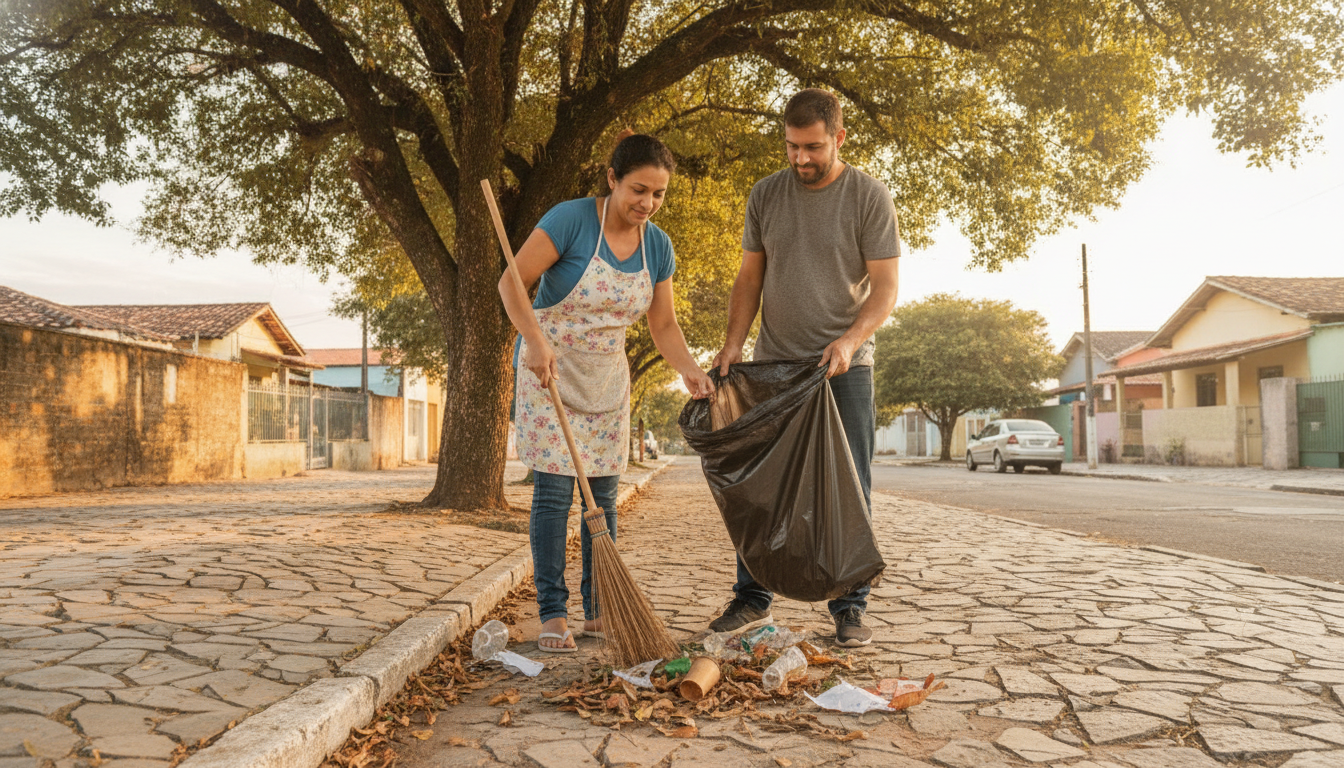
The minimal version of a cleanup drive can be you, a friend, an hour of free time, and two garbage bags. It doesn’t need to be big to be real. What matters is that trash gets off the ground, the street changes appearance, and people around perceive that someone cares about that space.
Take the first step this week: send a message in your neighborhood group asking if anyone wants to do a collective cleanup on Saturday. You’ll be surprised by how many people were waiting for someone to start.
