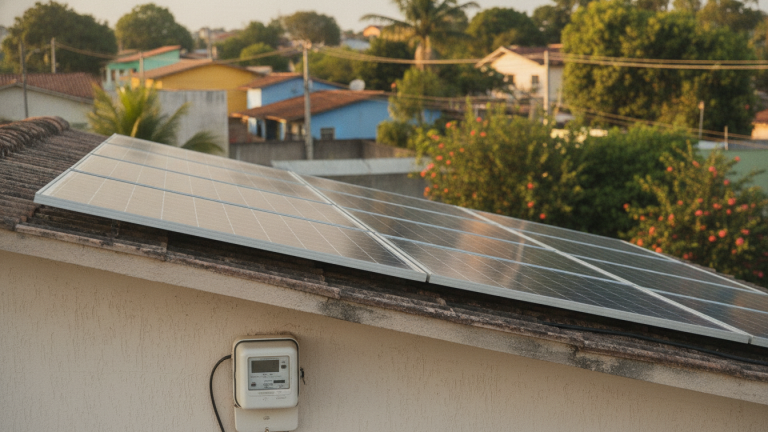
Did your electric bill arrive high again?
In Brazil, electricity tariffs have accumulated consecutive increases for years. According to ANEEL data, the average residential tariff in the country already exceeds R$ 0.80 per kilowatt-hour in much of the distribution network, and many families see bills reach R$ 400, R$ 600 or more per month. For those who pay this bill every end of month with that feeling of helplessness, there is a concrete alternative: photovoltaic solar energy can reduce this spending by up to 95%, depending on the size of the system installed and the house’s consumption.
This number is not a salesman’s promise. It reflects what happens when a properly sized system generates enough energy to cover almost all of the residence’s demand, leaving only the minimum availability rate from the distributor, which is charged even to those who produce their own energy. What’s left goes to the electrical grid as credit, and you use it later, at night or on days of lower generation.
In this text you will understand how solar energy works in practice, how much it costs to install, how long the investment takes to pay for itself, what mistakes to avoid, and how to take the first step today, whether you live in a house or even an apartment.
How photovoltaic solar energy really works
The most common system for residences is the so-called grid-connected system, or grid-tie. Panels installed on the roof capture sunlight and convert it into direct current. A device called an inverter transforms this current into alternating energy, just like what comes from the outlet. When your house produces more than it consumes, the excess goes to the distributor’s grid and becomes credit on your bill.
These credits have validity and can be used for up to 60 months, according to ANEEL rules established in Normative Resolution 482 and later updated by the Legal Framework for Solar Energy, Law 14,300 of 2022. This law brought legal certainty for consumers and the sector, consolidating the compensation model that has existed in the country for more than a decade.
A very common doubt is whether the system works on cloudy or rainy days. The answer is yes: the panels continue to generate energy even without full sun, because they react to diffuse light. If you want to understand this point better, this article on solar energy on cloudy days explains the process in detail. Generation drops, but doesn’t stop.
How much does it cost to install and how long to recover the investment
The cost of a residential system varies greatly depending on the house’s consumption, the quality of equipment, and the region of Brazil. In general, systems for residences with average monthly consumption between 300 and 500 kilowatt-hours cost between R$ 15,000 and R$ 35,000 installed, according to surveys from the national photovoltaic sector. In recent years, the price of panels fell significantly in the global market, which reduced access costs.
The investment return time, called payback, usually ranges from 4 to 7 years for residential systems in Brazil, depending on the local tariff and solar irradiation in the region. After this period, the energy generated is essentially free for the remainder of the panels’ useful life, which reaches 25 or 30 years with manufacturer warranty.
| Estimated monthly consumption | System size | Approximate cost | Average payback |
|---|---|---|---|
| Up to 200 kWh | 1.5 to 2 kWp | R$ 10,000 to R$ 18,000 | 5 to 7 years |
| 300 to 500 kWh | 3 to 5 kWp | R$ 18,000 to R$ 30,000 | 4 to 6 years |
| Over 600 kWh | 6 kWp or more | From R$ 30,000 | 4 to 5 years |
kWp = kilowatt-peak, unit indicating the maximum power of the system. Reference values for 2026; consult local quotes.
There are specific financing lines for solar energy in banks such as Caixa Econômica Federal and Banco do Brasil, as well as consortiums. In many cases, the monthly installment of the financing ends up below the amount the person stops paying on their electricity bill, making the cash flow positive from the first month.
Who can install: houses, apartments, and rental properties
Most people associate solar energy with houses with large roofs, but the scenario has evolved. Apartment residents can adopt the shared generation or remote self-consumption model, allowed by Law 14,300 of 2022. In this case, a group of condo owners or cooperatives invests in a solar farm outside the property and receives credits proportionally on their individual bills.
Residential condominiums can also install panels in common areas, such as garage roofs or building coverings, and divide the benefit among units. Several Brazilian city halls have encouraged this modality, and some states offer ICMS exemption on solar energy generated for self-consumption.
For those living in rental properties, the situation is more delicate. Technically, any structural change depends on the owner. But it’s worth the conversation: many owners agree to split the investment or assume the cost knowing the property increases in value.
Step-by-step guide to hiring solar energy for your home
You don’t need to understand electrical engineering to make this decision. The process is simpler than it seems when you follow the right order.
- Gather your electricity bills from the last 12 months. The installer will need your average consumption in kWh to properly size the system.
- Request quotes from at least three certified companies. Look for integrators with INMETRO certification and professionals registered with CREA. The ABSOLAR website (Brazilian Solar Photovoltaic Energy Association) lists member companies.
- Compare not just the price, but the quality of equipment. Panels and inverters from recognized brands have stronger warranties. Ask for technical specifications in writing.
- Analyze financing carefully. Simulate the installment and compare it with your average bill. If the installment is lower, you’re already ahead from the first month.
- Follow up on approval with the distributor. After installation, the energy company needs to approve the system’s connection to the grid. The legal timeframe varies, but usually takes a few weeks. The integrator typically handles this process.
- Monitor generation through the inverter app. Almost all modern inverters have remote monitoring. You’ll see in real time how much you’re generating and saving.
Common mistakes that make the system underperform
Buying the cheapest offer without checking the origin of the panels is the most frequent mistake. Equipment without INMETRO certification can lose efficiency quickly, and the warranty becomes worthless if the company disappears from the market.
Another mistake is oversizing or undersizing the system. An oversized system generates credits that expire unused; an undersized system doesn’t cover consumption. Proper sizing depends on actual consumption analysis, not estimates.
It’s also worth remembering that the roof needs attention. If the roof has old tiles or compromised structure, the ideal is to renovate before installing the panels, which have decades of useful life. Shadows from trees, water tanks, or neighbors also affect generation. A serious installer will perform this analysis before closing the contract.
The environmental impact you create by switching to solar
Photovoltaic solar generation does not emit greenhouse gases during operation. The carbon footprint exists in panel manufacturing, but industry studies point out that this debt is paid off in about 1 to 3 years of operation, depending on the energy matrix of the country where the panel was manufactured. From then on, each kilowatt-hour generated represents avoided emissions.
Brazil has one of the cleanest electrical matrices in the world, with a strong presence of hydroelectric plants. Even so, consumption growth pressures the system, and distributed solar energy relieves this demand during peak hours. According to ANEEL data, installed capacity for distributed solar generation in Brazil has grown significantly in recent years and already represents a relevant share of national generation.
Reducing grid consumption also means less pressure on biomes near reservoirs and transmission lines. Planting native trees in your yard or neighborhood is another gesture that complements this choice, and if you want to understand how to do it right, this guide on how to plant a tree the right way brings practical guidance.
Frequently asked questions about residential solar energy
Does the system work at night?
Not directly. Without sunlight, the panels don’t generate energy. At night, you use the electrical grid normally, but deduct the credits your system generated during the day. Those who want total independence from the grid need batteries, which significantly increases system costs.
Does solar energy increase property value?
Yes. Real estate market research indicates that properties with an installed solar system have a higher resale value than similar properties without the system. The benefit transfers to the buyer, who will inherit years of free generation.
Do I need municipal authorization?
It depends on the city. In many cities, installing solar panels on residential roofs doesn’t require a permit, only the approval process with the distributor. Check local rules with the integrator company or at the city hall before hiring.
What if the distributor changes the compensation rules?
Law 14,300 of 2022 guarantees current compensation conditions for systems installed before 2045. Those who install now are protected by this legal guarantee for decades.
A small action to start today

You don’t need to make the final decision this week. But you can take a first step now: grab your electric bill from last month and note the consumption in kWh. With that number in hand, you can already request a basic quote and understand whether the system makes sense for your case. Most companies do this simulation at no cost and with no commitment.
The high electric bill every month is a problem that has a known, tested, and accessible solution in Brazil in 2026. The sun’s energy won’t run out, and the money that stays in your pocket can go toward what you really want.
