Renewable energy: what exists today and what changes in your electricity bill
Your electricity bill arrived and you were confused about why it’s so high, even trying to save. At the same time, you see solar panels popping up on neighborhood roofs, hear about wind energy, hydroelectric power, green hydrogen, and you’re in doubt: after all, what type of energy does the electricity come from that powers your home? And are there alternatives that make sense for the everyday life of an ordinary person?
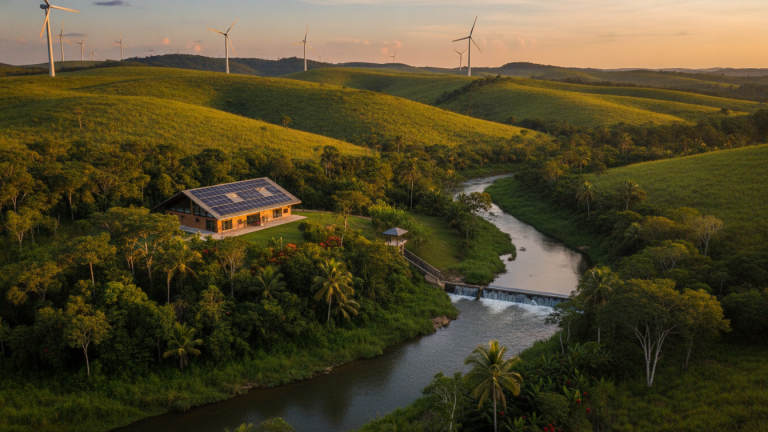
Brazil has one of the most renewable electricity matrices in the world. According to ANEEL data, most of the electricity generated in the country comes from sources that renew naturally, such as water, sun, and wind. This is a real advantage, but it doesn’t mean everything is solved: we still depend on gas and coal thermal power plants during water crises, and diversification of sources is increasingly necessary.
In this text, you will understand each type of renewable energy that exists today, how it works in practice, the weight of each one in the Brazilian context, and what you can do, starting now, to benefit from these alternatives, whether by reducing your bill or supporting more conscious choices.
What makes energy considered renewable
Renewable energy is energy generated by sources that regenerate naturally on a human timescale. The sun rises every day, the wind doesn’t stop, rivers keep flowing. This differentiates them from oil, natural gas, and coal, which took millions of years to form and are consumed much faster than nature can replenish.
Being renewable, however, is not the same as being free from environmental impact. A large hydroelectric dam, for example, can affect entire ecosystems, displace riverside communities, and modify river cycles. The renewability of the source is an important criterion, but it’s not the only one that defines whether an energy is truly sustainable.
Solar energy: the fastest growing in Brazil
The photovoltaic solar energy transforms sunlight directly into electricity through panels composed of semiconductor cells, usually made of silicon. When photons from sunlight hit these cells, they release electrons, generating electric current.
Brazil has a huge geographic advantage in this sector. Being a tropical country with high solar irradiation rates across virtually the entire territory, the potential is extraordinary. According to ANEEL, distributed solar generation, that installed on rooftops of homes, buildings, and companies, has grown rapidly in recent years and already represents a relevant portion of installed capacity in the country.
If you own your home or have condo approval, you can install panels on your roof and significantly reduce your electricity bill. For those who want to safely research providers, this guide on how to choose a solar energy company in Brazil can help a lot when making this decision.
Wind energy: the wind that becomes electricity in the Northeast
The wind energy is generated by turbines that capture the kinetic energy of the wind and convert it into electricity. The blades rotate, drive a generator, and the electric current is sent to the grid.
Brazil is one of the world’s largest wind energy generators. The Northeast region concentrates most of the country’s wind farms, with emphasis on states like Rio Grande do Norte, Ceará, and Bahia, where the wind blows regularly and intensely throughout almost the entire year. According to ANEEL, wind energy represents a growing slice of the national electricity matrix.
An important characteristic: wind and solar complement each other well in Brazil. In the Northeast, solar irradiation is intense during the day, while wind is usually stronger at night and in seasons when solar weakens. Combining the two sources helps keep the supply more stable.
Hydroelectric energy: the historical foundation of Brazil’s electricity matrix
The hydroelectric energy uses the movement of water, usually dammed in reservoirs, to turn turbines and generate electricity. Historically, it has always been the backbone of Brazil’s electricity matrix, accounting for a majority share of the country’s generation for decades.
Large hydroelectric power is efficient in terms of generation, but carries serious socio-environmental impacts: flooding of forest areas, displacement of populations, alteration of river regimes, and impact on fishing. On the other hand, small hydroelectric plants (PCHs) and run-of-river plants, which don’t depend on large reservoirs, have much lower impact and have gained ground in discussions about matrix expansion.
During dry periods, like those the country has faced recently, excessive dependence on hydroelectric power increases the risk of blackouts and activates the most polluting thermal power plants to compensate. This is one of the reasons why diversifying renewable sources is a strategic necessity, not just an environmental agenda.
Biomass and biogas: what’s left over becomes energy
The bioenergy encompasses energy generation from organic materials, such as agricultural residues, sugarcane bagasse, urban organic waste, and animal manure. In Brazil, sugarcane plays a central role in this story: the ethanol produced from it powers much of the country’s flex fuel car fleet.
The biogas is generated when organic residues decompose in oxygen-free environments, releasing methane that can be captured and used to generate electricity or heat. Sanitary landfills, pig farms, sewage treatment plants, and even restaurant waste can be sources of biogas. According to Abrelpe surveys, Brazil’s potential for biogas generation from urban solid waste is very little exploited to date.
For those living in an apartment who can’t install a solar panel, supporting composting initiatives in your neighborhood or properly sorting organic waste is a concrete way to contribute to the bioenergy chain.
Geothermal and tidal energy: the least known in Brazil
The geothermal energy takes advantage of the natural heat from the Earth’s interior. In countries like Iceland and New Zealand, it heats homes and generates electricity on a large scale. In Brazil, geothermal potential exists, but is still little explored commercially, partly because the areas of greatest geological activity are far from consumption centers.
The tidal energy and ocean wave energy also fall into the renewable category. It takes advantage of ocean water movement to drive turbines. Brazil has an extensive coastline, which represents interesting potential, but the technology is still in development phase and costs are high for large-scale use. These are bets for the future, not solutions available to the average consumer today.
Green hydrogen: the promise taking shape
The green hydrogen is not exactly a primary energy source, but an energy vector. It is produced by water electrolysis, using electricity generated by renewable sources to separate hydrogen from oxygen. This hydrogen can be stored, transported, and used to generate electricity or heat without emitting CO2.
Brazil has bet on this technology. The Northeast, with its abundance of sun and wind, has attracted green hydrogen projects with potential for export to Europe. According to the Ministry of Mines and Energy, there is a set of initiatives under development in Ceará and Rio Grande do Norte.
For the average consumer, green hydrogen is not something you’ll use directly at home in 2026. But it should transform sectors difficult to decarbonize, such as steelmaking, fertilizers, and long-distance transport.
How to compare the main renewable sources available
| Source | Available to the average consumer? | Environmental impact | Current cost in Brazil |
|---|---|---|---|
| Solar photovoltaic | Yes (roof or consortium) | Low | Medium, with payback in years |
| Wind | Indirectly (via grid) | Low to medium | Competitive |
| Hydroelectric | Indirectly (via grid) | Medium to high | Historically low |
| Biomass/biogas | Partially (ethanol, local biogas) | Variable | Source dependent |
| Geothermal | Not yet | Low | Still unviable in Brazil |
| Green hydrogen | Not yet | Low (if 100% renewable) | Under development |
What you can do now with this knowledge
- Check on your electricity bill if there is an option to switch to a certified renewable energy plan, such as those available from some utilities and traders.
- Research solar energy cooperatives by subscription, which allow you to have panels in remote plants without needing to install anything on your roof.
- Prefer ethanol when refueling your flex fuel car when the price is competitive; it’s a renewable biofuel produced on a large scale in Brazil.
- Sort organic waste correctly to reduce the volume of waste in landfills and contribute to local composting or biogas programs.
- When renovating or building, consult a credentialed solar energy installer; the investment usually pays for itself in a few years and adds value to the property.
- Follow news in the electricity sector; Brazil’s tariff structure changes frequently, and staying informed helps you make better decisions.
Frequently asked questions about renewable energy
Is all renewable energy clean and impact-free?
Not necessarily. Renewable means the source regenerates, but this doesn’t eliminate the impacts of the generation process. Large hydroelectric dams, for example, cause significant socio-environmental damage, even though they’re renewable. Solar and wind have much lower impacts, but also involve manufacturing equipment with minerals extracted from nature.
Is it worth installing solar panels in an apartment?
It depends on your condo and local legislation. There is a shared generation option that allows condo residents to participate in remote solar plants and deduct credit from their electricity bill. Consult your energy distributor and check ANEEL’s rules to understand what applies to your situation.
Can Brazil run 100% on renewable energy?
The potential exists. According to technical studies, a combination of solar, wind, hydroelectric, and biomass could meet national electricity demand. The challenge lies in energy storage for times when sun and wind are scarce, and transmission infrastructure to transport energy from producing regions to consumption centers.
What is the free energy market and how does it connect to renewables?
The free energy market allows high-consumption customers to negotiate directly with generators and traders, choosing the source. Many companies have switched to this market precisely to contract 100% renewable energy with certification. For individuals, the rules are still in transition, but access should expand in the coming years.
One small step that changes a lot
You don’t need to install a power plant in your backyard to be part of this energy transition. Starting by understanding where the energy you use comes from is already a real step. From there, whether evaluating a solar panel on your roof, sorting organic waste, or choosing ethanol at the pump, each informed decision contributes to a cleaner and more resilient system.
If solar energy is on your radar, it’s worth dedicating time to research well before signing any contract. A good start is reading about how to choose a solar energy company in Brazil to avoid common pitfalls and make a safe choice.
