
Why Choosing Public Transportation Is One of the Most Powerful Acts for the Planet
Imagine waking up tomorrow and discovering that a single change in your daily routine could significantly reduce your carbon footprint — without costing a fortune, without requiring sophisticated technology, and without giving up comfort. This change exists, and it comes through the door of a bus, subway, or train. Public transportation is one of the most underestimated climate solutions of our time, capable of transforming entire cities when adopted at scale.
The transportation sector is responsible for a significant share of global greenhouse gas emissions. According to the Intergovernmental Panel on Climate Change (IPCC), transportation accounts for approximately 16% of global CO₂ emissions, with fossil fuel-powered passenger vehicles being the biggest culprits within this category. In Brazil, data from the Greenhouse Gas Emissions and Removals Estimating System (SEEG) indicates that the energy sector — which includes transportation — is among the country’s main emission sources. Each car removed from the streets means less fuel burned, less carbon released into the atmosphere, and less pressure on the climate.
Best of all? This choice is available now, today, for millions of Brazilians who live in cities with some public transit infrastructure. In this article, we’ll explore why public transportation is an essential ally of sustainability, how it benefits both the planet and your wallet, and what you can do to incorporate this habit into your routine.
Public Transportation and Emission Reduction: The Numbers That Matter
When we compare carbon emissions per passenger, public transportation comes out ahead in virtually every scenario. A conventional urban bus, even diesel-powered, carries dozens of people at once — which drastically dilutes per capita emissions compared to individual cars.
Studies from the International Association of Public Transport (UITP) show that public transportation in urban areas can be four to six times more efficient in terms of CO₂ emissions per passenger-kilometer than individual motorized transport. Subways and electric trains achieve even greater reductions, especially when powered by renewable energy sources.
In the Brazilian context, where the electrical grid features significant participation from hydroelectric and renewable sources, electric subways and light rail systems have extremely low emission potential per passenger. Cities like São Paulo, Rio de Janeiro, Belo Horizonte, Recife, and Porto Alegre already operate metro-rail systems that benefit hundreds of thousands of passengers daily.
How Public Transit Combats Urban Carbon Emissions
- Fewer vehicles in circulation: each full bus can replace dozens of individual cars on the streets.
- Energy efficiency per passenger: the energy consumed is shared among many users.
- Accelerated electrification: electric bus fleets already operate in Brazilian cities like São Paulo and Curitiba, further reducing emissions.
- Reduced traffic congestion: fewer cars mean less idling engine time, which is one of the most inefficient and polluting forms of fuel consumption.
- Greener urban planning: cities that prioritize public transportation tend to be more compact, with less need for long commutes.
Beyond CO₂: Other Environmental Benefits of Public Transit
The discussion about public transportation often focuses on carbon emissions, but the environmental benefits go far beyond that.
Air quality: individual vehicles emit not only CO₂ but also nitrogen oxides (NOx), fine particulate matter (PM2.5), and volatile organic compounds, all harmful to human health and the environment. According to the World Health Organization (WHO), air pollution is responsible for millions of premature deaths worldwide each year. Fewer cars on the streets means cleaner air for everyone.
Land use: car-dominated cities require enormous areas for parking lots, overpasses, and expressways — spaces that could be parks, urban gardens, or housing. Public transportation frees up this space for more sustainable and human uses.
Reduced urban noise: heavy traffic noise is a form of pollution often ignored, but it affects human well-being and urban wildlife. Cities with efficient public transportation tend to be quieter.
Less pressure on natural resources: producing and maintaining a car requires extraction of metals, rubber, plastics, and fuel. When more people share public vehicles, the aggregate demand for these resources decreases.
Public Transportation and Your Wallet: The Economic Sustainability of Collective Choice
Talking about sustainability without mentioning the economic aspect is leaving half the story untold. For many Brazilians, choosing public transportation isn’t just environmental — it’s financial.
Maintaining a car in Brazil in 2026 involves costs that add up quickly: financing payments or purchase price, insurance, vehicle tax, maintenance, fuel, tolls, and parking. Research from the automotive sector and personal finance consistently shows that the total monthly cost of owning a vehicle far exceeds the value of a public transit pass, even in cities where fares are higher.
Additionally, time lost in traffic has an invisible but real cost. Cities with efficient public transportation allow people to work, read, or rest during their commute — something impossible behind the wheel.
Simplified Comparison: Car vs. Public Transportation
| Criterion | Individual Car | Public Transportation |
|---|---|---|
| Emissions per passenger-km | High | Low to very low |
| Average monthly cost | High (fuel + maintenance + taxes) | Moderate to low |
| Air quality | Worsens | Improves (collectively) |
| Urban space use | Intensive | Efficient |
| Traffic stress | High | Lower (passive passenger) |
| Productivity during commute | None | High |
How to Start Using Public Transportation More: A Practical Step-by-Step Guide
Adopting public transportation may seem challenging at first, especially for those accustomed to driving. But with a little planning, the transition becomes natural — and often surprisingly enjoyable.
- Map your routine: identify which trips you make most frequently and check which bus, subway, or train lines serve those routes. Apps like Google Maps, Moovit, and municipal transit apps show routes and schedules in real time.
- Start with one day per week: you don’t need to abandon your car all at once. Choose a fixed day to use only public transportation. Over time, increase the frequency as you feel comfortable.
- Combine modes: use a bicycle or walking for the initial stretch, and public transportation for most of the journey. This combination is known as multimodal mobility and is increasingly encouraged in Brazilian cities.
- Plan ahead: research schedules and possible connections between lines before leaving. Knowing exactly what to expect reduces the stress of change.
- Use a transit card: most Brazilian cities offer rechargeable cards with integration between lines, which reduces the cost per trip and simplifies payment.
- Make the most of your commute time: bring a book, use headphones for podcasts or courses, or simply take the opportunity to rest. The commute stops being “wasted time.”
- Share the experience: invite coworkers or neighbors to try it together. Changing habits is easier when done in a group, and the collective impact is much greater.
The Role of Cities and Public Policies in Sustainable Transportation
The responsibility for public transportation quality isn’t just individual — it is, above all, collective and political. Cities that invest in quality public transportation reap environmental, economic, and social benefits at scale.
Inspiring examples abound. Curitiba has been an international reference in BRT (Bus Rapid Transit) since the 1970s. Countries like Colombia, with Bogotá’s TransMilenio, and various European nations show that it’s possible to build efficient and widely used systems when there’s political will and adequate investment.
In Brazil, bus fleet electrification has gained traction in cities like São Paulo, which has established goals to decarbonize its public transportation fleet in the coming years. Each electric bus added to the fleet represents a concrete and measurable reduction in urban emissions.
As a citizen, you can:
- Vote for candidates who prioritize sustainable urban mobility in their platforms.
- Participate in public hearings about your city’s mobility plans.
- Sign petitions and support organizations that advocate for quality public transportation.
- Pressure companies where you work to offer public transit benefits instead of fuel vouchers.
Public Transportation as Part of a Sustainable Lifestyle
Choosing the bus or subway doesn’t need to be seen as a sacrifice. It can — and should — be seen as part of an identity: that of someone who thinks collectively, who sees the city as a shared space, and who understands that small daily choices add up to an enormous impact when multiplied by millions of people.
This same logic applies to other areas of life, such as reducing food waste, consuming less disposable plastic, and choosing sustainably sourced products. As we discussed in our article on sustainable living: small actions that change everything, real sustainability is built day by day, in the seemingly trivial decisions we make without thinking — until we start thinking.
Public transportation fits perfectly into this philosophy: it’s an accessible, immediate action with real impact. It doesn’t require expensive technology or great sacrifices. It only requires a change in perspective.
Conclusion: Your Next Trip Can Be the Beginning of Something Bigger
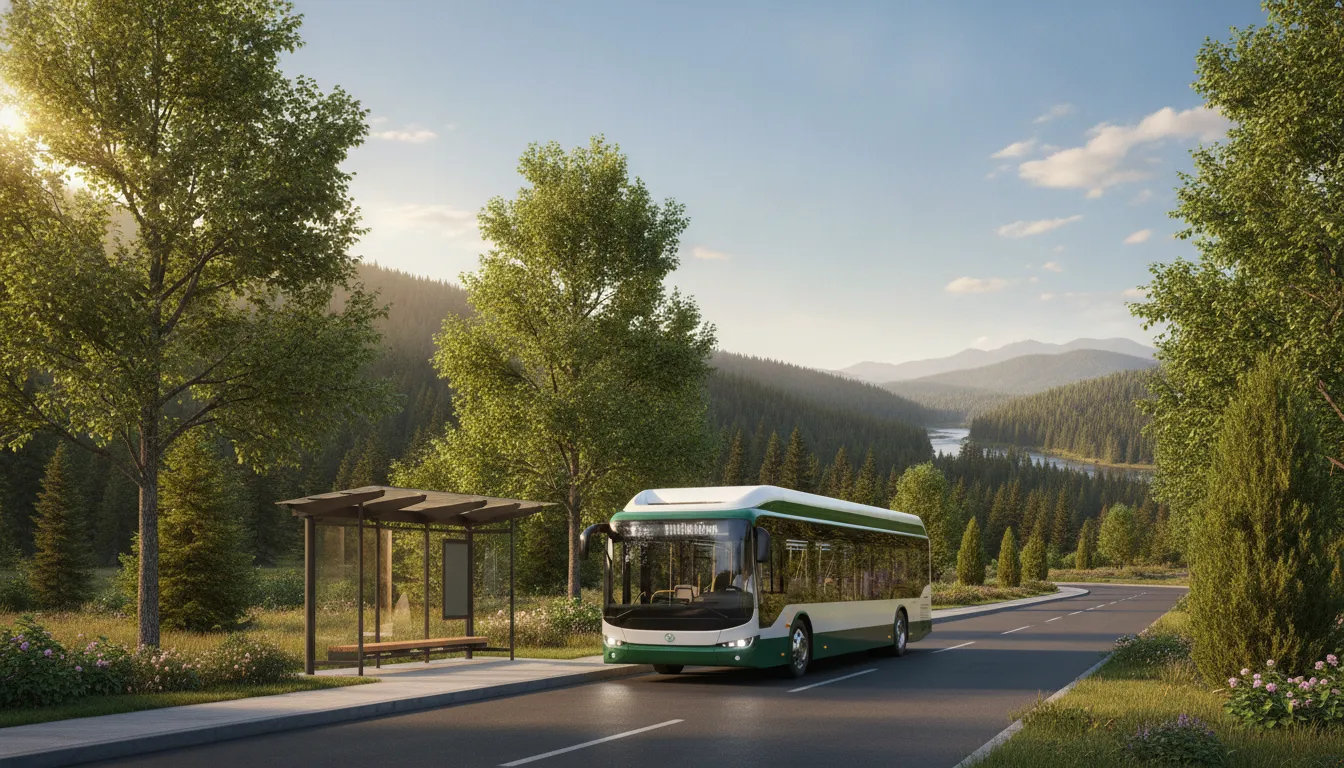
The planet doesn’t need perfection — it needs movement. And that movement can literally start with you boarding a bus or subway tomorrow morning.
Each public transportation trip is a silent vote for cleaner cities, purer air, and a more stable climate. Added together, these votes create real pressure for better infrastructure, for electric fleets, for mobility policies that put people and the planet at the center of decisions.
You don’t need to change everything at once. Start with one day, one line, one route. Explore what your city offers. Invite someone. Talk about it. And as you advance on this journey, continue discovering other ways to live more consciously and connected to the world around you — because every small action, as we constantly remind you here at Help the Planet, has the power to change much more than it seems.
