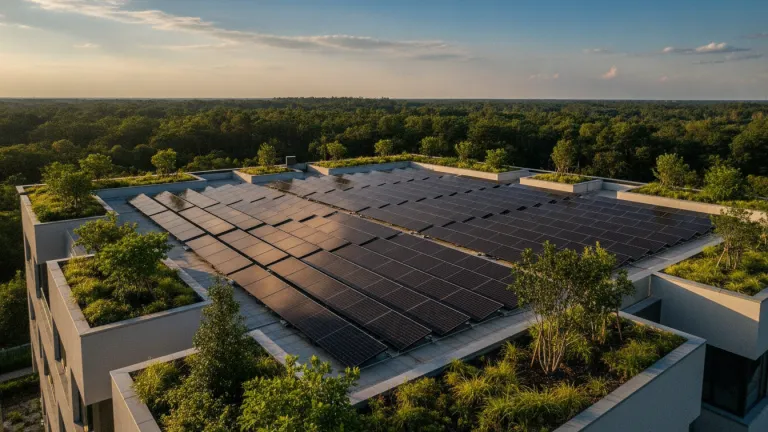
Imagine receiving your electricity bill at the end of the month and seeing a value close to zero — or even credits instead of charges. For millions of homeowners worldwide, this is already a reality thanks to residential solar energy. The sun, which shines generously for an average of over 2,500 hours per year in many regions, has transformed from mere scenery into one of the most accessible and intelligent energy sources a family can adopt.
Residential solar energy has grown significantly over the past decade. According to data from the International Energy Agency (IEA), global solar PV capacity has surpassed 1,000 GW, with residential installations accounting for a substantial portion of this growth. This expansion is no accident: it’s the result of increasingly affordable technology, accessible financing options, and regulatory frameworks that favor consumers.
But how does it all work in practice? How can panels installed on your roof power an entire house, reduce your electricity bill, and still help the environment? In this article, we’ll explain each step of the process clearly and accessibly — from the sun’s rays to your living room light switch.
What is photovoltaic solar energy and how does it differ from other solar technologies
When we talk about residential solar energy, we’re referring, in the vast majority of cases, to photovoltaic (PV) technology. It’s important to distinguish it from another common solar technology: solar thermal heating, those hot water systems with dark collectors installed on rooftops.
- Solar photovoltaic: converts sunlight directly into electricity, which can power all household equipment.
- Solar thermal: uses the sun’s heat to warm water, primarily for bathing and domestic use. It doesn’t generate electricity.
This article focuses on the photovoltaic system, which is responsible for reducing (or eliminating) your electricity bill. Both technologies can coexist in the same property and, together, offer even greater energy efficiency.
How solar panels transform light into electricity
The heart of the photovoltaic system is the solar cell, typically manufactured from silicon — a semiconductor material abundant in nature. The process follows what’s called the photovoltaic effect, discovered by Edmond Becquerel in 1839, but only widely applied decades later.
Here’s how the process works step by step:
- Photons from the sun strike the solar cell. Sunlight is composed of energy particles called photons.
- Photons excite the electrons in silicon. When colliding with semiconductor atoms, photons release electrons, generating electrical charge movement.
- This movement generates direct current (DC) electricity. The electricity initially produced is direct current, different from what we use at home.
- The inverter converts DC to alternating current (AC). The inverter is the second most important component of the system. It transforms energy into a format compatible with the electrical grid and all household appliances.
- AC energy powers the home. Lighting, refrigerator, electric water heater, television — everything is now powered by solar energy.
- Surplus goes to the electrical grid. When the system produces more than the house consumes, the excess is injected into the utility grid, generating energy credits that can be used at night or on cloudy days.
This last step is regulated through net metering or similar compensation systems, which exist in many countries with varying rules depending on local regulations.
The main components of a residential solar system
A grid-connected photovoltaic system (the most common type) is composed of several essential elements. Understanding them helps you know what you’re installing and communicate better with installers and suppliers.
| Component | Main Function |
|---|---|
| Photovoltaic modules (panels) | Capture sunlight and generate direct current |
| Inverter (or microinverter) | Converts DC to AC and manages generation |
| Mounting structure | Securely supports panels on the roof |
| Bidirectional meter | Records both consumption and energy injected into the grid |
| Cables and connectors | Conduct electricity between components |
| Battery (optional) | Stores energy for nighttime use or power outages |
The inverter deserves special attention. There are different types — the centralized inverter (most common and economical), microinverters (installed on each panel, with better performance in partial shading situations), and power optimizers. The choice depends on your roof’s characteristics and available budget.
How energy compensation works with net metering
One aspect that generates the most questions — and also most delights those who discover the system — is the matter of energy credits. Since the sun doesn’t shine at night and production varies throughout the day, it’s natural that the house sometimes produces more than it consumes and sometimes needs to draw energy from the grid.
Net metering systems typically work like this:
- During the day, with strong sun: panels produce more than the house consumes. The surplus is sent to the grid and you receive credits on your bill.
- At night or on cloudy days: the house consumes from the grid normally. Accumulated credits offset the bill amount.
- At month’s end: the utility calculates the balance. If credits exceed consumption, they typically remain available for future use (timeframes vary by jurisdiction).
Even with a well-sized system, consumers pay the utility a grid access fee or minimum charge. This covers use of the electrical infrastructure. It’s an important point to avoid unrealistic expectations: the bill rarely reaches absolute zero, but reduction can be 80% to 95% depending on system sizing.
How to size a solar system for your home
Before hiring any installation, it’s essential to understand the system size appropriate for your situation. An undersized system won’t reduce your bill satisfactorily; an oversized one may represent unnecessary investment.
Follow these steps to get an initial idea:
- Gather your last 12 electricity bills. Identify your average monthly consumption in kWh (kilowatt-hours).
- Consider the solar irradiation in your area. Solar maps and resources from organizations like the National Renewable Energy Laboratory (NREL) provide reliable data by location.
- Estimate the required power. Simply put, each kilowatt-peak (kWp) installed generates between 100 and 150 kWh per month under average conditions, depending on location and roof tilt.
- Evaluate available roof space. Each standard module currently occupies between 1.7 m² and 2.0 m² (18-22 sq ft). A 5 kWp system requires approximately 25 to 30 m² (270-320 sq ft) of usable area.
- Request at least three quotes. Compare not just price, but also equipment quality, warranties offered, and installer certifications.
- Verify that the installer has qualified professionals. Check for proper licensing and certifications required in your area.
For a more complete analysis of whether the investment is worthwhile in your specific situation, check out our article Is Installing Residential Solar Energy Worth the Cost in 2026?
The real environmental impact of residential solar energy
Beyond reducing electricity bills, solar energy contributes concretely to reducing greenhouse gas emissions. The electricity sector is responsible for a significant portion of global CO₂ emissions, and each residential system installed represents a measurable reduction in this footprint.
It’s true that manufacturing solar panels also has an environmental cost — it involves silicon extraction, industrial energy use, and waste generation. However, life cycle studies of photovoltaic modules consistently show that the energy payback time — the period needed for the panel to generate as much energy as was used in its production — is 1 to 3 years, while module lifespan is 25 to 30 years. This means that for the rest of its life, the panel operates with a broadly positive energy balance.
Another relevant issue is panel disposal at end of life. Recycling infrastructure for photovoltaic modules is still developing in many regions, and this is a point that deserves consumer attention. When choosing suppliers, ask about reverse logistics policies and responsible disposal — and be wary of vague environmental promises without practical proof, something we discuss in detail in our article about Greenwashing: What It Is and How to Identify It in Practice.
Practical checklist: what to do before hiring a solar installation
To make a safe and well-informed decision, follow this checklist:
- Analyze your energy bills from the last 12 months to understand your consumption pattern
- Check your roof structure — tile type, slope, orientation, and shading from trees or neighboring buildings
- Consult your local utility to understand grid connection requirements in your area
- Require the installer to present a technical project signed by a licensed engineer
- Research the recommended equipment — prefer modules and inverters with proper certifications
- Understand the warranty offered — quality modules have 25-year performance warranties; inverters generally 5 to 10 years
- Simulate financing — systems can be financed through specific credit lines at various banks and lenders, with varying terms and rates
- Confirm the investment payback period with the installer — average payback typically ranges between 5 and 8 years, depending on region and consumption
Conclusion: solar energy is within your reach

Understanding how residential solar energy works is the first step toward making an informed decision — and potentially a transformative one. What once seemed like technology of the future is now an accessible reality for millions of homeowners. With territories blessed by some of the world’s best solar irradiation, many regions have all the conditions to lead this energy transition, starting from household rooftops.
You don’t need to be an engineering specialist to take this step. With the right information, good suppliers, and careful planning, you can start producing your own clean energy and reap the benefits — economic and environmental — for decades.
Why not start today? Gather your recent electricity bills, research certified installers in your city, and request a quote. The sun is already shining — you just need to decide to harness it.
