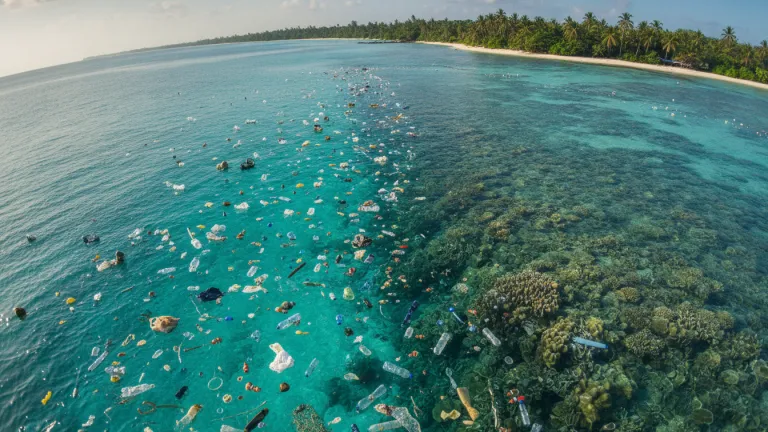
Imagine opening a can of tuna for lunch and discovering, years later, that microscopic fragments of plastic from that product’s packaging may already be circulating in your own bloodstream. It sounds like science fiction, but this is exactly what scientific studies published in recent years have been pointing out with growing concern. The plastic we discard — on beaches, in rivers, on sidewalks — travels a long, invisible, and disturbing path until it reaches the oceans, and from there, back to us.
Every year, an enormous amount of plastic waste escapes into the seas. Marine plastic pollution is recognized by the UN as one of the most urgent environmental crises on the planet, alongside climate change and biodiversity loss. The problem isn’t just aesthetic — those images of turtles trapped in packaging rings or beaches covered in bottles. The problem is chemical, biological, and systemic, affecting everything from the simplest organisms to humans at the top of the food chain.
In this article, we’ll explain what happens to plastic after it reaches the ocean: how it fragments, where it ends up, what it does to ecosystems and our bodies — and most importantly, what each of us can do to reduce our part in this story.
The path of plastic to the ocean
Plastic rarely goes directly from your trash to the sea. The journey is longer and often begins in urban areas far from the coast. Rain washes plastic waste from streets into storm drains and streams. These streams feed rivers. Rivers flow into the ocean.
According to data from the United Nations Environment Programme (UNEP), most plastic entering the oceans comes from land-based sources — that is, from cities, industrial areas, and inadequate disposal practices. Countries with precarious sanitation systems or deficient waste collection contribute disproportionately to this flow, although global responsibility is shared by all plastic-producing and consuming countries.
In Brazil, the situation is complex. Despite advances in environmental legislation, a significant portion of solid waste is still disposed of improperly, according to data from Abrelpe’s Solid Waste Overview. Rivers such as the Tietê, Capibaribe, and Paraíba do Sul have been identified as important vectors for transporting plastic to the Atlantic coast.
What happens to plastic in the sea: fragmentation and microplastics
When plastic reaches the ocean, it doesn’t disappear. It fragments. The combined action of ultraviolet radiation, heat, wave movement, and mechanical abrasion breaks larger pieces into increasingly smaller fragments called microplastics (particles smaller than 5 millimeters) and eventually nanoplastics (particles on the nanometer scale, invisible to the naked eye).
This process can take decades or centuries. A PET bottle, for example, can take between 400 and 500 years to completely decompose in the marine environment — and even then, what remains are microscopic particles, not the absence of plastic.
Microplastics have diverse origins:
- Fragmentation of larger items (bottles, bags, packaging)
- Industrial pellets (granules used as raw material in the plastic industry)
- Synthetic fibers released when washing polyester and nylon clothing
- Tires that release particles as they wear on roads, carried by rain
- Cosmetic products that previously contained plastic microbeads (now banned in several countries)
Scientific studies have found microplastics in virtually all marine environments evaluated: from ocean surfaces to the deepest trenches on the planet, including the Mariana Trench, more than 10,000 meters deep.
The great accumulations: the “plastic continents”
One of the most striking consequences of marine plastic pollution is the accumulation zones created by ocean currents, popularly called “islands” or “continents” of trash. The most well-known is the Great Pacific Garbage Patch, an area of high concentration of plastic debris located between Hawaii and California.
It’s important to demystify: these “islands” are not solid surfaces where one could walk. They are actually zones of high density of microplastics and smaller fragments, many of them suspended below the surface. The concentration is invisible from a distance but devastating to marine organisms living in this region.
There are five major oceanic gyres of accumulation in the world — in the North and South Pacific, North and South Atlantic, and the Indian Ocean. The South Atlantic, which includes regions near Brazil, also has documented accumulations of plastic waste.
Impacts on marine life: from turtles to plankton
The effects of plastic on marine organisms are varied and frequently fatal. Marine fauna suffers in two main ways: entanglement and ingestion.
Entanglement primarily affects marine mammals, birds, and turtles. Abandoned fishing nets — so-called ghost gear — continue to capture animals indefinitely. The IUCN (International Union for Conservation of Nature) recognizes entanglement in marine debris as a significant threat to several species listed as vulnerable or endangered.
Ingestion occurs at all levels of the food chain:
- Seabirds, like the albatross, mistake colorful plastic fragments for food and bring them to their chicks
- Fish and crustaceans ingest microplastics while feeding on plankton
- Turtles mistake plastic bags for jellyfish
- Plankton, the base of the entire marine food chain, can ingest nanoplastics
Beyond the physical effects (obstruction, false satiety, internal injuries), plastics carry toxic chemical additives — such as plasticizers, flame retardants, and heavy metals — and also adsorb persistent organic pollutants present in seawater. When ingested, these compounds can cause hormonal changes, liver damage, and other toxic effects in animals.
Microplastics in the human body: what we already know
Perhaps the most alarming — and most recent — aspect of the oceanic plastic crisis is its arrival in the human body. Research published in high-impact scientific journals has already detected microplastics in samples of human blood, lung tissue, placenta, breast milk, and feces from people in different countries.
How do they reach us?
- Through consumption of seafood, especially mollusks like mussels and oysters, which filter large volumes of water
- Through consumption of mineral water bottled in plastic
- Through inhalation of airborne particles
- Through sea salt and other processed foods
It’s important to be honest about what science still doesn’t know: the long-term effects of human exposure to microplastics are still being studied. There is no established scientific consensus on what concentrations cause harm to human health. What exists is a growing and legitimate concern that justifies preventive action.
Solutions that already exist — and what you can do today
The good news is that we’re not completely adrift. Public policies, technological innovations, and individual behavior changes combined have real potential to reduce the flow of plastic into the oceans. In 2024 and 2025, negotiations for a Global Treaty Against Plastic Pollution under UN mediation advanced significantly, with the goal of regulating the entire life cycle of plastic.
But while the world negotiates, you can act now. Here’s what works in practice:
- Refuse single-use plastic whenever possible: straws, disposable cutlery, plastic bags
- Carry your own reusable bottle made of stainless steel or glass — it reduces microplastic ingestion and packaging disposal
- Wash synthetic clothes with microfiber filters (already available on the market), which retain most fibers before they reach the sewage system
- Dispose of waste correctly: never throw trash in rivers, beaches, or vacant lots
- Participate in or organize cleanup efforts at rivers, beaches, and springs in your city
- Choose products with less packaging and buy in bulk whenever possible
- Pressure companies and supermarkets for more sustainable packaging — consumers have more power than they realize
- Support local policies for selective collection and composting — two actions that together divert enormous amounts of material from improper disposal
Small everyday swaps make a real difference when multiplied by millions of people. If you want to go further in conscious consumption, it’s worth reading about how buying from local producers can reduce the environmental impact of your choices.
The role of science and innovation in combating ocean plastic
Technology is also advancing. Researchers around the world are investigating solutions ranging from bacteria capable of degrading plastics (such as Ideonella sakaiensis, discovered in Japan in 2016 and still in the applied research phase) to biodegradable materials of plant origin that could replace synthetic polymers.
In the field of ocean cleanup, projects like The Ocean Cleanup are developing waste collection systems in rivers and oceanic accumulation zones — with promising results, though experts warn they are not sufficient on their own. Cleaning what’s already in the sea is necessary but insufficient without drastically reducing what enters.
The transition to a circular economy — where materials remain in use for as long as possible without becoming waste — is identified by UNEP and sustainability experts as the most effective structural path. This requires product redesign, collection and recycling infrastructure, and profound cultural change.
Conclusion: the ocean begins at your tap
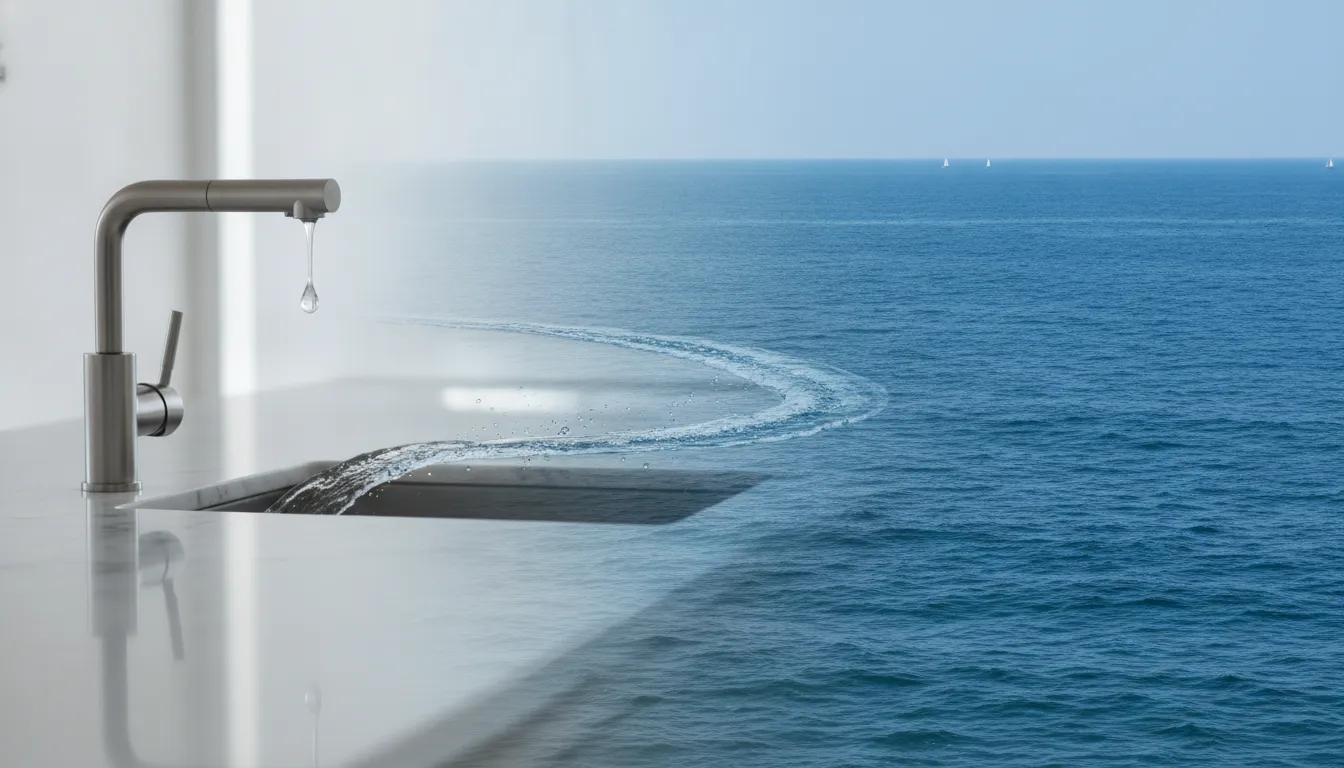
The plastic that reaches the ocean doesn’t come from nowhere. It comes from decisions: from industries that choose disposables, from governments that don’t invest in sanitation, and also from everyday choices of billions of consumers. The good news is that decisions can be changed.
The ocean covers more than 70% of the planet’s surface, produces more than half the oxygen we breathe, and regulates the global climate. Taking care of it isn’t a matter of romantic love for nature — it’s a matter of practical survival.
You don’t need to solve the entire crisis. But you can start today: swap a plastic bottle for a reusable one, participate in a cleanup effort, or simply never leave plastic waste by a riverbank again. Multiplied by many, this matters — a lot.
The ocean has no voice to ask for help. But we have a voice to act on its behalf.
