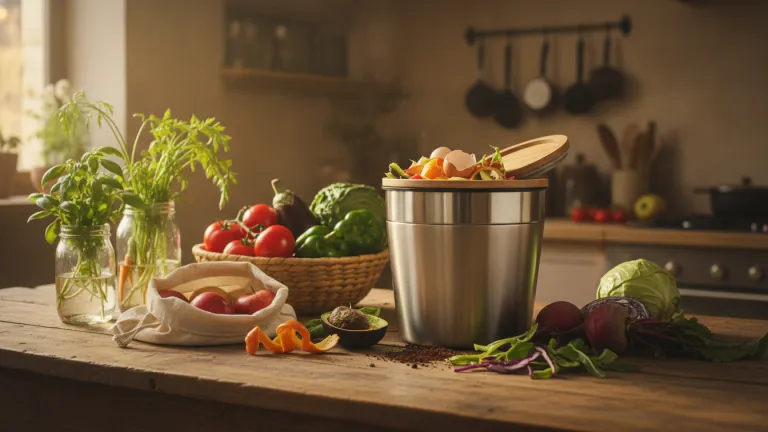
Why the Kitchen Is the Heart of Waste
Have you ever opened the fridge and found that kale leaf wilting in the back, the tomato that softened before being used, or leftover rice forgotten for days? This seemingly mundane scene repeats itself in millions of homes every day — and has a much greater environmental cost than we imagine.
Food waste is one of the most underestimated everyday environmental problems. According to the Food and Agriculture Organization of the United Nations (FAO), about one-third of all food produced worldwide for human consumption is lost or wasted along the supply chain. In many countries, estimates based on research data indicate that losses and waste occur at all stages — from harvest to table — with domestic consumers responsible for a significant portion of what gets thrown away. This discarded food carried water, energy, labor, and land to be produced. And when it rots in landfills, it still emits methane, a greenhouse gas with warming power far greater than carbon dioxide.
The good news is that the kitchen can also be the starting point for real change. With simple, organized habits, it’s possible to drastically reduce household waste, save money, and even eat better. This article brings practical strategies, organized by topic, for you to apply today.
The Environmental Impact of Food Waste You Don’t See
When we throw food away, we rarely think beyond the trash bag. But the waste cycle begins long before — and ends long after — that moment.
To produce food, natural resources are consumed in large quantities: water for irrigation, fuel for transportation, plastic packaging for storage, fertilizers and pesticides that impact soil and water bodies. When this food never gets consumed, all these resources were used in vain.
At the final destination, organic waste deposited in landfills undergoes anaerobic decomposition (without oxygen), releasing methane (CH₄) into the atmosphere. Methane is a greenhouse gas that, according to the IPCC, has a global warming potential dozens of times greater than CO₂ over a 20-year horizon. Understanding this chain of impacts is fundamental to understanding why the greenhouse effect is directly linked to our daily habits — including those in the kitchen.
Shopping Planning: The First Step Against Waste
Most household waste begins long before any food spoils. It starts at the supermarket, without a list and without planning.
How to create an efficient shopping plan
- Create a weekly menu before going to the store. Decide on meals for the next seven days, considering your actual routine — days when you work late, eat out, or have guests.
- Take inventory of your fridge and pantry. Before writing your list, see what you already have at home. Prioritize using what’s already there first.
- Write your list organized by category. Vegetables, proteins, grains, dairy. This prevents impulse purchases and helps maintain focus.
- Buy quantities appropriate for your reality. “Buy 3, pay for 2” promotions are only worthwhile if you’ll actually consume everything before it expires.
- Prefer farmers’ markets for fruits and vegetables. You buy the exact amount you need, without the obligation of pre-packaged quantities from supermarkets.
This simple planning may seem laborious at first, but quickly becomes a habit that saves time, money, and consistently reduces waste.
Refrigerator Organization: Every Food in Its Right Place
A disorganized refrigerator is a food-wasting machine. When we don’t see what we have, we forget — and we forget until it spoils.
Basic organization principles to reduce waste
- FIFO (First In, First Out): always place older foods or those with shorter expiration dates in front. Newer items go in the back.
- Respect temperature zones: the bottom drawer is colder and ideal for meats. Middle shelves are good for dairy and leftovers. The door, being warmer, is suitable for condiments and beverages.
- Use transparent containers: what you see, you use. Opaque containers hide leftovers that end up forgotten.
- Never store fruits and vegetables together without separation: many fruits release ethylene, a gas that accelerates the ripening (and spoiling) of nearby vegetables.
- Label leftovers with dates: a small piece of masking tape and a pen are enough to know how many days that soup has been stored.
Beyond the refrigerator, the pantry also deserves attention. Grains, flours, and cereals in airtight containers last much longer and stay protected from humidity and pests.
Whole Food Utilization Techniques
One of the most powerful ways to reduce kitchen waste is to change how we view food. Much of what normally goes in the trash is actually edible and nutritious.
What you can use that you normally discard
| Discarded part | How to use it |
|---|---|
| Kale and broccoli stems | Stir-fry, soup, or smoothie |
| Zucchini and cucumber peels | Baked chips or pickles |
| Beet and carrot leaves | Sautéed with garlic and olive oil |
| Banana peel | Vegan pulled “pork,” cake |
| Vegetable cooking water | Base for broths and soups |
| Stale bread | French toast, croutons, breadcrumbs |
| Dried-out cheese | Grated for gratins |
Whole food utilization doesn’t require advanced culinary skills. It only requires the habit of asking: “What else can I do with this before throwing it away?”
If you want to dive deeper into this topic with detailed recipes and techniques, check out our complete guide on reducing food waste at home.
Preservation and Storage: Make Your Food Last Longer
Knowing how to store food correctly can double (or triple) the shelf life of many items. It’s not complex chemistry — these are simple techniques anyone can apply.
Practical preservation tips
- Fresh herbs like parsley and cilantro: wrap in slightly damp paper towel and store in a sealed bag in the refrigerator, or freeze chopped in ice cube trays with a bit of water or olive oil.
- Leafy greens: wash, dry well, and store with paper towel absorbing excess moisture inside a sealed container.
- Ripe fruits: very ripe bananas, mangoes, and avocados can be frozen and used later in smoothies or recipes.
- Cooked beans and rice: last up to 5 days in the refrigerator and can be frozen for up to 3 months without significant quality loss.
- Bread: freeze slices separated by parchment paper. Defrosting in the toaster maintains texture.
- Blanching technique: vegetables like spinach, green beans, and broccoli can be quickly pre-cooked in boiling water, cooled in ice water, and frozen — lasting months this way.
Freezing is one of the most underutilized tools in home kitchens. Used intelligently, it transforms leftovers into future meals ready for consumption.
Composting: When Organic Waste Becomes Fertilizer
Even with all the planning and utilization, there will always be organic waste: eggshells, coffee grounds, unusable fruit peels, used napkins. For these materials, composting is the best destination.
How to start composting at home (even in an apartment)
- Choose the method suitable for your space. For apartments, worm composters (vermicomposting) are compact, odorless when properly managed, and very efficient. For houses with yards, larger composters or ground piles work well.
- Separate organic waste from the rest of the trash. A small container with a lid on the kitchen counter makes disposal easier during meal preparation.
- Balance wet and dry materials. Fruit peels and food scraps (wet) should be alternated with paper, sawdust, or dry leaves (dry). This balance prevents bad odors and speeds up decomposition.
- Avoid meats, dairy, and very fatty foods in home composters — they attract pests and can create odors.
- In a few months, you’ll have ready compost, a natural fertilizer rich in nutrients perfect for plants and home gardens.
For those living in cities without space or interest in composting at home, many municipalities have organic waste collection points or community composting programs. It’s worth researching what exists in your area.
Quick List: 15 Habits to Adopt This Week
To make it easier, here are concrete actions you can start implementing immediately, at no cost and without complication:
- Create a weekly menu before going to the store
- Never go to the supermarket without a list and while hungry
- Check the fridge and pantry before buying
- Store leftovers in transparent, labeled containers
- Use the FIFO method in the fridge and pantry
- Freeze what you won’t consume within 2 days
- Use stems, peels, and leaves when preparing meals
- Transform stale bread into croutons or toast
- Use vegetable cooking water as broth
- Store fresh herbs with damp paper towel
- Prepare “fridge meals” once a week using what’s left over
- Buy fruits and vegetables in smaller quantities more frequently
- Defrost foods with planning, in the refrigerator, don’t throw them away
- Start a compost bin, even a small one
- Involve your family or housemates — collective habits are more lasting
Take the First Step Today

Reducing kitchen waste doesn’t require perfection. It requires awareness and small decisions, repeated with consistency. Every meal you plan, every food you store correctly, every peel you transform into an ingredient instead of throwing away represents a real impact — on the environment, on your grocery bill, and on the quality of your diet.
You don’t need to change everything at once. Choose two or three habits from this list and start with them. When these are incorporated into your routine, add more. Over time, you’ll be surprised by how much waste you’ve stopped generating and how much better you’ve started using what you have.
The kitchen is a place of creativity and care. When we use these values also in relation to the planet, we transform a domestic space into an act of collective responsibility. Less waste in your kitchen means less pressure on the planet’s natural resources — and that starts now, with the next meal you prepare.
