Greenhouse Effect: What It Is and Why It Affects Us
Imagine an invisible blanket wrapped around the Earth. It retains part of the Sun’s heat, prevents temperatures from plummeting at night, and makes the planet habitable. This is the natural greenhouse effect — a process that has existed for billions of years and without which Earth’s average temperature would be approximately -18 °C, making all life as we know it impossible.
The problem begins when this blanket becomes too thick. Since the Industrial Revolution in the 19th century, humanity has been releasing increasing amounts of greenhouse gases (GHGs) into the atmosphere, intensifying a process that was previously balanced. The result is global warming: a phenomenon that is already reorganizing climates, ecosystems, and economies around the world — including in Brazil.
In 2026, this topic is no longer a distant prediction. It’s a reality that appears in heat waves across southeastern Brazil, floods in Rio Grande do Sul, droughts in the Pantanal, and climate news dominating headlines. Understanding the greenhouse effect is the first step toward acting with awareness — and that’s exactly what you’ll find in this article.
What Is the Greenhouse Effect and How Does It Work
The greenhouse effect is a natural process of thermal regulation in Earth’s atmosphere. It occurs because certain gases present in the atmosphere absorb infrared radiation (heat) emitted by Earth’s surface and radiate it back downward, instead of letting it escape into space.
The mechanism works like this:
- Solar radiation (visible light) passes through the atmosphere and heats Earth’s surface.
- The surface re-emits this energy as heat (infrared radiation).
- Greenhouse gases absorb part of this heat and return it to the surface.
- The planet’s temperature remains in balance — or rises when these gases are in excess.
The Main Greenhouse Gases
Not all atmospheric gases contribute to the greenhouse effect. Oxygen and nitrogen, for example, let radiation pass through. However, GHGs have a molecular structure that efficiently absorbs heat. The main ones are:
| Gas | Symbol | Main Human Source | Warming Potential (GWP-100) |
|---|---|---|---|
| Carbon dioxide | CO₂ | Burning fossil fuels | 1 (reference) |
| Methane | CH₄ | Livestock, landfills, natural gas | ~28 times CO₂ |
| Nitrous oxide | N₂O | Fertilizers, agriculture | ~265 times CO₂ |
| Fluorinated gases (HFCs, etc.) | — | Refrigeration, air conditioning | Thousands of times CO₂ |
Source: IPCC, Sixth Assessment Report (AR6), 2021–2022.
CO₂ is the most abundant gas released by human activities and, therefore, the main contributor to the increased greenhouse effect since industrialization.
The Difference Between Natural and Anthropogenic Greenhouse Effect
It’s essential to understand that the greenhouse effect itself is not the villain — it’s necessary. What has become problematic is the anthropogenic greenhouse effect, meaning the one intensified by human action.
Before the Industrial Revolution, atmospheric CO₂ concentration was around 280 parts per million (ppm). According to NOAA (National Oceanic and Atmospheric Administration) data, this value has exceeded 420 ppm in recent years — the highest level recorded in the last 800,000 years, based on Antarctic ice core data analyzed by researchers from EPICA (European Project for Ice Coring in Antarctica).
This increase of more than 50% in atmospheric CO₂ concentration is the main driver of observed global warming. According to the Intergovernmental Panel on Climate Change (IPCC), in its Sixth Assessment Report (AR6), the global average temperature has already increased approximately 1.1 °C above pre-industrial levels — and we’re on a trajectory that could exceed 1.5 °C within this decade, depending on actions taken by countries.
How Brazil Contributes to and Is Affected by the Greenhouse Effect
Brazil holds a unique position in the global climate debate: it is both a significant GHG emitter and one of the countries most vulnerable to the consequences of warming.
Brazilian Emissions: Where They Come From
Unlike industrialized countries, where fossil fuel burning dominates emissions, Brazil’s profile is different. Historically, deforestation and agriculture account for the largest share of national emissions. According to the Greenhouse Gas Emissions and Removals Estimation System (SEEG), from the Climate Observatory, land use and agriculture sectors have dominated the national emissions inventory.
This means that when an area of Cerrado or Amazon is deforested, the carbon stored in trees is released into the atmosphere — directly amplifying the greenhouse effect.
Impacts Already Felt on National Territory
The effects of warming are not abstract for Brazilians:
- Extreme drought: the Pantanal recorded large-scale fires in recent years, associated with severe drought periods.
- Intense rainfall: extreme precipitation events have caused disasters in states like Rio Grande do Sul, Santa Catarina, and São Paulo.
- Increased urban heat: cities like São Paulo, Rio de Janeiro, and Manaus have recorded historic temperature highs.
- Threats to agriculture: crops like coffee, soybeans, and corn may have their production zones displaced as the climate changes, according to Embrapa studies.
- Public health: extreme heat increases hospitalizations for cardiovascular and respiratory diseases, especially among the elderly and children.
Why the Intensified Greenhouse Effect Affects Our Daily Lives
You don’t need to live on the coast or in a risk area to feel the effects. Global warming has practical consequences that reach your routine:
- Higher energy bills: hotter summers increase the use of air conditioning and fans, raising residential electricity consumption.
- More expensive food: droughts and extreme weather events affect harvests and raise prices at the supermarket.
- Health at risk: heat waves are public health events, especially for vulnerable groups.
- Amplified inequality: low-income populations living in peripheries with fewer green areas suffer disproportionately from urban heat.
- Threatened biodiversity: the International Union for Conservation of Nature (IUCN) identifies climate change as one of the main threats to global biodiversity, affecting ecosystems we depend on for water, food, and climate regulation.
Understanding this chain of impacts is essential to realize that climate is not just an environmentalist issue — it’s an economic, social, and public health matter.
What Can Be Done: From Individual to Collective Action
The good news is that we have tools to act — and every level of action counts.
What You Can Do Today
- Reduce red meat consumption: cattle ranching is one of the main sources of methane in Brazil and worldwide. Reducing it, even partially, makes a difference.
- Prefer public transportation, cycling, or walking whenever possible. The transportation sector is one of the largest CO₂ emitters in cities.
- Avoid food waste: producing food that ends up in the trash generates emissions with no benefit.
- Consume energy from renewable sources: in Brazil, solar energy is growing rapidly. It’s worth researching solar energy cooperatives or panels for your home.
- Support and demand climate policies: vote consciously, follow environmental legislation, and support organizations working for the climate.
- Plant trees responsibly: reforestation helps capture carbon, but it needs to be done the right way. Learn more at Planting Trees the Right Way Makes All the Difference.
The Role of Companies and Governments
Individual changes are important, but insufficient without systemic transformations. Companies have a responsibility to measure, reduce, and offset their emissions — a commitment that falls under the ESG agenda. To understand how this works in practice, check out the article on ESG in Companies: What It Means in Practice.
Governments, in turn, need to advance deforestation regulation, energy transition, low-carbon public transportation, and climate adaptation in cities. Brazil, with its potential in renewable energy and biodiversity, has a strategic role in this global transition.
Common Myths About the Greenhouse Effect
It’s important to separate fact from misinformation:
- “The greenhouse effect is an invention.” False. It’s a physical phenomenon documented since the 19th century, when scientist Eunice Newton Foote, in 1856, experimentally demonstrated that CO₂ absorbs heat.
- “The climate has always changed naturally, so it’s not human’s fault.” Climate does indeed change naturally in long cycles. But the speed and magnitude of current warming are incompatible with natural causes — science establishes with very high certainty the human origin of recent warming.
- “Plants absorb all the CO₂ we emit.” Forests and oceans absorb part of emissions, but not all. And when forests are destroyed, they go from carbon sinks to carbon sources.
- “Only rich countries need to act.” All countries need to act, with differentiated responsibilities. Developed countries have greater historical responsibility, but no nation is exempt from the challenge.
Conclusion: Understanding Is the First Step to Acting
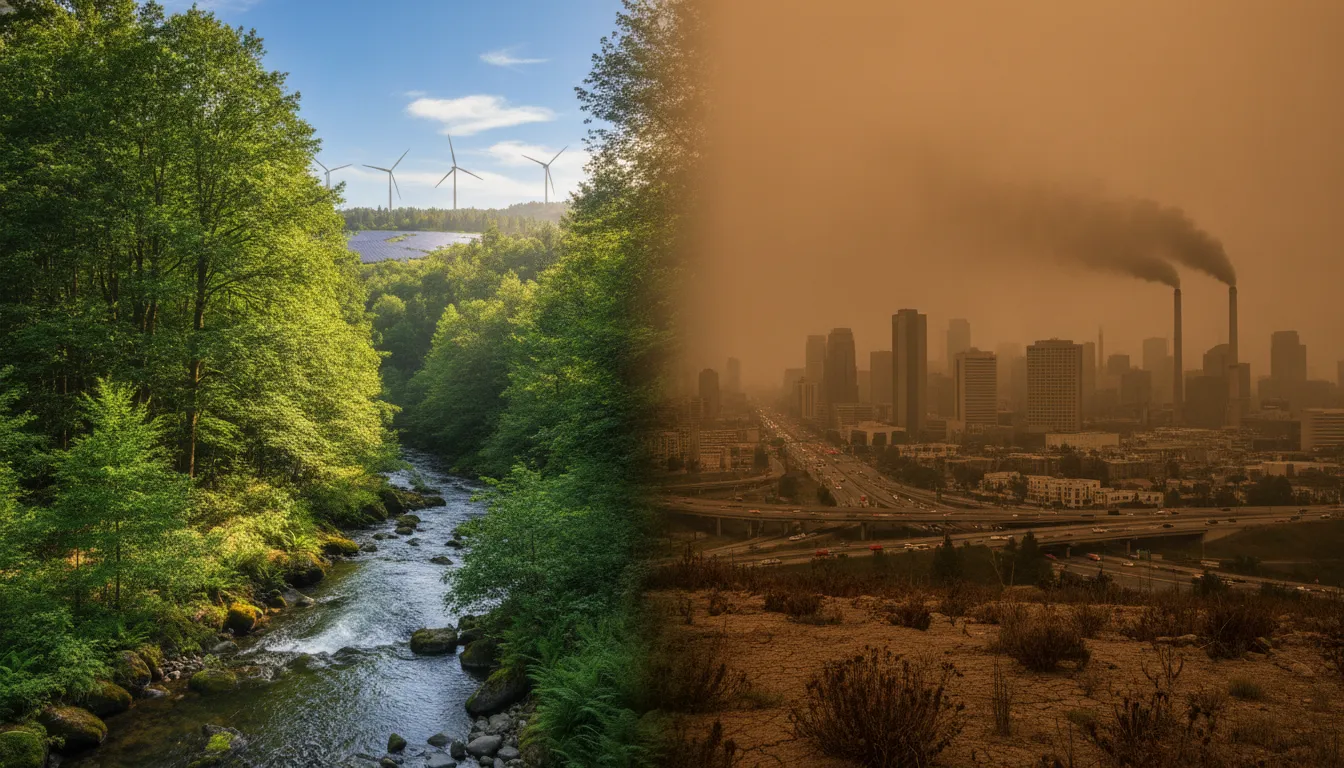
The intensified greenhouse effect is one of the greatest challenges of our generation — but also an opportunity to rethink how we relate to the planet. Science is clear: the window to limit the worst impacts is still open, but it’s progressively closing.
You don’t need to be a scientist, politician, or business leader to be part of the solution. Understanding the problem, making more conscious daily choices, and demanding accountability from those in power is already a powerful way to act. To take the next steps, explore our guide on Sustainable Habits to Adopt Today and Feel the Difference and start today.
The planet needs many hands — and yours makes a difference.
