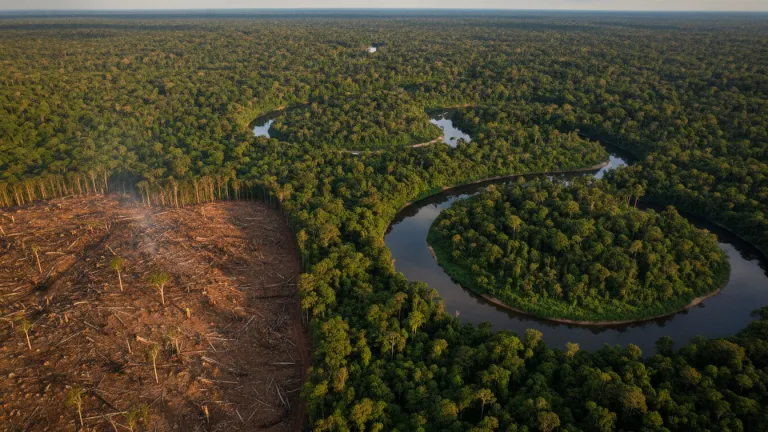
The Amazon is often called the “lungs of the planet” — and this metaphor, while popular, underestimates what the forest truly represents. More than producing oxygen, it regulates climate on a continental scale, harbors unparalleled biodiversity, and stores decades of accumulated carbon. When an Amazonian tree is felled, the impact doesn’t stay confined to that hectare of ground. It spreads through rivers, rainfall, temperatures, and human lives thousands of kilometers away.
Deforestation in the Amazon is not a new problem, but it remains urgent. Despite significant advances recorded in recent years, such as the substantial reduction in deforestation in Brazil between 2023 and 2025, the forest still faces intense pressures from illegal mining, land grabbing, and agricultural expansion. Understanding what’s at stake — with real data, without empty catastrophism — is the first step toward acting consciously.
This article explains, clearly and based on evidence, what Amazon deforestation does to the planet: to the global climate, to biodiversity, to the water cycle, to local populations, and to Brazil’s own economic prospects. And, in the end, it shows what you can do about it.
What Is Amazon Deforestation and What’s the Scale of the Problem
The Brazilian Amazon covers approximately 5.5 million km², representing about 60% of the entire Amazon rainforest, which extends across nine South American countries. It is the largest tropical forest biome in the world.
Cumulative historical deforestation in Brazil up to recent years has removed an area equivalent to more than 20% of the original biome cover in the Brazilian portion — a figure surveyed by the PRODES system of Brazil’s National Institute for Space Research (INPE). At the peak of the crisis, between 2019 and 2021, Brazil recorded annual deforestation rates exceeding 10,000 km², reaching approximately 13,000 km² in 2021, according to PRODES/INPE data.
The good news is that there has been a decline. Between 2023 and 2025, the Brazilian federal government resumed environmental control policies, and deforestation numbers dropped significantly. But experts warn that the forest has already lost so much that certain regions — especially in the south and east of the Amazon — are close to an ecological tipping point, beyond which degradation would become self-sustaining, regardless of human policies.
The Impact of Amazon Deforestation on Global Climate
The link between tropical deforestation and climate change is direct and well-documented by the IPCC (Intergovernmental Panel on Climate Change). Tropical forests act as carbon sinks: they absorb CO₂ from the atmosphere and store it in biomass — trunks, branches, roots, and soil.
When a tree is felled and burned, this stored carbon is released back into the atmosphere. The burning of tropical forests is one of the main sources of greenhouse gas emissions in the world. In the 2022 IPCC report (AR6), deforestation and land-use change appear as responsible for a significant portion of historical global CO₂ emissions.
In Brazil’s case, the land-use change and forestry sector (which includes deforestation and fires) has historically ranked among the largest national sources of greenhouse gas emissions, even surpassing the energy sector in some years — data recorded in national emissions inventories released by the Ministry of Science, Technology and Innovation.
In practical terms: every hectare of Amazon forest cleared releases decades of accumulated carbon, contributing to the global warming that affects more intense winters in Europe, droughts in Africa, and more powerful hurricanes in the Caribbean.
The Biodiversity Crisis: Species the World Could Lose
The Amazon harbors one of the highest concentrations of biodiversity on the planet. It’s estimated that the forest is home to more than 10% of all known species on Earth — a figure consolidated by research from the IUCN (International Union for Conservation of Nature) and Brazilian scientific institutions such as INPA (National Institute for Amazonian Research).
This includes:
- More than 40,000 described vascular plant species
- Approximately 1,300 bird species
- More than 3,000 types of freshwater fish
- Hundreds of amphibian, reptile, and mammal species, many not yet catalogued by science
Deforestation fragments this ecosystem. When patches of forest are isolated by pastures or plantations, animal populations become confined to “islands” that cannot support their long-term reproduction. This phenomenon, called the edge effect, results in the silent extinction of species that never even get discovered.
Biodiversity loss is not just a moral or aesthetic tragedy. Ecosystem services such as pollination, pest control, and disease regulation depend directly on biological diversity — and have concrete economic value for agriculture and human health.
The Water Cycle and “Flying Rivers”: How Deforestation Affects Water
One of the most underestimated effects of Amazon deforestation is its impact on rainfall patterns — including in regions far from the forest.
The Amazon functions as a giant moisture pump. Trees absorb water from the soil and release it into the atmosphere through a process called evapotranspiration. This moisture forms air masses loaded with vapor that move toward southern and southeastern Brazil — the so-called “flying rivers”, a term popularized by researcher Antonio Donato Nobre from INPA.
These atmospheric rivers are responsible for much of the rainfall that irrigates food-producing regions in Mato Grosso, São Paulo, Paraná, and Minas Gerais. When the forest is cleared, this “pump” loses power.
Research published in peer-reviewed scientific journals suggests that the reduction in Amazon forest cover is already associated with changes in precipitation patterns in Central Brazil. More intense and prolonged droughts, like those recorded in southeastern Brazil in recent years, are related to forest degradation — although climate is a complex system, and multiple factors interact simultaneously.
In summary: deforesting the Amazon also means drying up rivers and compromising food production in states more than a thousand kilometers from the forest.
The Impact on Indigenous Populations and Local Communities
Deforestation doesn’t just affect nature. It destroys entire ways of life. The Brazilian Amazon is home to more than 300 indigenous peoples, with unique languages, cultures, and knowledge systems, according to data from FUNAI (National Foundation for Indigenous Peoples).
These communities depend directly on the forest for food, medicine, spirituality, and identity. The advance of illegal deforestation onto indigenous lands — often associated with illegal gold mining — results in violent conflicts, river contamination by mercury, and collapse of health conditions for these populations.
Beyond indigenous peoples, riverside and extractivist communities build their economy around products from the standing forest: Brazil nuts, açaí, rubber, sustainably managed timber. The living forest has more economic value than the pasture that replaces it — an argument increasingly supported by environmental economics studies.
What You Can Do: Concrete and Accessible Actions
The deforestation issue may seem distant and intractable for those living in cities. But everyday consumer choices have a real impact on the supply chain that pressures the forest. Here are practical actions you can take:
- Reduce beef consumption: extensive cattle ranching is the main direct cause of deforestation in the Amazon, according to MapBiomas data. You don’t need to become vegetarian overnight — reducing consumption already makes a difference.
- Check the origin of your food: apps and certification labels help identify products from deforestation-free supply chains.
- Support monitoring and conservation organizations: entities such as ISA (Socio-Environmental Institute), Imazon, and WWF-Brazil work with data and political pressure to protect the forest. Donations, even small ones, sustain this work.
- Hold your political representatives accountable: deforestation is also a governance issue. Voting and demanding active oversight from legislators is one of the most powerful tools citizens have.
- Avoid products with non-certified palm oil: deforestation isn’t exclusive to the Amazon; other biomes like the Cerrado and Atlantic Forest also suffer, and global supply chains bear responsibility.
- Reduce your overall consumption: everyone’s environmental footprint includes items produced in supply chains that pressure forests. Being eco-friendly without spending much is easier than it seems — and every small choice adds up.
Reasons for Hope: What Works in Protecting the Amazon
Amid a challenging scenario, there are concrete lessons that public policies work. Brazil has already shown the world that it’s possible to drastically reduce deforestation: between 2004 and 2012, the country cut Amazon deforestation rates by about 80%, according to INPE data, thanks to a combination of satellite monitoring, intensified enforcement, creation of protected areas, and international market pressure on the soy supply chain.
This historic result proves that deforestation is not inevitable. It’s a consequence of political and economic choices — and therefore can be reversed with the right choices.
Internationally, the Amazon Fund, managed by BNDES with contributions mainly from Norway and Germany, financed conservation and sustainable development projects for over a decade. The resumption of its operations in 2023 was a positive sign. Global climate agreements, such as the Paris Agreement, also create incentives for countries to protect their forests.
The solution is neither simple nor quick. But it exists — and it’s being built by scientists, indigenous peoples, public managers, responsible farmers, and conscious consumers around the world.
Conclusion: The Forest Is Also Yours
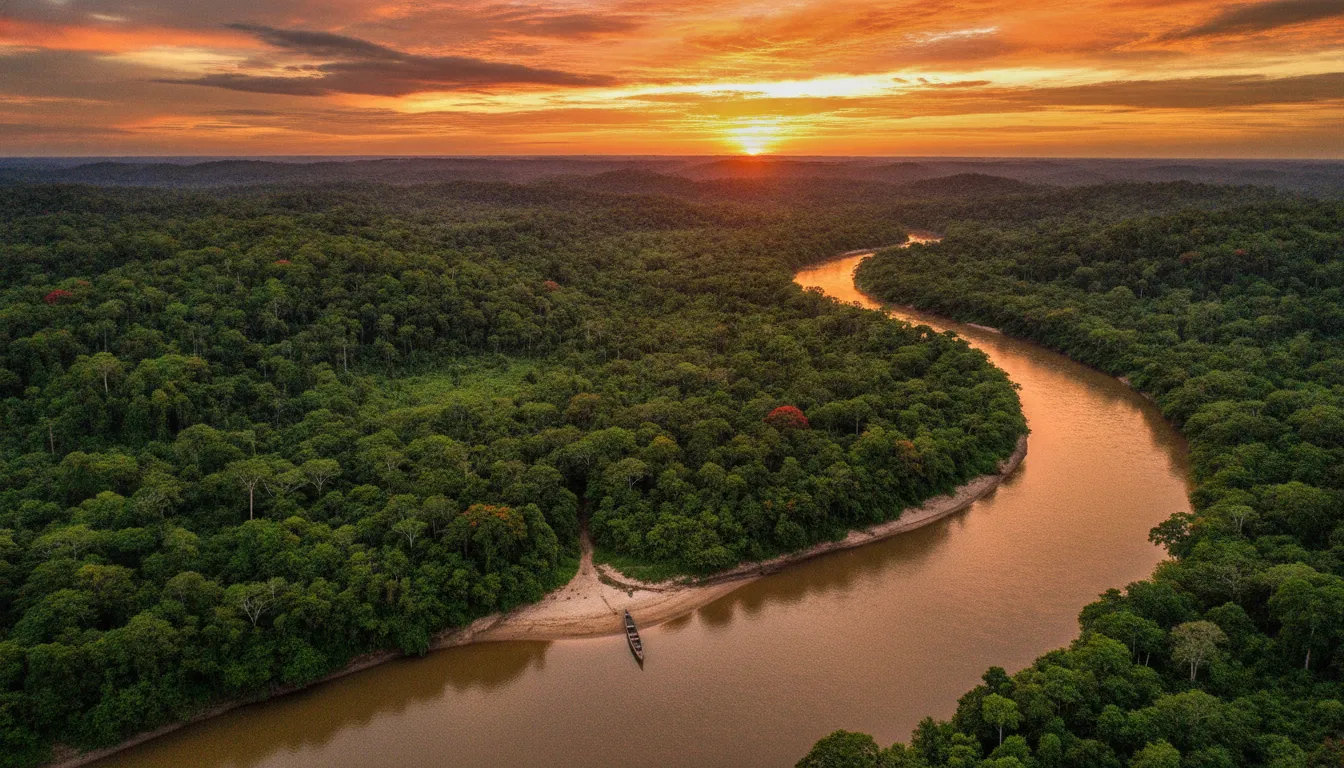
Deforestation in the Amazon is not a distant problem, restricted to environmentalists or residents of northern Brazil. It affects the climate that regulates your temperature, the rainfall that produces your food, the air you breathe, and the future you’ll leave for the next generations.
The good news is that the trajectory is not fixed. Tropical forests have the capacity to recover when protected. Effective environmental policies exist and work. And every person who understands the problem and acts — in their consumption choices, in their vote, in their voice — is part of the solution.
If you want to go further and reduce your environmental footprint in daily life, start with simple steps: being eco-friendly without spending much is easier than it seems. The Amazon needs robust public policies — but it also needs informed, engaged citizens willing to act. You are one of them.
