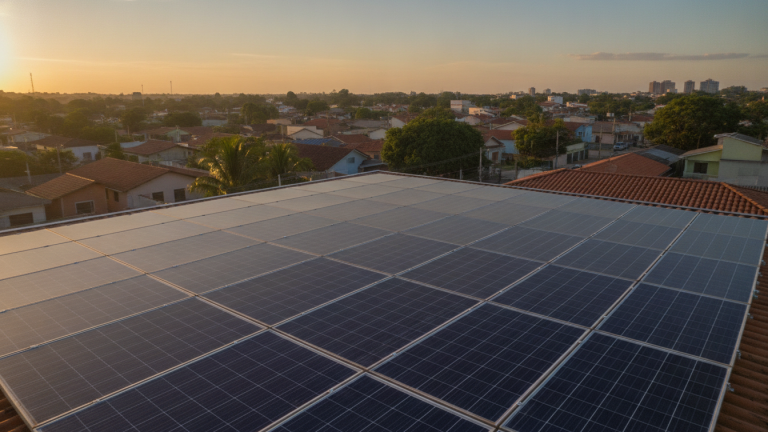
What is solar energy payback and why it matters to you
Imagine receiving your electricity bill at the end of the month and feeling that pinch. In 2025, electricity rates in Brazil underwent significant adjustments, and many people started looking at solar panels on their neighbor’s roof with a mix of curiosity and doubt: “Is it really worth it?” The answer depends on a simple concept called payback, which is the time it takes for the initial investment to pay for itself through savings on your electricity bill.
This article will show you, with real data and no beating around the bush, how long it takes for a solar energy system to pay for itself in Brazil in 2026, what influences this timeline, and how you can calculate an estimate for your own home.
The Brazilian solar market in 2026
Brazil is today one of the largest solar energy markets in the world. According to data from ANEEL and the Brazilian Photovoltaic Solar Energy Association (ABSOLAR), the country has exceeded significant milestones in installed capacity in recent years, driven by Law 14.300/2022, the so-called Legal Framework for Micro and Mini-Generation Distribution, which regulated the rights of those who generate energy at home.
This law ensured clearer rules for the compensation system, called net metering (or energy compensation). Basically, when your panels produce more than you consume, the excess goes to the electrical grid and you earn credits that reduce your next bills. This is fundamental to understanding payback, because the speed at which you recover your investment depends directly on how much you stop paying the utility company each month.
Brazil has an enormous natural advantage: we are one of the countries with the highest solar incidence on the planet. Even southern states, considered less sunny in the Brazilian context, receive more solar radiation than much of Europe, where the solar market has been consolidated for decades.
How much does it cost to install solar energy in 2026
The cost of a residential photovoltaic system varies widely, but there is a practical reference. According to ABSOLAR, the average installation price for a residence with consumption between 300 and 500 kWh per month was in the range of R$ 15,000 to R$ 30,000 in recent years, depending on the system’s power, equipment quality, and region of the country.
This value includes solar panels, inverter, mounting structure, wiring, and installation. Labor costs represent a significant portion of the total, so researching companies certified by INMETRO and accredited by the local utility makes a difference in both price and safety.
Some factors that increase costs:
- Roof with unfavorable slope or orientation (ideal is north-facing in Brazil)
- Need for structural reinforcement on the roof
- Systems with batteries for storage (even more expensive, but useful in areas with frequent power outages)
- Distance from the panel to the inverter and electrical panel
How to calculate solar energy payback
The basic calculation is straightforward: you divide the total system cost by the monthly savings on your electricity bill. If the system cost R$ 20,000 and you save R$ 500 per month, the simple payback is 40 months, or about 3 and a half years.
In practice, the calculation is somewhat more refined because it accounts for energy inflation (rates rise over time, which accelerates payback), panel degradation (generally, panels lose about 0.5% to 1% of efficiency per year), and financing costs, if you didn’t pay upfront.
Step-by-step to estimate your payback:
- Get your last three electricity bills and calculate the average monthly consumption in kWh.
- Request quotes from at least three certified installation companies.
- Ask each company to inform the estimated system production (in kWh/month) for your location.
- Calculate estimated monthly savings by multiplying the system production by your energy rate (in R$/kWh, shown on your bill).
- Divide the total system cost by monthly savings to get the simple payback in months.
- Consider that rates tend to rise over the years, which reduces this timeline in practice.
| Consumption profile | Estimated system cost | Estimated monthly savings | Approximate payback |
|---|---|---|---|
| Low (up to 200 kWh/month) | R$ 10,000 to R$ 15,000 | R$ 150 to R$ 250 | 5 to 7 years |
| Medium (300 to 500 kWh/month) | R$ 18,000 to R$ 28,000 | R$ 400 to R$ 700 | 3 to 5 years |
| High (above 600 kWh/month) | R$ 28,000 to R$ 50,000 | R$ 700 to R$ 1,500 | 3 to 4 years |
The above data are market reference estimates. The actual payback depends on your local rate, the utility company, and the conditions of your roof.
What accelerates or delays the return on investment
Living in a city with more hours of sunlight per day makes a huge difference. Cities like Fortaleza, Cuiabá, and Petrolina have solar radiation much higher than average, which means the panels produce more energy for the same installation cost. In Porto Alegre or Florianópolis, production is lower, but the payback still usually happens within a reasonable timeframe.
The electricity rate is another decisive factor. Utilities with higher rates, such as some in the Northeast and Southeast, create greater monthly savings, accelerating payback. ANEEL periodically publishes rates by utility, and you can check these values directly on your electricity bill.
Financing also changes the scenario. Many public and private banks offer credit lines specifically for solar energy. BNDES has programs focused on this segment, and financing can facilitate access, but interest increases the total cost and extends the payback. Simulate carefully before signing any contract.
Common mistakes when investing in solar energy
A frequent mistake is oversizing the system thinking “the bigger, the better.” If you install capacity far beyond your consumption, you’ll generate energy credits that you may not always be able to use, especially after the Legal Framework of 2022 changed the rules for the validity of these credits (which now have a 60-month deadline for use). The system should be sized for your actual consumption.
Another mistake is failing to verify the installer company’s certification. Demand that the company be registered with the local utility and that equipment have INMETRO certification. Panels without proper sourcing may perform much below promised and damage the calculated payback.
Finally, many people forget to check the roof’s condition before installation. A roof with broken tiles or compromised structure will need repairs before receiving panels, and this extra cost needs to be included in the payback calculation.
Solar energy and sustainability beyond the electricity bill
Financial payback is what gets the most attention, but there’s another return that doesn’t appear on your bank statement. A residential photovoltaic system prevents the emission of tons of carbon dioxide over its useful life, which is around 25 to 30 years for good quality panels. Solar energy doesn’t produce pollutants during generation, makes no noise, and takes up space that already exists: your roof.
In Brazil, part of our energy matrix still depends on fossil fuel power plants, activated especially during dry periods or high demand. Each household that generates its own energy helps reduce this dependence. Small individual actions have a real collective effect when multiplied across millions of homes.
If you’re thinking about other ways to reduce your home’s environmental impact, know that it’s possible to combine different practices. Reducing the organic waste that goes to landfills, for example, also has a significant impact, and you can start with something as simple as setting up a composter in a small apartment without needing a yard or much space.
Frequently asked questions about solar energy payback
What is the average payback in Brazil today?
Based on market references available in 2026, the average payback for Brazilian residences falls between 3 and 6 years, depending on the region, the utility rate, and the size of the installed system. Those living in areas with high solar radiation and high rates tend to have faster returns.
Can apartments install solar energy?
Yes, but with more limitations. There is the modality of shared generation and the so-called solar condominiums, which allow apartment residents to participate in a collective system. It’s also possible to subscribe to remote solar plants, where you sign up for a plan and receive credits on your bill without installing anything on your property. ANEEL regulates these modalities.
Do solar panels work on cloudy days?
Yes, with reduced efficiency. Photovoltaic panels generate energy from light, not from heat or direct sunlight. On cloudy days, production drops, but doesn’t reach zero. In Brazil, even in regions with more rain, the average annual radiation is sufficient to make the investment viable.
Do I need frequent maintenance?
Maintenance of a residential solar system is simple and infrequent. The main need is cleaning the panels, which accumulate dust and can have reduced efficiency over time. In regions with little rain, it’s recommended to wash the panels every three or four months with water and a soft cloth. The inverter, an electronic component of the system, has a shorter useful life than the panels (usually 10 to 15 years) and may eventually need replacement.
Get a quote this week

The first step requires no money at all: get your last electricity bills, note the average consumption in kWh, and request quotes from certified installation companies in your city. With two or three quotes in hand, you’ll already be able to apply the payback calculation described here and see with your own eyes if it makes sense for your situation.
Solar energy is no longer a privilege for the wealthy. With accessible financing, rising rates, and an increasingly competitive market, 2026 is a good time to at least discover if it’s worth it for you.
