Imagine opening your closet and noticing clothes with tags still attached — pieces bought months ago that were never worn. Now multiply that by millions of people around the world doing the same thing, several times a year. This is the portrait of fast fashion: a business model that turned clothing into a disposable product, with collections that renew in weeks and prices so low that buying seems to cost nothing. But someone always pays the bill — and who pays the most, systematically, is the environment.
The fashion industry is among the most polluting on the planet. This is no exaggeration: reports from the United Nations Environment Programme (UNEP) indicate that the textile sector is responsible for a significant share of global greenhouse gas emissions, besides being one of the largest consumers of freshwater and one of the main polluters of rivers and oceans. The problem isn’t about dressing well — it’s about how we arrived at a system where a t-shirt can cost less than a coffee and be discarded after two or three washes.
In this article, we’ll understand the real scale of fast fashion’s environmental impact, without catastrophism but without euphemisms. And more importantly, we’ll show what you can do today to be part of the solution.
What is fast fashion and why has it become an environmental problem
The term fast fashion describes a production model where large retail chains launch dozens of collections per year — instead of the traditional two (summer and winter) — with pieces produced quickly, at low cost, and in large volumes. Pioneering brands of this model popularized the idea that being fashionable didn’t have to be expensive, democratizing access to fashion. But the low price tag often hides extremely high costs for the planet and for workers involved in the production chain.
The model works by stimulating constant consumption: new pieces arrive in stores every week, creating a sense of urgency and novelty. The result is that, according to UNEP data, global clothing production practically doubled between 2000 and 2015, while the time people use each piece dropped drastically. Clothes are used less and less before being discarded — and most end up in regular trash, without any proper treatment.
How much CO₂ does fashion put into the atmosphere
The carbon footprint of the textile industry is significant. UNEP estimates that the fashion and apparel sector accounts for about 8 to 10% of global carbon dioxide emissions — more than international aviation and maritime transport combined. This estimate considers the entire chain: fiber cultivation, dyeing, manufacturing, transportation, and disposal.
The production of polyester, a synthetic fiber derived from petroleum and present in most fast fashion pieces, is especially carbon-intensive. Besides emissions during manufacturing, polyester is not biodegradable, meaning a discarded piece can remain intact in landfills for hundreds of years.
Even cotton, considered more “natural,” has a significant impact: its conventional production is highly dependent on pesticides and intensive irrigation. If you want to better understand how to calculate your own responsibility in this process, you can use tools like those presented in Calcule sua pegada de carbono em poucos passos.
The water crisis: dyeing, cultivation, and waste
The textile industry is one of the largest consumers and polluters of freshwater in the world. The dyeing and fabric treatment process is responsible for a significant fraction of global industrial water pollution — UNEP points to the sector as one of the largest contributors to the contamination of rivers and water sources, especially in producing countries in Asia and Latin America.
Conventional cotton production requires immense volumes of water. Estimates widely cited by organizations like WWF indicate that thousands of liters of water are needed to produce just one kilogram of raw cotton — enough to make a single t-shirt and a pair of jeans. The Aral Sea in Central Asia is one of the most dramatic examples of ecological collapse caused by intensive irrigation for cotton production: what was once one of the world’s largest lakes has shrunk drastically over the decades.
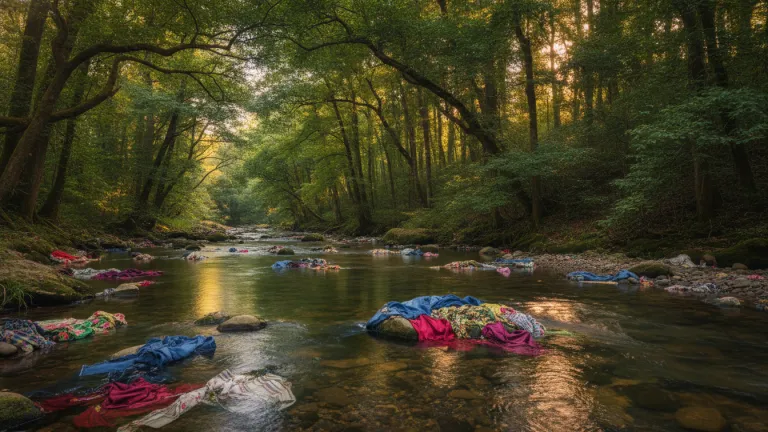
The dyes and chemicals used in fabric processing frequently reach rivers without proper treatment, especially in countries with weaker environmental oversight. Rivers with water colored by textile effluents are a reality in regions of India, Bangladesh, and China — countries that concentrate much of the global apparel production. This affects aquatic ecosystems, communities that depend on these waters, and local public health. Just as wasting water in the shower may seem insignificant but adds up, fashion’s water waste also accumulates — it’s worth checking Quanto água você desperdiça no banho sem perceber? to get a sense of scale.
Microfibers: the invisible enemy of the oceans
Every time we wash clothing made of polyester, nylon, or acrylic, it releases plastic microfibers — tiny fragments, invisible to the naked eye, that pass through washing machine filters and reach rivers and oceans. Researchers estimate this is one of the main sources of plastic micropollution in aquatic ecosystems.
Microfibers are consumed by marine organisms, enter the food chain, and eventually reach humans. Scientific studies have already detected microplastics in fish, seafood, salt, drinking water, and even human blood. The long-term impact of this exposure is still being studied, but it’s already concerning enough for health and environmental organizations to draw conclusions about the urgency of the problem.
Solutions exist: special filters for washing machines that capture microfibers are already available on the market and represent a concrete measure any consumer can adopt.
The disposal problem: mountains of clothing and saturated landfills
Brazil generates significant volumes of textile waste per year. According to data from the Brazilian Textile and Apparel Industry Association (ABIT), the country is one of the largest fashion producers and consumers in the world. It’s estimated that a very small portion of discarded clothing in Brazil undergoes any type of reuse or recycling — most goes to sanitary landfills or dumps.
Globally, UNEP estimates that less than 1% of clothes produced worldwide are recycled to become new clothing. The rest is incinerated, landfilled, or abandoned. Rich countries frequently export their used clothes to Global South countries — which seems like a donation but often overwhelms local markets and results in mountains of discarded fabric in places like the Atacama Desert in Chile, where tons of discarded clothing form surreal and toxic landscapes.
What you can do: a practical guide to consuming fashion consciously
The good news is that every consumption choice counts — and there are real and accessible alternatives. Here’s what you can do starting today:
Before buying:
- Ask yourself: “Will I wear this at least 30 times?” This is a simple and effective rule.
- Research the brand: there are seals and certifications (such as GOTS for organic cotton, Fair Trade, and B Corp) that indicate more responsible practices.
- Avoid impulse purchases. Wait 48 hours before completing an unplanned purchase.
Alternatives to fast fashion:
- Thrift stores and secondhand clothing: the used fashion market has grown significantly in recent years, with quality physical and digital options.
- Clothing swaps: swap groups among friends, family, or online communities are free and fun.
- Clothing rental: for special occasions, renting is much more sustainable than buying a piece used only once.
- **Slow fashion brands:** invest in more durable pieces, even if the initial cost is higher. In the long run, it’s cheaper — and pollutes much less.
Taking care of the clothes you already have:
- Wash with cold water whenever possible (reduces energy consumption and fiber wear).
- Use special washing bags for synthetic clothes that capture microfibers.
- Repair before discarding: a missing button or an open seam doesn’t have to be the end of a piece.
- Donate clothes in good condition to institutions or swap groups.
When disposing:
- Look for textile collection points: some city governments, NGOs, and even fashion stores offer this option.
- Never throw clothes in regular trash if you can avoid it — even in poor condition, fabrics can be used as raw material for other products.
Conscious fashion: trend or real necessity?
In recent years, interest in slow fashion, circular fashion, and brands with social and environmental commitment has grown. Stricter regulations are being discussed in blocs like the European Union, which has advanced legislation to make textile products more durable and recyclable. In Brazil, the debate is still in its early stages, but more demanding consumers are already pressuring brands to be more transparent.
The transformation of the sector doesn’t depend only on individuals — it requires structural changes in production chains, government regulation, and corporate responsibility. But consumer power is real: when many people change their habits, the market responds.
Conclusion: dressing well and caring for the planet are not opposites

Fast fashion has accustomed us to believe that more is always better — more options, more novelties, more pieces. But the model has reached a point where its environmental costs can no longer be ignored: carbon emissions, water consumption, chemical pollution, microfibers in the oceans, and mountains of clothing in landfills.
The good news is that the way out isn’t giving up the pleasure of dressing well. It’s relearning to value what we already have, choosing more carefully what we buy, and supporting a fashion model that respects the planet and the people involved in production.
Every t-shirt that lasts five years instead of five months is a small victory with real impact. Start with your closet today — and invite someone you know to do the same. The planet thanks you, one choice at a time.
